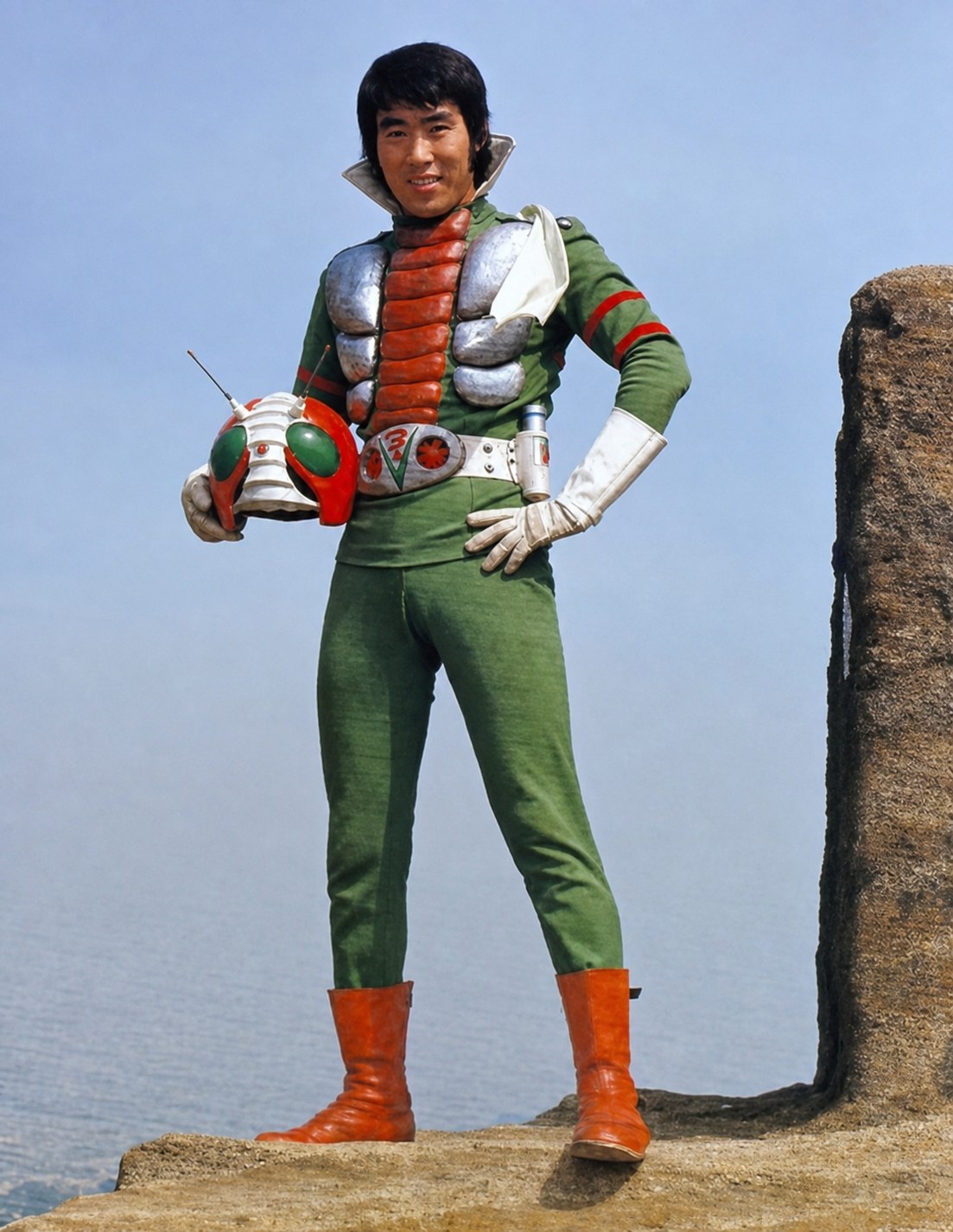
The fourth episode of Kamen Rider V3, broadcast in early 1973, holds a shot that still makes people stop breathing. The Toei camera climbs the side of an industrial smokestack more than a hundred and sixty feet tall and finds the hero at the very top, standing on the lip of the flue, cut against the sky with the wind pulling at his scarf.
Japan at the time was used to the tricks of the genre, the miniatures, the rear projection, the clever cut in the edit, and at first glance the shot looks like one more of them. Up there was a man of flesh and blood, dressed as V3 from head to foot, balanced on the only foothold available, the lightning rod, with no safety line and no net below. The shot almost did not happen. The director had thrown it out as too dangerous, and it fell to the fight coordinator Kazutoshi Takahashi, known in the group as the Kashira, or chief, to insist that it could be done. Years later Takahashi described what went through his head as he watched the young man climb: if he fell, he meant to throw himself after him. The young man did not fall, and when he came back down he pulled off the mask and asked the director, with the bluntness of someone barely past twenty, whether the plan had been to kill him. For decades the story circulated that a colleague was hidden inside the smokestack holding his ankles, and he put an end to that legend himself years later, pointing out that any hand up there would only have thrown him off balance. It was one performer alone, on top of a concrete tower, wearing a suit that belonged to a different character. The career of Tetsuya Nakayashiki is built out of scenes like that, of practical courage and anonymity.
The man with no face
In Japan he is known as Mister Kamen Rider. A radio show devoted to tokusatsu, the Japanese genre of costumed heroes and rubber-suited monsters, went further when it hosted him in 2020 and introduced him as Mister Showa Rider. Both nicknames are reaching for something no other performer in the franchise can claim. Between 1971 and 1984, across thirteen years, Nakayashiki was the suit actor for almost every Kamen Rider of the Showa era, the reign of Emperor Hirohito, which ended in 1989. A suit actor plays the character entirely from inside the costume, doing the fighting and the posing while another actor supplies the face and the voice. His list runs Kamen Rider 1 and 2, V3, X, Amazon, Stronger, Skyrider and Super-1, a full decade of Japanese television with a single gap, Riderman, who went to a colleague. Season after season the suit changed, the story changed and the actor who lent the hero his face changed, and the body under the mask stayed where it was.
The usual explanation is physical, and the Japanese Wikipedia credits the casting to his build: tall, long in the leg, the kind of body a camera wants for an action lead. Fans put it more plainly. The silhouette that comes to mind when you picture a Kamen Rider standing still, trunk squared and arm cocked for the blow, is the one he helped fix in place. What rarely enters the accounting is how Nakayashiki felt about any of it. On a night in 2025, in front of a packed room in Shibuya, at seventy-six, he talked about his own youth:
"I hated it. I got into this life because I wanted to be an actor. I did not want to hide my face. Today there are young people who dream of being suit actors. In our day nobody was like that. We did it because it was work, because it paid. That is how it started."
Tetsuya Nakayashiki, Shibuya, 2025That bluntness explains where the career comes from. It began as one job among others, at a time when nobody in Japan imagined making a living inside a hero costume. The method, the discipline and the commitment that became his signature were built on top of the work itself, year after year, largely against his own wishes.
Iwate, invented movie posters and a run to Tokyo
Nakayashiki was born on June 5, 1948, in Kuji, a coastal town in the cold north of Iwate Prefecture, a region Japanese cinema tends to associate with fishing, winter and distance from the big cities. Decades later the same countryside would produce Hiroaki Murakami, the young actor Nakayashiki would later turn into Skyrider. The family register reads Tetsuo, and the Tetsuya he became known by was a teenage invention. A fan of the Nikkatsu action stars, men like Akira Kobayashi and Jo Shishido, the boy spent his afternoons drawing posters for films that did not exist, all of them starring himself, signed with stage names he made up and swapped week after week, because what he wanted above everything was to be seen.
At seventeen he left school and home in a departure his biographers describe as close to running away, and he went up to Tokyo. By day he worked at a food company, and on his time off he circled the entertainment business through the back door, as an extra. The way in came through a master of tate, the staged swordplay of period films, named Kando Arashi. In December 1966, at eighteen, Arashi introduced him to the organization that would define his life: the Ono Ken'yukai, the troupe of stage swordsmen Kotaro Ono had founded a few years earlier to supply Japanese television with convincing fights, falls and deaths.
There was nothing glamorous about the beginning. In those first years, between shooting days on Judo Icchokusen and on the newborn Kamen Rider, there was plenty of time and very little work, and the routine came down to training. Two sessions a day, an iron hierarchy and a room full of veterans with closed faces, which he still remembers with good humor. "Their faces were frightening," he says, before adding, with the comic timing of a stage man, that his own was no better.
The chocolate factory
In 1970 Nakayashiki did what many aspiring actors do once and almost no official biography records. He quit, left the Ken'yukai, walked away from the business and took a night shift at a chocolate factory, spending his small hours among conveyor belts of bonbons. The break lasted about a year, and in the fall of 1971 he went back to the group. The group at that exact moment had its hands full with a new show, shot in a hurry at a shabby studio called Ikuta, about a grasshopper man who fought a secret organization. Kamen Rider had been on the air for a few months, and Nakayashiki came in at the bottom, the way everyone came in: Shocker foot soldier, monster of the week, small on-camera bit parts.
Two pillars hold up the training of those years. The first is the code Kotaro Ono imposed on the group, an ethic that sounds almost monastic today: take pride in playing the Rider, never spoil the children's dream, never smoke or sprawl on the ground where the public can see you. The old master, stingy with praise, summed Nakayashiki up in a phrase that counted as a medal. He called him a man of effort. The second pillar has a name of its own: Masaru Okada, who joined the Ken'yukai four months after him. Squeezed in among intimidating veterans, the two newcomers became something like brothers and agreed that if either got chewed out, they would take it together. Six decades later they still share a stage.
Episode 46: the day he became the Rider
Nakayashiki moved inside the hero in two stages, at the improvised pace of the productions of the day. First came the special arc shot on Sakurajima, where he wore the original Kamen Rider 1 suit, the version collectors would nickname the Sakurajima 1. Soon after, in episode 46, he took over the show's lead Rider, number 2, covering the regular casting. The timing has a symmetry to it. Episode 46 was also Masaru Okada's debut as fight coordinator, standing in for the injured Kashira, so the two classmates were promoted on the same day, with no idea that an era was starting.
V3: the man who memorized every line
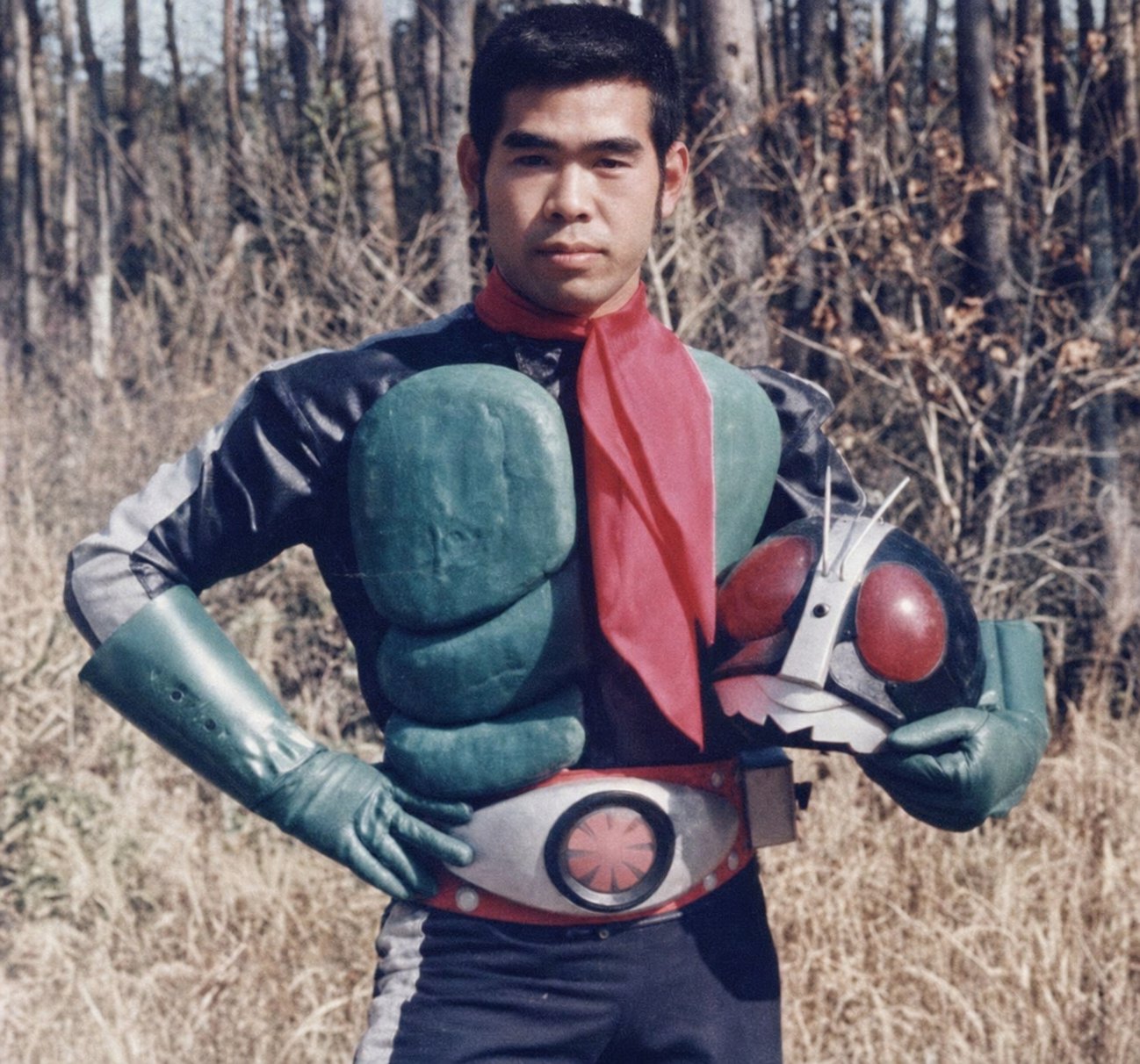
Kamen Rider V3, in 1973, was the turning point. For the first time Nakayashiki started a series already cast as the hero, and he had to build a character from nothing, at twenty-five and with little behind him. He is severe about that beginning, and says he was stiff, that he moved only the way the Kashira told him to. It was inside V3 that he settled on the method that would set him apart for the rest of his career, and the man who told the public about it, in an interview many years later, was the actor Hiroshi Miyauchi, the face of Shiro Kazami:
"Tetsu-chan memorized every one of V3's lines from the script and spoke them in full inside the mask. I went around with my head bowed in gratitude."
Hiroshi Miyauchi, the actor who played V3What Miyauchi describes was calculation. Before every spoken scene the two of them worked out where the body would breathe, at what tempo each sentence would land and where every pause would fall. The voice Miyauchi recorded later had to fit Nakayashiki's gestures, and one character, assembled by two people on different days, had to reach the screen as a single thing. "To the children, that V3 was one person," he likes to say, and the line sums up the silent pact between the actor and the performer.
There was also a conviction he carried into every suit that followed. After the transformation, the hero became for Nakayashiki a creature in its own right, with a weight and a physics that no longer belonged to the civilian actor. He kept away from Miyauchi's mannerisms and worked to give V3 a whole presence built from inside the costume, with a way of running, stopping and striking that belonged to the hero and to nobody else. Decades later the idea would be common ground among suit actors. At that moment it was being invented day by day on the set, by professionals learning in practice, with no manual and no theory.
The smokestack, and three near deaths
The V3 smokestack is the image that stuck, and it is far from the only time danger came close. In a 2017 interview Nakayashiki was asked to recall the scenes where he felt death at his shoulder, and none of them had been planned as a stunt. On a shoot with coordinated explosions, he ran, tripped and fell flat across the spot where the next charge was buried, and he survived because the effects technician, in a reflex of fractions of a second, decided not to press that button. On another, a jump into the sea ended with a violent blow to his side, and he was trapped underwater, his body refusing to answer and water coming in through the mask, until he felt, in his words, strength rise out of nowhere, tear the mask off and carry him up. About that day, he says:
"I remember that I came up first, and the mask came up after me."
Tetsuya Nakayashiki, on the sea jump in V3About the smokestack, Nakayashiki speaks with the plainness of men of his generation. The Kashira and the old man gave the order, so he did it, and by good luck he had no fear of heights. Press him on the memory and the size of the fright slips out. He recalls:
"Climbing to the top was a terror beyond measure. But 'what if I fall and die,' that never crossed my mind. All I thought about was what to do to make the children happy. In the middle of the work you go into a kind of trance, and the danger does not register."
Tetsuya NakayashikiThe years when he was everybody
The stretch between 1974 and 1978 is where the phrase one man band stops being a figure of speech. Kamen Rider X, in 1974, was by his own account the most comfortable of them all. The series leaned on duels with bladed weapons, home ground for a man trained in the Ken'yukai's stage fencing and staff work, and the X mask, cleaner in design, let him see. Kamen Rider Amazon, at the end of that same year, brought a rotation with the veteran Fumiya Nakamura and holds a detail few people remember. The Human Face Rock, the giant talking stone that guarded the Inca secrets of the plot, was sculpted from Nakayashiki's own features, so the one time his face appeared in the series, he had lent it to a boulder.
Kamen Rider Stronger, in 1975, closed the run and stands, in his telling, as the hardest suit of the era to wear: the mask barely let him see, the horns were enormous and the shoulder pieces got in the way of every move. All of it ran alongside a schedule that put him inside several other heroes at once. He was Aorenger on Gorenger, the silver robot Skyzel in Kyodain and, in 1978, the civilian lead of Red Tiger, the first time his name went at the top of the credits and his face appeared uncovered. In the early episodes of that series his lines were dubbed by a beginner named Toru Furuya, later the voice of Amuro Ray in Gundam, and from the fifth on Nakayashiki demanded to speak in his own voice. At thirty he got a taste of being heard, which he had been after since the posters he drew as a boy.
Skyrider: "use us"
In 1979, after four years with no Kamen Rider on the air, Toei decided to revive the franchise, and the producer Toru Hirayama went to the Ken'yukai with a request that came with a name attached: the Rider had to be Nakayashiki. The Nakayashiki of that moment was tired of masks and was holding an offer for a film role with his face showing, the kind of part he had always wanted. Toei pressed, and he took it, on a condition the group still remembers, because it involved no fee, no credit and no comfort. He said:
"Use us, the whole Ono Ken'yukai. That is my condition for saying yes."
Tetsuya Nakayashiki, on coming back as SkyriderHe would go back into a mask he was tired of as long as the younger men of the group came with him, with guaranteed work on the production, a piece of leadership in which loyalty to the collective came ahead of what he wanted for himself. On set the civilian hero was Hiroaki Murakami, a newcomer of twenty-two picked out of thousands of applicants and, like him, born in Iwate. Nakayashiki adopted the young man, and the affection lasted. On a national broadcast decades later, Murakami produced a letter he had kept from the suit actor and remembered the dinners the veterans bought for the rookie.
Super-1: the peak, with a broken bone
Kamen Rider Super-1, in 1980, is usually named as the high point of the whole career. When the manga artist Kenichi Muraeda, who draws Kamen Rider SPIRITS, had to explain to his readers who Nakayashiki was, he reached for a line that became a touchstone among fans:
"If you ask a room full of people what the best action in the history of Kamen Rider was, I think every one of them will answer: Nakayashiki in Super-1."
Kenichi Muraeda, author of Kamen Rider SPIRITSOkada, the fight coordinator on the series, calls Super-1 the final form of Ono Ken'yukai tate. Nakayashiki, so hard on himself about every other period, makes an exception here. He says body and mind were at their most mature and that by then he could move without checking the result in the rushes. Getting there took preparation to an extreme. The production asked him, Okada and the lead actor to train in Chinese kenpo with a real master, so that hero and civilian performer would share one vocabulary of blows. Nakayashiki also enrolled at a Goju-ryu karate dojo and broke a bone at a tournament in the middle of the series. In the Super-1 film, the fracture produced the least likely detail of his career. In a single fight sequence he appears on both sides, face showing as the villain Ryutaro Otora and inside the suit as the hero, hiding the broken bone under a black support glove that sharp-eyed fans still spot on screen.
"I will go into Super-1, but I will not do another new Rider"
The end of the era has a date, a place and a sentence. In 1984 Toei was preparing the television special that would introduce ZX, the tenth Rider in the line, and called on the Ken'yukai one more time. Everyone expected the obvious casting, and it was Okada who carried to the young Mitsutoshi Shiroya the message that closed thirteen years of history:
"Nakayashiki said: 'I will go into Super-1, but I will not do another new Rider.' Shiroya, that leaves only you."
Masaru Okada, passing on the messageThe care inside that refusal is worth noticing. Nakayashiki is in the special from beginning to end, face showing, as one of the villains. What he turned down was wearing a Rider nobody had played before, and he still insisted on a gesture no contract required. He offered to put on the Super-1 suit one last time, the role of his peak, the one he never handed to anyone. That was the farewell he chose for himself, closing out his run in the franchise from inside the work he considered his best.
After the mask
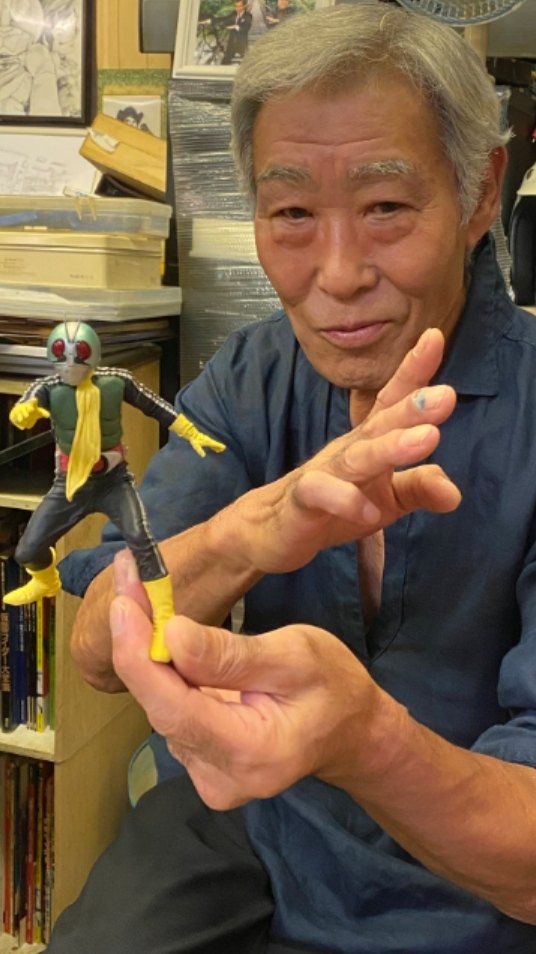
At thirty-six, having been almost every hero on Japanese television, Nakayashiki went back to where he started: jidaigeki, the sword theater that gave the Ken'yukai its name. He went freelance and made EDO WONDERLAND, the theme park in Nikko that rebuilds the Japan of the samurai, his artistic home for decades, performing with his face uncovered and a sword in his hand in front of audiences with no idea who the elegant gentleman was. On television he became one of those faces that viewers of period drama recognize without knowing the name, with small parts in productions like Ryoma ga Yuku and in NHK's taiga Sanga Moyu. In 2001 Toei paid him a quiet tribute. In episode 28 of Kamen Rider Agito, the hero needs help with his motorcycle, and the man who turns up is an old garage owner, rheumatic and grumbling, who delivers a line from someone who knows the subject: look at the bike and you can tell what the owner is like. The man who had been Kamen Rider for thirteen years came back to the franchise as the mechanic who looks after the Riders' bikes.
The man who hated hiding his face
Every long career keeps one knot that is hard to untie. Nakayashiki's sits in the distance between what he wanted and what he did. He dreamed of being an actor with a face, of seeing his own name on posters like the ones he scribbled as a boy, and he spent his life lending his body to heroes the public would never connect to him. Faced with that mismatch, he gave himself to the work with a rare seriousness. He memorized lines nobody would hear in his voice, tuned his breathing to serve an actor who would take the credit, and climbed a hundred and sixty feet of smokestack to draw a gasp out of children who would never learn his name. He did it year after year, treating as a trade the thing he would have preferred not to be doing. Hiroo Kawarasaki, a colleague from the Ono Ken'yukai, sums up what reached the screen:
"A born Kamen Rider. His standing posture was already the character."
Hiroo Kawarasaki, colleague at the Ono Ken'yukaiThe recognition arrived by the quietest route available. Half a century later, when somebody anywhere on the planet imitates a Kamen Rider, trunk squared, arm cutting the air, transformation shout and all, they are repeating without knowing it the gestures of a man born in Kuji, in the north of Iwate, who would rather have been doing something else. "In our day nobody dreamed of this," he says of the suit actors working now. The care he put into a job he did not choose for himself turned that trade into something a person can dream about.
Read next
Kazuo Niibori, Mr. Red: Aka Ranger in Gorenger and thirteen more redsOsamu Kaneda, Mr. Action: the man who turned action into dramaHirofumi Ishigaki: the 2018 interview on a long career as a suit actorMotokuni Nakagawa, Mister Pink: the suit actor who played five heroinesHimitsu Sentai Gorenger: our entry on the series where he played Aorenger (in Portuguese)The rare Shocker Ohno manga that opened up the backstage of tokusatsuEvery profile and interview in the Suit Actors sectionTetsuya Nakayashiki 中屋敷哲也 (b. 1948). Profile researched in August 2026 from Japanese sources: interviews with the actor himself and accounts from colleagues about his career as the suit actor of the Showa era Kamen Riders.