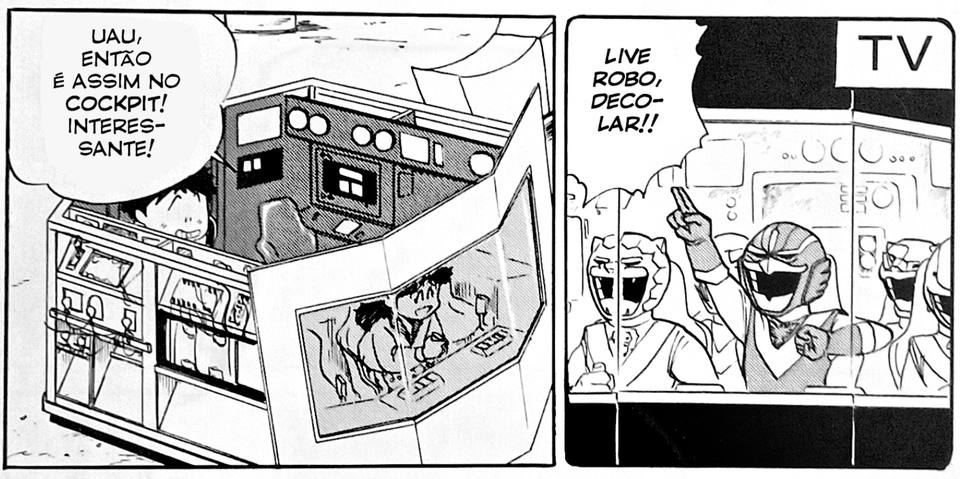
A 1989 manga recorded the unglamorous working life of Japan's suit actors, the performers hidden inside the hero costumes. Michel Borges is now trying to get it published in Brazil.
Long before it filled stadiums, theme parks and convention halls, tokusatsu, the Japanese genre of live-action superhero shows built on practical effects, also lived on makeshift stages in department stores and shopping malls. Those dates usually ran with a handful of performers, a thin budget, costumes worn down by years of touring and almost no room for error. The hero still had to walk out in front of a room full of children, beat the monsters and keep the illusion intact.
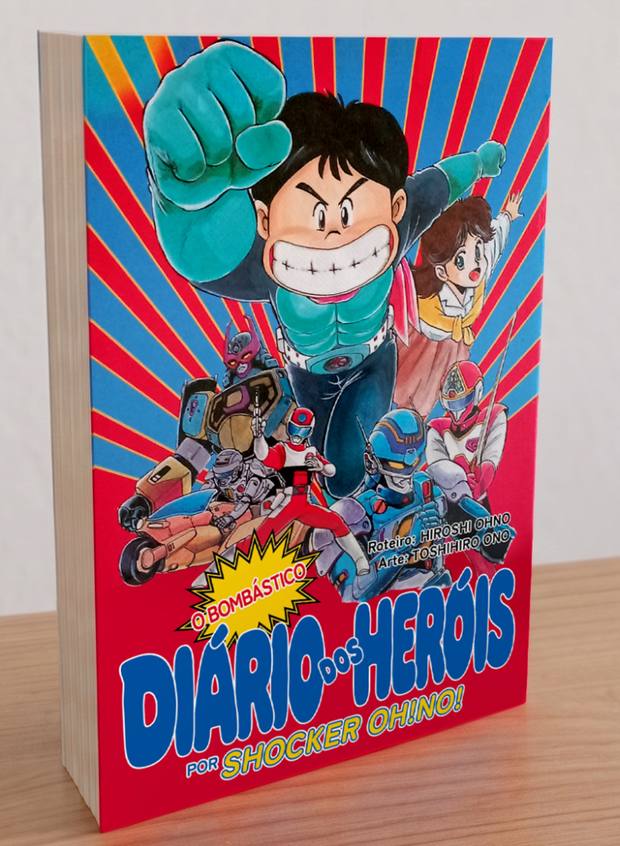
That world sits at the center of ショッカーO野の熱血ヒーロー日記, romanized as Shocker Oono no Nekketsu Hero Nikki and translatable as Shocker Ono's Red-Blooded Hero Diary. The Brazilian edition will carry the title O Bombástico Diário dos Heróis por Shocker Ohno, roughly The Explosive Hero Diary by Shocker Ohno.
Published in Japan in 1989, the book is hard to file on a shelf. Anyone opening it for a superhero adventure or a conventional television history will find something else, which is a funny first-person account in comics form of the people who wore the costumes, took the falls, ran the shows and improvised whenever something went wrong, which it always did.
Who is Shocker Ono?
Shocker Ono was born Hiroshi Ono. His stage name turns up in several romanizations, among them Shocker Oono, Shocker Ohno and Shocker OH!NO!.
His official profile says he worked as a junior stuntman while still a student, attached to the Ono Ken'yukai gym and to the Japan Action Club. He appeared in productions across the Kamen Rider, Super Sentai and Uchuu Keiji lines, the same corner of Japanese television that gave Brazil its 1980s favorites, from Changeman to Jaspion and the Space Sheriffs.
His credits include Crusher in Uchuu Keiji Gavan, Fightlow in Uchuu Keiji Sharivan, Mecha Clone in Choudenshi Bioman, Shitoppei in Kagaku Sentai Dynaman, Madaraman and Emperor Taboo in Dai Sentai Goggle V, and Dustler in Denshi Sentai Denziman. He also played the monster Kamagirigan and a Combatroid in the special Birth of the 10th! Kamen Riders All Together!!.
That list explains the angle the manga takes. Ono was not a reporter watching the set from a safe distance. He knew what the job does to a body: the heat inside a mask, the weight of a costume, the repeated falls onto hard ground and the long days spent playing nameless creatures whose whole purpose was to lose to the hero.
He later worked as a radio writer and host, a television and events producer, a director, an action choreographer and a talent manager. For a time he managed Shotaro Ishinomori, the creator of Kamen Rider, who handed him the stage name Shocker Ono, a nod to the criminal organization that supplies that series with its foot soldiers.
His official bibliography lists the manga alongside books and columns with titles like Rider Kick wa Itakatta, or The Rider Kick Hurt, plus Tokusatsuman Genba Houkoku, The People Who Held Up the Champions of Justice and The Remodeled Man Carries On Today. The titles point to one preoccupation he never dropped, which is putting the ordinary workers back inside the heroic imagery.
Backstage at the hero shows
One of the best Japanese descriptions of the book sits in the reprint petition filed on Fukkan.com. By that account the manga covers everything from the large productions staged at the Korakuen amusement park in Tokyo down to touring shows run by a crew of three.
That detail matters for understanding what kind of book this is. It draws on the Toei television series and on the people who worked in them, and its center of gravity sits in the live hero shows, known in Japan as attraction shows or character shows.
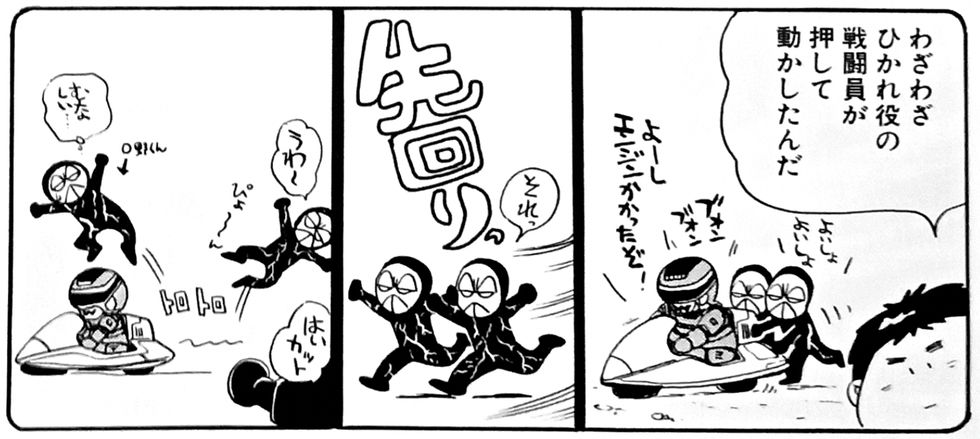
The logistics of those performances had almost nothing in common with a television shoot. There was no editing to hide a mistake, no second take and no way to swap in another performer once the show started. A small cast had to supply heroes, monsters and enemy soldiers at once, so some people changed costume several times in the same show. The sound came off a tape or was run from the side of the stage, and every failure had to be solved in front of the audience.
The Fukkan text calls the manga a comics version of Rider Kick wa Itakatta. What the book celebrates is not only the feats on stage. It is also the spills, the exhaustion, the costumes, the travel, the shortages and the improvising skill of the crews.
One Japanese reader who worked in action shows wrote that the book taught him how to carry himself on the job and how to think about that kind of work. Another remembered the crews in the manga finding a way to stage the show even when they did not have enough performers to fill out the villain's army.
Comments like those suggest the book worked as something close to an informal survival manual for action performers. None of the knowledge arrives as technical instruction. It comes through stories about mistakes, hard days and fixes invented on the spot.
Comedy, accidents and improvisation
Much of the book's value survives in the small stories Japanese readers still repeat.
One of them involves a department store show where a scheduling error meant Gavan, the first of the Space Sheriffs, could not appear. The audience was told, and the children and their parents refused to settle down. An administrator from the store finally climbed onto the stage and announced: “We apologize to everyone. Gavan really is not coming.”
The anecdote comes from a Japanese reader who says he bought the manga and still keeps his copy at his parents' house. It is a personal recollection rather than a scan of the page, so it deserves some caution.
The story still captures the comedy the book runs on. Gavan is supposed to be a man who crosses space to defend the Earth, and here his fate rests on the scheduling of a retail promotion and on a store employee with a microphone explaining that the character will not be showing up.
Another recollection tied to the book has Sharivan and Shaider beating the villains and then leaving the stage arm in arm, close to skipping, which makes comic wreckage of the solemn bearing the two Space Sheriffs keep on television. The story resurfaced in a Japanese Hero News thread about old tokusatsu shows.
There is also the odd business of the shout “katsudon, one order!”, katsudon being a bowl of rice topped with a fried pork cutlet. Writing about episode 29 of Uchuu Keiji Shaider, a Japanese blog says the explanation for that phrase on Toei sets can be found in Nekketsu Hero Nikki.
The mention appears on the blog Darupen, which points readers to the book for the full story. The phrase seems to have served as an audio cue or a reference shout during filming, one of those informal fixes that settle into a crew's internal culture.
Each anecdote on its own reads as an inside joke. Collected in one volume they amount to a document, because Ono preserved a professional culture that passed by word of mouth among performers, assistants, action directors and event organizers, and that no official press kit was ever going to record.
The possible Animec connection
Ono's official profile lists the book and the column Tokusatsuman Genba Houkoku, roughly Field Report from a Tokusatsu Man, as separate entries. The column ran in the monthly magazine Gekkan Animec.
Japanese readers describe the manga as an inheritance from that well known series of articles. Some of the material may well come from experiences and accounts Ono had already published in the magazine.
The exact relationship remains unclear. The available sources do not say whether the manga is a direct adaptation of the column, a selection of cases drawn from it, a continuation of it or a project written from scratch.
Animec stopped publishing in 1987 and the volume came out in 1989, which makes reuse or reworking of the material chronologically plausible. Nobody should present it as settled fact without the preface, the afterword or a direct statement from the authors.
The Brazilian publicity likewise describes the book as based on a diary Ono kept. The authors themselves may have supplied that during the negotiations, though no Japanese record available online explains it in any detail.
The safe statement is that the manga was built from Hiroshi Ono's experiences, notes and stories. The word diary belongs to the title and to the way the book presents itself, which does not require every episode in it to be a literal transcription from one personal notebook.
Toshihiro Ono before Pokemon
The art is by Toshihiro Ono, who would later become known for Barcode Fighter, for his The Legend of Zelda adaptations and above all for Dengeki! Pikachu, the Pokemon manga published in English as The Electric Tale of Pikachu and in Brazil by Conrad as As Aventuras Elétricas de Pikachu.
The Shocker Ono book occupies an unusual spot in that career. Japanese databases such as MangaSeek generally give 1992 and The Legend of Zelda Gaiden as his official debut, yet Nekketsu Hero Nikki came out three years earlier, in 1989.
That makes the volume a rare look at his early professional work, well before the licensed series that made his name. The assignment here was shop talk, backstage comedy and caricatures of real people.
The drawing had a delicate job to do. Along with recognizable heroes and monsters, Toshihiro Ono had to turn working professionals into comic characters without erasing how physically hard their work was.
Japanese booksellers describe the result as an unusual manga about the backstage of hero shows, entertaining even for readers with no prior interest in the genre. One specialist shop put it plainly, saying the book is very funny even for people who do not follow tokusatsu closely, because what holds the stories together is love for the heroes and for the work.
For the Brazilian campaign, Toshihiro Ono sent a rare personal statement about how the book was made. In the message published by Tokusatsu.com.br, he says he was living at the time in an old one-room apartment and struggling to put together three meals a day.
His editor in chief, by his account, handed him a wallet with cash in it and told him to eat and then draw a good manga. Toshihiro says he finished the book in the middle of that stretch and remains grateful for the help.
The shows the book portrays are almost four decades old, and the artist believes its charm and its humor still hold. He also said he wants to share that fun with Brazilian readers.
The statement changes how the volume reads. Nekketsu Hero Nikki records the hardships of the suit actors, and it was itself made during a precarious stretch in the artist's own life.
Subject and production line up neatly. A book about the anonymous workers who kept the heroes upright was drawn by a young artist who was fighting to stay in the trade himself.
Why the book vanished
Rapport was a publisher deeply tied to fan culture, animation, manga and tokusatsu. When it shut down, much of its catalog became hard to recover. Nekketsu Hero Nikki has no known Japanese reprint and exists only in that original edition.
In 2009 readers opened a reprint campaign for it on Fukkan.com. The comments are telling. People call the book a classic that should not stay buried, and some ask for a second volume on top of a new edition.
One reader says he wants the book back because it guided him when he started working in action shows. Comments like that show the stakes go past collecting. For a certain group of people the manga became a professional reference and a personal one.
The physical rarity and the absence of any digital edition explain why so few interviews and close readings exist. For years most of what circulated came from fragmentary memories, used bookshop listings and fan comments.
Even in Japan a clean copy is not easy to find. The book ended up in a strange position, covering hugely popular characters, made by two people who both went on to recognition, and unknown to most of the audience for either.
What Michel Borges started
The book's history picked up an unexpected chapter in Brazil through the cartoonist Michel Borges, known for his work on Combo Rangers and for drawing O Regresso de Jaspion, or The Return of Jaspion, an officially licensed project written by Fabio Yabu and published by Editora JBC.
Borges approached Shocker Ono to ask whether a Brazilian edition was possible. According to Tokusatsu.com.br, Ono brokered the contact and the permission from the artist Toshihiro Ono, which allowed the local edition to move forward.
The project was announced on July 3, 2026, during the Anime Friends convention in São Paulo, and the crowdfunding campaign opened on July 10. The edition is being presented as O Bombástico Diário dos Heróis por Shocker Ohno.
The Brazilian edition is expected to keep the binding format of the original tankobon. Sushi POP reports that it will also carry pages colored by Borges, made for this edition with the authors' permission.
Borges took on the adaptation and the graphic production, which goes well past translating the balloons. The job is a hard one. The book runs on names, trade jargon, puns and references to Japanese productions of the 1980s.
A Brazilian edition has to balance historical fidelity against plain comprehension, especially for readers who know these characters through the names and the voice work of the Brazilian dubs. It also has to supply context for working practices that were obvious to a Japanese crew in the 1980s and mean nothing to a reader today.
The campaign is still open on Catarse, the Brazilian crowdfunding platform.
A Brazilian edition that matters historically
If the manga does reach Brazil, it will matter for reasons that go past nostalgia. Brazilian memory of tokusatsu has for decades concentrated on the actors whose faces appeared on screen.
The suit actors, stunt performers, choreographers and assistants stayed far less known, though they built an essential part of how those series look. They gave weight to the blows, personality to the monsters and physical presence to the masked heroes.
The book offers a chance to turn the view around. The reader gets the hero from backstage: the person trying to breathe inside the mask, the performer who just changed costume, the employee trying to calm a room full of children and the small crew manufacturing a spectacle larger than its own budget.
That angle also brings the book close to how these characters reached Brazilian audiences. Whole generations met the Japanese heroes at mall appearances, conventions, circuses and birthday parties as much as on television.
The conditions and the licensing systems were different, and the basic problem was the same one: build a shared fantasy on very little money. The audience needs a convincing hero, and putting one on stage means handling schedules, equipment, transport, costumes, safety and whatever goes wrong that afternoon.
If the campaign closes successfully, Brazil will get a book that stayed out of reach even for most Japanese readers. The edition would do more than rescue a publishing curiosity. It would preserve the memory of a profession built on anonymity, physical effort and improvisation.
The men behind the masks
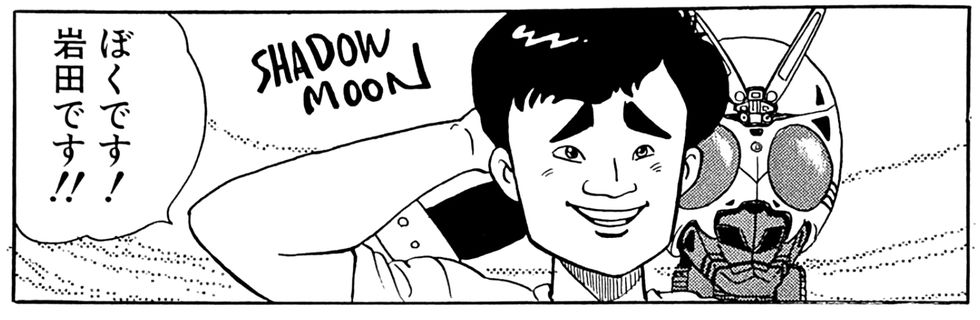
On television the hero almost always arrives on time. The armor is intact, the transformation works and the finishing move puts the monster down. In the backstage Shocker Ono describes, none of that was guaranteed.
The hero could run late. The costume could tear. The cast could be too small, so one performer covered several characters. A shoot could require somebody to yell an absurd phrase to mark the beat of an action cue. On some department store stage, an employee could find himself explaining to hundreds of people that Gavan really was not coming.
Nekketsu Hero Nikki draws its force from the distance between what the audience sees and what it takes to put that on stage. Showing the tricks does not shrink the heroes. Ono's argument, made entirely in jokes, is that the heroism sat with the workers who had no powers and got the show finished anyway.
Almost four decades later, Michel Borges is extending that act of preservation. The original book rescued the stories of the old hero shows from word of mouth, and a Brazilian edition could keep the manga itself from disappearing while finally introducing readers to the men who literally held up the masks of tokusatsu.