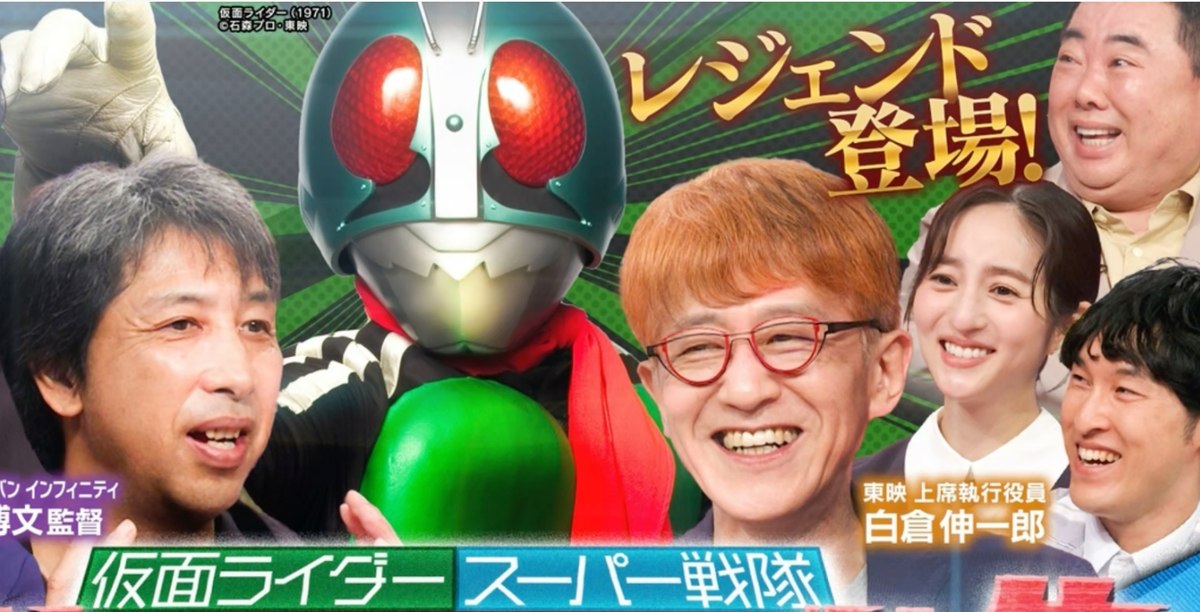
Koichi & Shige no SHOW-man!!, a Japanese variety show on TV Asahi, gave its latest episode over to the second half of a special about the costumed heroes made by the Toei studio. Shinichiro Shirakura and Hirofumi Fukuzawa came back to the panel to explain how Kamen Rider, Super Sentai and Metal Hero, the studio's 1980s line of heroes in metal armor, have kept up with a changing Japan and stayed on the air for decades.
The first episode traced the history of Kamen Rider and the way its fight scenes were shot. The closing episode turned to the business underneath the shows: how Toei widened its audience, read each decade, sold its heroes abroad and built brands that outlast a single generation of children.
Casting unknown young actors
One of the strategies the program singled out is Toei's habit of handing Kamen Rider to actors almost nobody had heard of yet. A number of them went on to become major names in Japanese film and television.
Those young leads also brought in the mothers watching alongside their children, and a wider female audience with them. Shirakura said the thinking behind that did not begin in the Heisei era, the imperial reign that ran from 1989 to 2019.
According to him, the franchise has always looked for actors who embodied the kind of leading man a given period admired, going back to Hiroshi Fujioka, the first Kamen Rider, in 1971.
The arrival of Pretty Cure, Toei's magical girl series, on the same Sunday morning block made the girls and the mothers watching those shows back to back matter even more.
Heroes that mirror their moment
The special also showed how Kamen Rider storylines began tracking whatever the country happened to be paying attention to.
Kamen Rider Fourze arrived while Japan was fixed on space, after the Hayabusa probe returned to Earth with samples from an asteroid and the astronaut Satoshi Furukawa flew to the International Space Station.
Years later, the public argument about artificial intelligence shaped the world of Kamen Rider Zero-One. The lead character runs a technology company, and the machines his company builds sit at the center of the plot.
During the Covid-19 pandemic, Kamen Rider Saber built its concept around books and storytelling, an adventure meant to make the months indoors less dull for children. The following year, Kamen Rider Revice worked in dance and movement so that families would get up and exercise together.
For the program, that ability to read the mood of the country and turn it into entertainment is one of the reasons Kamen Rider has stayed close to its audience.
Super Sentai followed the same clock
Super Sentai, the team-hero line American viewers know through Power Rangers, went through the same process. In 1975, as color television spread through Japanese homes, Himitsu Sentai Gorenger put five heroes on screen in five different colors.
At the height of the "trendy dramas", the glossy romantic serials of the late 1980s, Choujin Sentai Jetman gave its team a love triangle and open jealousy. The show joked about itself as a trendy drama wearing hero costumes.
Later, the success of science fiction shaped the concept of Mirai Sentai Timeranger, and the popularity of magic stories opened the door to Mahou Sentai Magiranger.
Fukuzawa said that after so many teams and so many styles, the hard part is answering the same question every year: what makes a hero read instantly as a product of right now?
He said the answer shows up in the action as well. The way a hero fights, the way he moves and even the way the camera frames him can date him to a decade.
Selling a Japanese hero to the world
The program also covered the franchise's push overseas. Kamen Rider Zeztz was presented as the first entry released simultaneously in more than 100 countries and territories, and it reached the top of the worldwide trending list on X after its opening episode.
Shirakura said that reach forced the team to watch for cultural friction. The series borrows from spy fiction, and because the word "spy" carries a negative charge in some countries, the production settled on "agent" instead.
The design of the hero took foreign viewers into account too. Round eyes are a Kamen Rider trademark, and in some cultures a character with that face does not read as a hero at all, so the studio kept the franchise look and sharpened the shape of the eyes slightly.
Gavan and a new kind of hero
Another highlight of the special was Space Sheriff Gavan (Uchuu Keiji Gavan), first broadcast in 1982. Gavan never transformed biologically the way Kamen Rider does. He was fitted with a metal combat suit through a process called Jouchaku.
In the original series the suit locked into place in five hundredths of a second. That was far too fast for anyone to follow, so every episode replayed the sequence in slow motion, which is how it became one of the most remembered images in the show.
The word Jouchaku comes from a technique used to apply metal coating. Shirakura said the same process went into manufacturing Gavan's silver suit, so the name of the transformation grew out of the way the costume itself was made.
The series is also remembered for the work of Kenji Ohba. A member of the Japan Action Club founded by Shinichi Chiba, the actor American audiences know as Sonny Chiba, Ohba performed most of his own action, and the program replayed the jumps, the fights, the motorcycle stunts and the chases in which the star himself is clearly on camera.
For Shirakura, Gavan holds a particular place in the studio's history:
"For Toei, Gavan is the third pillar, alongside Kamen Rider and Super Sentai."
He also recalled that Gavan opened the way for Sharivan and Shaider, laying the base of what would later be known as the Metal Hero franchise.
Gavan returns four decades later
More than forty years on, the character came back in Chou Uchuu Keiji Gavan Infinity, the first production under the PROJECT R.E.D. banner.
The new series keeps the traditional pieces, including the Jouchaku command and the slow-motion replay of the transformation. What changed is the speed, since the suit now assembles in a single millisecond rather than five hundredths of a second.
The new version also widens the original idea by putting several Gavans from different universes on screen.
Fukuzawa said the shots before the transformation are built to carry over the physical energy Kenji Ohba brought to the part. New actors are pushed to move and perform before the suit goes on, which keeps the performer's own body part of the hero's identity.
The toys that pay for Kamen Rider
The last strategy the program laid out was the way the toys themselves evolved.
In 1971, the first Kamen Rider transformation belt won children over by reproducing the lights and the movement they had seen on television. It sold roughly 3.8 million units.
When the franchise came back in 2000, a new belt arrived every year, each one carrying a different piece of technology. The Kamen Rider Faiz gear used a cell phone and played back recorded voices, Kamen Rider Den-O added contactless card reading, and Kamen Rider Decade turned cards into items tied to video games, candy and other products.
In Kamen Rider OOO, the collectible medals became a phenomenon of their own, with more than 33 million of them distributed.
From 2013, Toei and Bandai began selling directly to the adults who had grown up on the shows. The Complete Selection Modification belts used better materials, details that matched the props seen on television, and new lines recorded by the original actors.
The program made the case that the toys work as more than merchandise. Children use them to act out the transformation and step into the story. Adults use them to hold on to the heroes of their childhood.
Across more than five decades, Toei has changed its themes, its actors, its action, its technology and the ways it reaches an audience. The wish to turn into a hero has not moved at all. That combination of change and continuity is what keeps these shows alive.