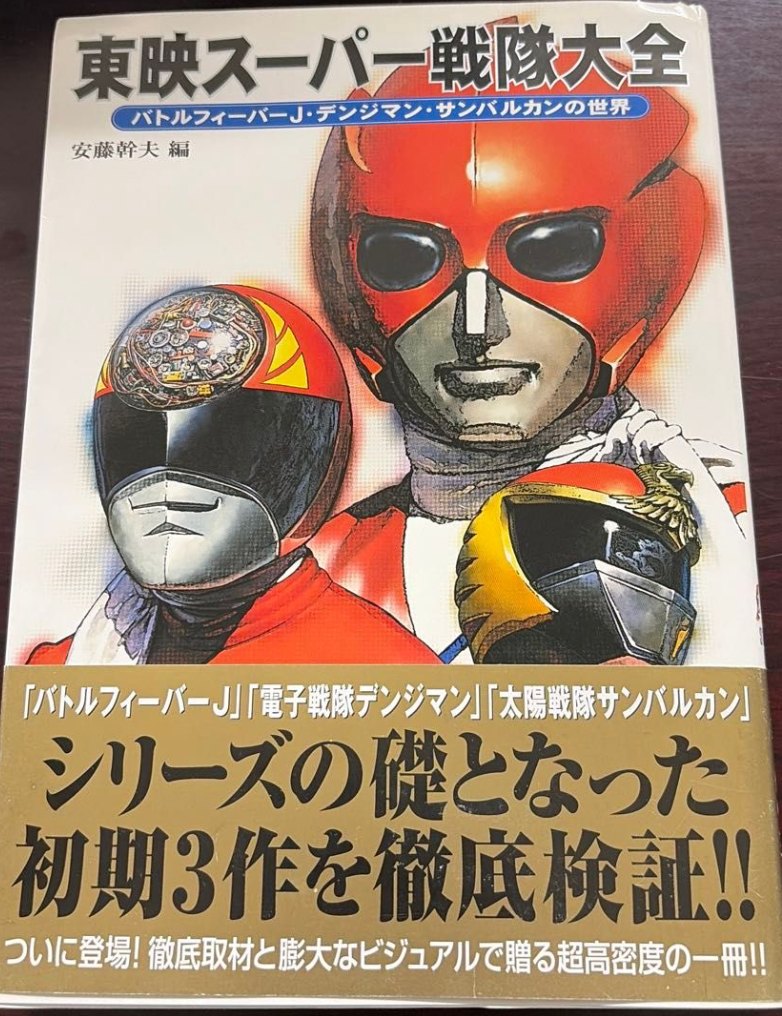
Published by Futabasha in February 2003, Super Sentai Chronicle Vol. 1: Battle Fever J / Denziman / Sun Vulcan is a 255-page book edited by Mikio Ando. The volume gathers more than two thousand images, episode guides, production photographs, preliminary drawings, sculpting studies and interviews with the people who worked on the three series.
The book covers the years between 1979 and 1982, when Toei reorganized its idea of the hero team and set down several elements that Super Sentai would keep for decades. Super Sentai is the long-running Japanese franchise whose footage and format gave rise to Power Rangers in the United States. Battle Fever J folded a giant robot into the structure of the team, Denshi Sentai Denziman (Electronic Squadron Denziman) built a mythology that leaned less on the partnership with Marvel, and Taiyo Sentai Sun Vulcan (Solar Squadron Sun Vulcan) tested ways of refreshing characters and conflicts across a full year of episodes.
The interview section includes the producers Susumu Yoshikawa and Takeyuki Suzuki, the writer Shozo Uehara, the actor and stunt performer Kenji Ohba, the designers Muneo Kubo and Katsushi Murakami, the action coordinator Osamu Kaneda, the actress Machiko Soga, the director Yoshiaki Kobayashi and the composer Chumei Watanabe. Having people from that many departments in one book lets the reader follow the planning, the writing, the character design, the construction of the suits, the action, the music and the part played by the toy manufacturer.
In July 2004, Futabasha published a companion volume devoted to Goggle V, Dynaman and Bioman. Mikio Ando edited that one as well, and its page count runs to 271. No bibliographic record of a third book exists, so the collection ended after covering six productions released between 1979 and 1984.
Both volumes belong to a wider Futabasha line of compendiums about special-effects series and other popular productions. One direct predecessor was the book on Gavan, Sharivan and Shaider, published in 2000. That editorial background helps explain the structure adopted here, in which three consecutive series are examined through interviews, archive images, episode guides and production documents.
WHAT THE BOOK SETS OUT TO DO
The contribution of the book lies in the combination of visual documentation and firsthand accounts. Instead of offering synopses, promotional photographs and character sheets, the volume tries to reconstruct the conditions under which the three series were planned and made. The interviewees talk about budget trouble, suit construction, casting changes, the relationship with the toy company Popy, replacements on the action teams and revisions made while the shows were already on the air.
The book shows that the Super Sentai format did not arrive as a single, fully organized plan. It was assembled little by little, through decisions taken in different departments. The staff had to reconcile unfinished scripts, drawings prepared well in advance, suits that wore out, requests from the manufacturers and the weekly television schedule.
Muneo Kubo, who worked on planning and character design, describes that system:
"The production system back then was not as systematic as the one animation uses today. We started building that system bit by bit, beginning with Spider-Man. I would stockpile drawings, the script would be written, I would adjust the drawings to fit the story, and then I would see what came out of the workshop. For all that mess, we talked to each other constantly. What made Battle especially interesting was the group of writers. Mr. Takaku wrote heavy espionage, Mr. Uehara wrote science fiction and Mr. Soda threw unpredictable curveballs. With that range of scripts, the drawings I made changed along with them."
The account works against the idea that Toei already had a stable formula in hand on Battle Fever J. Monsters could be drawn before the scripts were finished and given their roles afterward. A design created as a spare could move to the center of an episode once a particular writer picked it up.
The interviews were conducted more than twenty years after the productions, so they should be read as retrospective memories, open to simplification and error. The book offsets that limitation in part by reproducing documents, photographs and drawings made at the time, which lets the reader check the recollections against the surviving material.
HOW BATTLE FEVER J CAME ABOUT
The Battle Fever J section opens with the collaboration agreement between Toei and Marvel Comics. The earlier experience with the Japanese Spider-Man had already shown that Toei was not interested in literal adaptation. The costume of the lead character survived, while his origin, his enemies and the dramatic structure were invented in Japan.
Popy, the toy company later folded into Bandai, suggested that the Marveller ship should turn into the giant robot Leopardon. That decision put a robot inside a solo superhero show and served as the precedent for the structure adopted on Battle Fever J.
The project that became the series was first called Captain Japan and used Captain America as one of its references. The clearest link to Marvel survived in Miss America, while the other members were converted into characters that belonged to Toei.
The preliminary documents differ considerably from the show that reached the air. Miss America was described as a young woman born in a region of California with abnormal gravity. After losing her mother in a tornado, she was rebuilt by a medical team and came away with superhuman abilities and immortality.
The robot, provisionally named Nelsun, had been conceived as a rescue machine. Its equipment included lights to blind opponents, restraining cables and jets of salt water. Those ideas were cut back or dropped once the robot was defined mainly as a fighting machine.
The central idea of Captain Japan was to tie each member to the music and dance of a different country. Disco, Spanish dance, tropical rhythms, Russian dance and kung fu would all be converted into fighting styles. The planning document stated that "the best dance is the strongest combat technique".
Chumei Watanabe explains how that proposal shaped the music:
"They told me to think of music that carried the character of each country. If it was Russia, a Russian dance. If it was Spain, they would fight while dancing a Spanish dance. I thought, this is going to be hard, and at the same time I found it interesting and threw myself into it. In the beginning a choreographer of dramatic dance joined the staff and worked out the routines. As the broadcast went on, the dances faded away, and I thought that was a shame. My guess is that action and dance did not blend well once everything was shot on video, and not that the music failed to fit."
The interview follows one idea from the planning stage to its retreat during production. Dance stayed in the poses and in the general identity of the characters. It stopped dictating every fight because the combination with televised action did not work consistently.
Watanabe explains as well that he started working before the scripts were finished:
"If the show began airing in February, the meetings about the music ran through December of the previous year. At that point I would get the planning document from the producer, with explanations of the character setups and the story. Since the theme song has to be recorded within that same year, the work moves fast and in parallel. It is very rare for the script to be ready when the planning starts to move, so you cannot dive very deep at the outset."
That schedule helps explain why the music could preserve features of an early version of the project that were changed later during filming. The composer worked from general descriptions while writers, directors and action coordinators were still deciding how those ideas would appear on screen.
SCULPTING AND PRELIMINARY DRAWINGS
The five Battle Fever J costumes went through studies in drawing and clay. Some of the proposals for the masks anticipate solutions used later on Denziman and Goggle V.
The Miss America prototype, prepared by Popy and Katsushi Murakami, had real hair. In the final version the strands were replaced by golden nylon attached directly to the mask. The sketches reproduced in the book include asymmetrical shapes and different combinations of helmet, face and emblems.
The design of Battle Fever Robo was finished late. For the scene in which the robot appears still under construction, the crew used a real torso made of plastic reinforced with fiber. The first suit was used in the early shoots and then discarded, replaced by another version from episode five onward.
Those records show that approved drawings were not simply transferred to the screen. Sculpting called for corrections, and the final look of a character could come out of problems met during construction or filming.
The book documents how Popy took part in creating the weapons and the finishing moves. Battle Fever Robo was first meant to be associated with Japanese fencing, and the company wanted a final technique that showed off the sword included with the toy. Takeyuki Suzuki worked out a specific move, while the effects crew installed batteries in the halberd and the sword so they would throw sparks on impact.
The influence of the manufacturer did not begin once the series was finished. Toy and show were planned together, so weapons, transformation devices, names and techniques had to work on television and in the stores.
Kinya Sugi remembers a similar case on Sun Vulcan:
"There was the Cosmo Vulcan, right? At the start it was called Cosmo Vulcan. Then all of a sudden, from the script for episode 16 on, it read Cozmo Vulcan, take off. It switched to Cozmo out of nowhere, and Mr. Kawasaki seemed to have trouble saying it. Since the name of the toy had been settled as Cozmo, and Mr. Kawasaki was the only one with that line, they told him: Kawasaki-san, hold back the tears and say it."
The story is told as a joke, and it shows the position Popy occupied. A decision taken for the name of a toy could change the script and force an actor to alter the pronunciation of a line already in use.
THE CHANGE OF ACTION TEAM
The first episodes of Battle Fever J had their action coordinated by Big Action, under the direction of Issei Takahashi. From episode 7 the Japan Action Club took over, with Osamu Kaneda coordinating. According to the interview, the switch had not been planned from the start. The Japan Action Club was working on Spider-Man, and the invitation came shortly before that production ended.
Kaneda kept some of what the previous team had created, above all the presentation poses. He also changed the relationship between the choreography, the camera and the editing:
"I wanted depth in the image. Not just a flat fight moving sideways, but something coming from the back of the set toward the camera. At the same time, other shots had to be fast and hit hard. I would ask the camera operator: do not shoot everything from a distance, use the zoom, catch the moment the enemy is hit. Sometimes the operator worried because the enemy had already gone down in the previous shot, and I would say, it is fine, I will cut the scene together from the best pieces. I wanted a quick rhythm so the audience would not look away."
The change amounted to more than harder stunts. Kaneda altered the way the movement was recorded and edited. Realistic continuity could give way to the impact of a blow, and moving the performers from the back of the frame toward the front increased the sense of depth.
The new coordination came with a gradual replacement of the performers inside the suits. Kaneda says that keeping the same suit actors under a different direction could produce a visible difference in the style of the movement. On the work of Kazuo Niibori as Battle Japan, he says:
"Not just anyone can handle the leader role. He was the best at it. It is not about doing whatever you want, it is about finding the best way to make the character look alive on screen."
The remark treats the suit actor as a performer, and not merely as the person who takes the falls and the acrobatics. His movement had to communicate leadership, personality and continuity with the actor who played the character out of the suit.
KENJI OHBA AND THE LINK BETWEEN ACTING AND ACTION
Kenji Ohba played Shiro Akebono out of the suit and performed the action as Battle Kenya. He took part in creating movements and poses, drawing on experience built up since his first jobs at the Japan Action Club:
"I came up with the ideas for the action myself, including the presentation pose. I had worked with that team since I was a beginner on Kikaider, so by the time we reached Battle Fever we were trained professionals and could talk openly, including going out for drinks after work to discuss the show."
On Denziman, Ohba again combined acting and action, this time as Daigoro Oume and Denzi Blue. What the crew shared about the personality of the character made the later recording of the fight vocals easier, and it let him slip in improvisations and jokes without breaking continuity.
Ohba describes where some of the movements of Denzi Blue came from:
"Denzi Blue had that Hey! pose that came from the circus. I also suggested working in the time-difference attack from volleyball. In the Denzi Drill, where he dives into the ground, I wanted to express the idea of coming up out of the earth. I based things on what I saw in movies and found interesting, like the style of Bruce Lee in Enter the Dragon."
Circus, sport and martial arts cinema went in whenever Ohba found a movement that suited the character. The action came out of the references the actor brought as much as out of the script or the coordinator.
The director Yoshiaki Kobayashi offers a related explanation:
"When you direct characters who transform, the way you express the character before the transformation and the way you express him afterward have to be connected so the image holds together. Otherwise the person from before and the transformed hero become two completely different people. In my case, before the transformation he is an ordinary young man, and after it he changes completely and becomes very cool. That is how I directed."
Taken together, the interviews with Kaneda, Ohba and Kobayashi show that the identity of a transformed hero depended on cooperation among the actor, the suit actor, the action coordinator, the director, the camera, the editing room and the voice crew.
WHAT DENZIMAN SETTLED
On Denziman the direct influence of Marvel loses weight, and the series presents a more organized mythology. The Denzi planet, the dog IC, the Denzi Tiger, the Vader Clan and Queen Hedrian make up a more integrated world than the international lineup of Battle Fever J.
Greater conceptual unity did not remove the technical problems. The visor of the masks had to be fixed to an edge shaved down to roughly two millimeters. The process cracked masks often, which forced the crew to keep three spares on hand. The chest emblem was made of acrylic and held on with Velcro, so it could be removed when necessary. Weapons and accessories were reused across different episodes and productions.
That information moves the analysis from design to the material conditions of the shoot. The costumes had to look consistent for a full year, through wear, falls and repairs.
The interviews show that the personalities of the members were adjusted during production as well. Ohba meant to make Daigoro different from Battle Kenya, and he kept the comic function once the yellow member took a more serious line. The taste of the character for sweet bean bread was settled in a conversation with the director:
"We decided that in a conversation with director Takemoto. We wanted something memorable, like the curry of KiRanger. It is not that I love it madly, but among breads it is my favorite."
The comparison with KiRanger shows that the production was starting to recognize patterns of characterization created by the earlier series. Food, gestures and habits helped tell the members apart without long explanations.
The actor who played Denzi Yellow says he was told at first to play the character for comedy. Since Ohba already held that ground, he moved toward the gentleness and the vulnerability of the youngest member. The division of roles inside the team was corrected as the actors watched how the whole thing was working.
MACHIKO SOGA AND QUEEN HEDRIAN
The interview with Machiko Soga documents her part in creating Queen Hedrian. The actress did not confine herself to playing a character fully defined by the script and the wardrobe. She contributed to the makeup, the comedy and the vocal pattern of the villain:
"When I create a character, I always ask where the story is going and then add my own seasoning. I did not want to be an ordinary villain. I wanted a comic touch without losing the evil at the core. The laugh should not be merely funny, it should be a little sinister. I would tell the director and the camera crew, I am going to be even more wicked, and they encouraged me."
Soga suggested the glittering eyelashes and part of the makeup, looking to tie the appearance of the character to the decadent origin of the Vader Clan. Her account also records the physical conditions imposed by the costume:
"The Queen Hedrian costume was a real challenge. In summer it was too hot and the material suffocated me. In winter the cold went straight through it. Shooting in quarries or out in the open was exhausting. I remember the sweat running inside the gloves and the mask, and my fingertips throbbing with the heat. Once the camera started rolling, I forgot all of it."
In the episode where she had to wear a kimono over the costume of the queen, the actress could barely breathe. The eyelashes and the makeup made it hard to wipe away sweat, so the actresses who played Miller and Keller helped her between takes.
The character kept taking shape during the recording of the voice. Soga marked the harder characters to read in the margins of the script and added laughs and grunts to raise the impact of the scenes. According to the actress, the sound director sometimes asked her to hold back, and her instinct was to push past the instruction.
"It amazes me that people still look for Queen Hedrian on the internet or send me letters. It makes me feel that all the effort was worth it. I really love Denziman. It was a job where I could put in all my passion and creativity. Seeing that the children who watched it back then are adults now and still remember me is the greatest prize an actress can receive."
The return of Hedrian in Sun Vulcan can be read as a narrative decision and as recognition of how well the performance of Soga had landed. The actress says she tried to make the character more desperate and vengeful in the following series, avoiding an exact repeat of the Denziman version.
SUN VULCAN AND THE NEED FOR RENEWAL
The Sun Vulcan section examines how the production tried to hold the interest of the audience across roughly fifty episodes. Cutting the team to three members made it easier to distinguish the weapons and the movements of each one, and it reduced the possible interactions among different personalities. The answer was to widen the conflicts among the antagonists and to make changes in the cast.
One account from the production sums up the strategy:
"Even a show that runs for a whole year must not bore the children watching. We actively prepared new characters and new episodes to keep the program attractive and hold attention. The lineup of three heroes worked very well on Sun Vulcan. The charm and the weapons of each one could be expressed in detail, which raised the quality of the action scenes."
The arrival of Amazon Killer strengthened the villains because using the Zero Girls alone was starting to produce repetitive situations. Inazuma Ginga introduced an independent force, and putting Hell Saturn, Queen Hedrian and the brain of Black Magma in the same room allowed unstable alliances and disputes over power.
"In the second half, with Amazon Killer arriving to replace Zero One, we wanted to strengthen the side of the villains. With only the Zero Girls, the show was getting a little repetitive. The role of Amazon Killer was a woman with complicated feelings, and I think her entrance worked well. The monsters from Inazuma Ginga also made an impression."
In certain episodes the conflicts among the antagonists become more complex than the relationships among the three members of Sun Vulcan. Shozo Uehara had used infighting inside enemy organizations before, and here the device came to carry part of the dramatic continuity.
The replacement of the first Vul Eagle was written into the plot. Ryusuke Ohwashi is transferred to NASA and replaced by Takayuki Hiba. Instead of hiding the change of actor, the series turned it into an event and used the new member to shift the dynamic of the group.
DIRECTION, SPECIAL EFFECTS AND BUDGET
The interview with Yoshiaki Kobayashi explains how production limits could be converted into visual choices. The director says he turned to night locations because the shadows and the loss of spatial definition produced an atmosphere of instability:
"Night locations are expensive, and the atmosphere that exists at night is very good. At night the sense of stability is more ambiguous, you do not know where to go and you lose your sense of direction. That was the feeling of instability I was after. When there are more night scenes, the lights and the shadows become more prominent than whatever the sun lights up, which gives an extra dimension. Instead of fights planted firmly on the ground, I looked for fights where gravity seems uncertain or where you cannot tell where the light is coming from."
Kobayashi also discusses experiments in episodes 38 and 48 of Denziman that would be developed later in the combat dimension of Gavan. He acknowledges how useful the device was in economic terms:
"The idea of moving instantly to that space where the laws do not apply and everything floats is very attractive and very convenient for the budget limits of the show. If the battle shifts instantly from the city to a rocky canyon, the situation is clear in a single cut, going beyond the reality of space."
The remark does not reduce the invention to a cost-saving measure. The abstract space allowed locations to be reused, spared the show realistic explanations and gave the action scenes freedom. Financial limits and visual interest could lead to the same solution.
Kobayashi says as well that the director of a hero show could not look after the dramatic scenes alone and leave the action to the specialists. He had to coordinate performance, choreography and effects so that the fights carried part of the story:
"We could only move the story forward if the fight choreographer understood that this was not only action, it was also directing the narrative. It was around the time of Gavan and Goggle V that I started asking the action coordinator for that ability, rather than for plain brawling."
THE MUSIC OF CHUMEI WATANABE
The interview with Chumei Watanabe goes beyond the opening and closing songs. The composer discusses the production of incidental music, the number of cues, his dealings with the Columbia label and the difficulty of writing short pieces that could be reused in many situations.
"In the days when I was doing this, the pieces were short. The compositions had to be applicable to a range of situations. When that is the case, you cannot put much force into any one piece. I normally wrote almost seventy cues, though on Spider-Man I made only about fifty. Since the image on screen did not fit the music perfectly on its own, I was concerned, and I wanted to write tracks that could be enjoyed independently. That was my wish."
Watanabe compares the recordings made with live instruments to the later practice of combining brass with synthesizers:
"The old recordings were simple and had a raw, realistic sound, different from today. The tendency now is to double the brass with synthesizers to suppress the noise of the winds, and that is not much to my taste."
The music had to work as material for television editing, and Watanabe tried to write cues that held their interest away from the scenes they were composed for. The release of records with incidental music, which began with Spider-Man and continued with Battle Fever J, also helped preserve that repertoire.
THE COMIC BOOK ADAPTATIONS
The survey of the versions published in magazines such as TV Land, TV Magazine, TV-Kun and Boken Oh widens the scope of the volume. The adaptations were not simple transcriptions of the episodes. Each artist rearranged characters, monsters and conflicts according to the space available and the direction of the magazine.
In one version of Battle Fever J, Diane dies in combat. In another, Battle Fever Robo is defeated by Satan Egos. Some adaptations use monsters created only for the comics, while others stay closer to the television version.
In the Denziman version published by TV Land, the dog IC never appears and Queen Hedrian turns into a giant monster and is destroyed. That decision keeps her from returning in the Sun Vulcan adaptation, which shows that each version could establish its own continuity.
The book analyzes how hard it was to fit five heroes, foot soldiers, monsters and a robot battle into a few pages. This section helps explain how Super Sentai circulated across different media, though it is one of the most specialized parts of the volume.
THE VERDICT
Super Sentai Chronicle Vol. 1: Battle Fever J / Denziman / Sun Vulcan works better as a source on production than as a general introduction to the three series. Its organization assumes that the reader recognizes the characters, the episodes and the professionals. The number of names, episode numbers, comic versions and manufacturing details can slow down anyone who does not already know Battle Fever J, Denziman and Sun Vulcan.
The interviews have to be read as retrospective testimony. The professionals are talking about work done more than two decades before publication, and some recollections may be simplified or inaccurate. The book reduces that limitation by reproducing documents and images made at the time, though it does not replace a chronology built on complete administrative records.
The range of perspectives is one of its qualities. Rather than crediting the shape of Super Sentai to a single producer or designer, the volume shows how decisions taken in different departments fed into one another. The toy manufacturer changed weapons and names, the action coordinator changed where the camera stood, the actor added movements to the transformed character, the actress took part in the makeup and in the voice recording of the villain, the composer worked from projects that were still incomplete, and the director fit locations and effects to the money available.
Putting the three series together makes a progression visible. Battle Fever J still carries marks of the Marvel agreement and a visual process open to change, and it establishes the association between hero team and giant robot. Denziman organizes an independent mythology and builds greater continuity among characters, action and antagonists. Sun Vulcan tests mechanisms of internal renewal, including the team of three, the replacement of the red hero and the deeper feuds among the villains.
The volume does not show that the modern formula was completed for good in 1981. Its material indicates that Super Sentai remained open to change. What settled in that period was a system able to absorb changes of cast, design, structure and commercial strategy while keeping its general identity.
The sequel published in 2004 reinforces that reading by following Goggle V, Dynaman and Bioman. The end of the collection after the second volume limits its historical reach, and the two books cover a coherent stretch, from 1979 to 1984, in which many of the procedures associated with the annual production of Super Sentai were established.
By gathering preliminary materials, photographs, sculpting studies and interviews with people from different departments, Super Sentai Chronicle Vol. 1: Battle Fever J / Denziman / Sun Vulcan remains a useful source on the formation of modern Super Sentai. Its value lies less in the retelling of the stories and more in the documentation of how the work was done, showing how artistic, technical and commercial decisions were taken inside the same production.