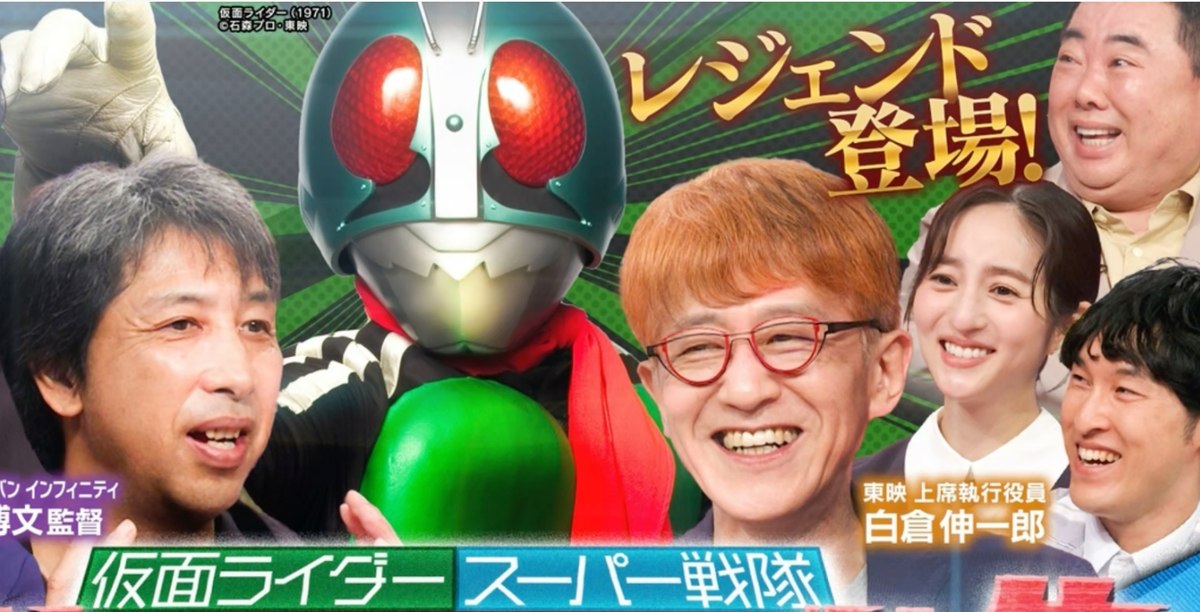
The Japanese variety show 光一&シゲのSHOWマン!!, hosted by Koichi Domoto and Shigeaki Kato on TV Asahi, aired the first half of a special on Toei's heroes on Monday, August 3, 2026. The episode pulled up archive footage and walked through fifty-five years of Kamen Rider, from the 1971 debut of the original series to Kamen Rider Zeztz, a production that now reaches more than a hundred countries and territories.
The guests included Shinichiro Shirakura, a senior Toei executive and the producer behind several of the studio's biggest titles of the Heisei and Reiwa eras. Those are names of imperial reigns on the Japanese calendar, and fans use them to sort the franchise into phases. Beside him sat Hirofumi Fukuzawa, a former suit actor who wore several Super Sentai red costumes before moving into action direction and filmmaking.
The program also brought in self-declared fans of the Toei heroes along with guests who knew almost nothing about them. Working from those different vantage points, the special covered collecting, the years Kamen Rider spent off television, the influence of Ultraman, the realism of Kuuga, the way concepts have evolved and the changes in action technique.
The quotes in this article have been translated from Japanese and lightly edited for clarity.
From 1971 to more than a hundred countries
The first Kamen Rider premiered in 1971, in the closing stretch of the Showa era. The franchise has carried on through Heisei and into Reiwa, piling up thirty-seven television series along with films, streaming titles and productions for other platforms.
The special made a point of the international reach Kamen Rider Zeztz has managed. The show no longer goes out to a Japanese audience alone. It landed in more than a hundred countries and territories at once, the United States, Brazil and Indonesia among them.
According to the program, the series hit number one worldwide on the X trending list shortly after the first episode went out. That result says a good deal about how far a hero built for Japanese television has traveled as a brand.
The episode also reminded viewers that Kamen Rider is only one part of the Toei hero story. The studio produces Super Sentai, which began in 1975 with Himitsu Sentai Gorenger, and a long roster of characters that shaped Japanese tokusatsu, the live-action special-effects genre, across five decades.
What fans do with the toys
Before getting to the history, the panel talked about what Kamen Rider means to each of them. One guest owns a large collection of transformation belts and has rigged LED lighting to show a few of the pieces off.
Even so, he keeps most of the collection out of sight, worried about what the years do to plastic. He put it this way:
"I don't much like leaving them on display, because time takes its toll on them. I would rather keep them in their boxes."
That drew a laugh in the studio and an obvious question: what is the point of buying that many toys and then putting them away? Part of the pleasure, he said, is opening the boxes again after a long gap:
"Sometimes I open the boxes. That smell you get when you open one again after a long time is irresistible."
He also wears the belts now and then. On one of those occasions he pulled a coat over the top and left the house with it still buckled on:
"One time I put the belt on, threw a coat over it and walked to the convenience store."
Stories like that show how far the merchandise carries the experience beyond the broadcast. For adult fans the belts work as memory objects, each one tied to a specific stretch of their lives and to how they felt watching at the time.
One of the women on the panel came at the subject from the opposite side and admitted she knows very little about any of it. She wants to keep up with her nephews and understand the characters, and the sheer size of the franchise keeps getting in her way:
"There is so much history that sometimes it feels too late to start. I really do want to learn, though."
That gap between the veterans and the newcomers gave the program its starting point for the retrospective that followed.
The birth of Kamen Rider and the Showa years
In 1971 audiences met Takeshi Hongo, a young man rebuilt into a modified human by the secret organization Shocker. He escaped before the brainwashing was finished and turned the powers Shocker had given him back on Shocker itself.
That origin set up one of the durable themes of the franchise: the hero and his enemies draw on the same source of power. Kamen Rider could have ended up among the forces threatening humanity, and he chose to use what he was given to protect it.
The first Rider was designed after a grasshopper. The strength in his legs and the height of his jump produced the Rider Kick, which became the best-known move in the series.
Across the Showa years the franchise kept trying out new styles. Kamen Rider Amazon stood out for his look, his animal instincts and the roughness of his fights:
"Amazon leaves a very strong impression. The impact of him is enormous."
Sky Rider gave the lead the ability to fly. Kamen Rider Black RX, which began airing in 1988, picked up the story of Kamen Rider Black.
The program also revisited the guest appearances by earlier Riders in Black RX. When an enemy proved too strong, the veterans came back to fight alongside the lead. Those meetings drove home the idea that every series belonged to one continuous line.
For the children watching in the late 1980s, seeing the older Riders return meant several generations of heroes in the same frame. All of that goodwill was about to run into a long stop on television.
"We lost to Ultraman"
After Kamen Rider Black RX wrapped, roughly eleven years went by without a new weekly Kamen Rider series on the air. Asked by the hosts what had happened, Shirakura gave a blunt answer:
"To put it in the simplest possible terms, we lost to Ultraman."
Through the 1990s Ultraman came back with Ultraman Tiga, Ultraman Dyna and Ultraman Gaia. Those shows handed the character to a new generation and proved there was still room on television for a major tokusatsu hero.
Shirakura admitted that the rival's success got Toei's attention:
"When we saw that, we were extremely envious."
The producer stressed that the new Ultraman shows went well past reviving the old parts. They brought in fresh concepts and readings, updating the franchise while keeping the character recognizable to anyone who had grown up with him.
That mix of the familiar and the new made the comparison sting at Toei. The company understood that bringing Kamen Rider back would not be enough on its own. The hero would have to be presented a different way.
The conversation turned to what the two franchises take from each other. Kamen Rider has episodes in which an enemy grows to enormous size, or the Rider himself appears at giant scale. Asked whether the crew studies how Ultraman handles that, Shirakura answered with a joke:
"We watch it as a reference so that we don't copy it."
Behind the joke he acknowledged a two-way influence. The crews do not work together on any regular basis, and each side keeps an eye on the solutions the other comes up with.
Ultraman did more than fill the slot Kamen Rider had left open. Its revival was the proof Toei needed that its own franchise could come back too.
Kuuga and the return
The comeback arrived in 2000 with Kamen Rider Kuuga. The series closed the eleven-year gap and set up the annual rhythm that carried the franchise through the whole of the Heisei era and into Reiwa.
The special argued that Kuuga changed how the hero and the world around him were portrayed. One of the clearest signs of it showed up in the transformation sequences.
In the older shows the villains generally waited for the hero to finish his pose and complete the change. The convention protected one of the high points of every episode. Kuuga's monsters had no such patience and would attack while the transformation was still under way.
The choice made those scenes feel urgent and grounded. The same thinking went into where the fights took place. Earlier series dropped their characters into quarries, empty lots and remote fields with no explanation of how anyone had gotten there.
In Kuuga the police worked with the hero and helped steer the creatures toward places where no civilians would be caught in the fight. The quarry was still there, and now the story explained why.
The police also stopped serving as the helpless institution of the older shows. Officers investigated the killings, studied the language the enemies spoke and built weapons and tactics to back Kuuga up.
A hero who did not want to fight
The realism of Kuuga reached past police procedure and battle locations. The series spent real time on what was going on inside Yusuke Godai.
Godai is written as a gentle, cheerful man with no taste for violence. Becoming Kuuga never gives him any pleasure in fighting. He goes into every battle because people need protecting.
The special went back to one of the best-remembered episodes, in which an enemy attacks a group of schoolchildren. When Godai finally corners the creature responsible, his anger comes out all at once.
One of the guests pointed to the distance between how Godai normally carries himself and what happens in that scene:
"It hurts to watch someone that gentle pushed into behaving that way."
The fight lands because the win is only part of what it shows. The confrontation costs Godai something, and the audience sees it. The harder he hits, the more uncomfortable it becomes to watch him set aside the face he usually wears.
"He is a hero, and it wounds him to have to reach for violence."
Realism, police work and human drama together won Kuuga an audience of adults alongside the children it was made for. The success settled the question of whether Kamen Rider could return without replaying the Showa stories.
Ryuki and the Riders who fight each other
Kamen Rider Ryuki pushed the experiment somewhere else. The show put thirteen Riders into a contest in which the prize was having a wish granted. Winning meant surviving until only one of them was left.
The conflict no longer ran only between heroes and monsters. The Riders went after one another, each of them carrying his own motives and his own code.
Shinji Kido, the lead, refused the whole premise and spent the series trying to stop the fight:
"The Riders fight each other while the main character tries to bring that war to a halt."
Ryuki put pressure on the assumption that a belt and a suit of armor are enough to make someone a hero. Some of the contestants acted out of decency. Others were driven by self-interest, revenge or an appetite for power.
The series opened the door to shows with large Rider casts, internal rivalries and morally slippery characters. Carrying the name Kamen Rider stopped being an automatic sign of which side a character was on.
Den-O, women in the audience and young actors
The program singled out Kamen Rider Den-O as the point where the audience widened:
"It was from Den-O onward that the number of women fans jumped all at once."
The comedy, the charm of the Imagin and the traffic between the different personalities taking over the hero's body pulled in viewers who had skipped the previous seasons.
Kamen Rider also came to be seen as a launching pad for young actors. A string of leads and supporting players took the show as one of the first substantial jobs of their careers and went on to prominent work in Japanese film, television and entertainment.
The retrospective also stopped on Kamen Rider W, described on air as a "two-in-one Kamen Rider". Shotaro Hidari and Philip merging into a single hero became one of the signature ideas of the Heisei run.
Other seasons kept widening the range. Kamen Rider Ghost built its year around ghosts and dressed its transformations in garments that look like hooded parkas.
Demons, candy and concepts that keep getting stranger
The experimenting carried on into Reiwa. Kamen Rider Revice, made during the fiftieth anniversary celebrations, gave the hero a demon of his own as a partner. The bond between the two of them and the business of signing contracts with dangerous powers sat at the center of the season.
Kamen Rider Gavv followed with something closer to the corner store: candy and packaged snacks. When the hero eats certain sweets, small creatures appear and power his transformations.
Each kind of food maps to a different form. Gummies, cakes and chips turn into colors, textures, armor and abilities.
The guests said the scenes work on the appetite:
"When he eats the candy, you want to eat some too."
On paper, food sounds a long way from the traditional image of Kamen Rider. The design work absorbs the theme without erasing what the franchise looks like:
"Even so, they manage to turn all of it into something that looks like Kamen Rider."
Thirty minutes on air and the week that follows
One of the panelists noted that candy, coats and other everyday objects let children carry the show off the screen. After an episode, they spot those things at home, in shops and in whatever game they invent next.
Shirakura said that relationship is planned into the productions. The job, as he sees it, is not finished when the thirty minutes are up:
"The broadcast only lasts thirty minutes, and after that there is a whole week until the next episode."
What matters most, he said, is what a child does with that gap:
"We have to think about how much fun the child can have, and how much anticipation, across that week."
By that logic Kamen Rider is not confined to the broadcast slot. It keeps going in the conversations, the toys, the poses practiced in front of a mirror, the wait for the next episode and the way each child folds the hero into a game.
The remark explains why the belts and the transformation gadgets matter commercially, and it reaches past sales figures. For Shirakura those objects keep the story alive across the seven days between one episode and the next.
Zeztz and the belt that left the waist
Presenting Kamen Rider Zeztz, the program praised the visual effects and the premise of a hero who fights threats in waking life and inside dreams.
The most talked-about change is the transformation device itself. Instead of sitting only around the waist, it runs diagonally across the torso and reaches up toward the shoulder.
Shirakura acknowledged that the decision started arguments among fans:
"Up to now there was this notion that if it isn't at the waist, it can't be a belt."
The change reads as radical because it touches one of the most recognizable pieces of Kamen Rider. It may also clear ground for the projects that come next:
"Now we can think that next time we will be able to put it anywhere."
For half a century the belt at the waist looked like a rule nobody could touch. After Zeztz the designers have room to imagine other shapes and other places to mount a transformation device.
So what makes a Kamen Rider?
The discussion about the gear led to the question at the center of the special: what does a character need in order to count as a Kamen Rider?
For decades the mask, the oversized eyes, the motorcycle, the belt and the Rider Kick looked like a stable working definition. Season after season has since altered or dropped one piece of it or another.
Shirakura answered on purpose in a way that settles nothing:
"The definition exists and at the same time it does not exist."
There is no fixed checklist of required elements, the producer said. The test that matters is whether a project holds on to the intent and the spirit of what Shotaro Ishinomori created:
"What counts is whether we are truly inheriting Ishinomori's will."
That does not mean anything goes. Ideas come up in development that make the team itself decide a concept has drifted too far from Kamen Rider.
The habit is to start at the extreme rather than with something safe. From there the team works the idea back toward the identity of the franchise.
"First we fly very far away. Then we come back."
One of the panelists caught how backward that sounds. The team does not take the classic model and add small variations to it. It starts from a proposal that looks absurd and then hunts for the way to make it function as Kamen Rider.
The method explains how the franchise has absorbed such different themes without locking itself into one formula. The goal is to keep finding new answers to the question of what a Kamen Rider can be.
The force of the Showa fights
The last stretch of the program compared the techniques of one period against another. The guests said the Showa fights had an energy of their own, built on big movement, jumps, falls and real explosions.
"That over-the-top force in the Showa era Riders has turned into part of their charm."
The old productions had far less to work with. Everything rested on what the performers could do physically, on the choreography and on the trampolines that supplied the jumps.
The explosions went off on location as well, which gave the footage a sense of danger and scale that is hard to manufacture digitally:
"The explosions were not CGI. They were real explosions, and there was tremendous nerve in that."
Some of those scenes never aimed for the logic and realism that today's shows chase. The sheer intensity of the performances is what fixed the visual identity of the Showa Riders.
From the trampoline to digital effects
Fukuzawa explained how technology kept adding options to the action. In the early years the crews leaned on body movement and trampolines. Later came wires, cranes and rigs able to lift performers and move them across much longer distances.
As digital compositing improved, it became possible to stack different techniques inside one sequence. A fight today can open with physical action, move into wire work and pick up visual effects in post-production.
The challenge for the directors is making all of those techniques read as one continuous scene:
"We have to arrange every element so that the fight has rhythm."
CGI never wiped out physical action. It works alongside the suit actors, the choreography, the wires and the explosions. Fukuzawa believes that language has to keep developing in step with what audiences expect and what the available tools allow.