In the fall of 1995, in a coffee shop, a 24-year-old stunt performer who was overweight and known for playing monsters heard this from action director Junji Yamaoka: "Next year, you are doing Pink."
Motokuni Nakagawa was more than ten kilos heavier than the job allowed, and he was spending his days sweating inside the machine monsters of "Chouriki Sentai Ohranger". His first thought, as he told it years later on his own blog, was this: "A Pink played by someone like me? Nobody is going to want to watch that." The diet followed, daily running and no alcohol, five kilos gone in the first two weeks and twelve in all, until the morning he urinated bright red and had to learn in a hurry what exertional hematuria was. At the Pink Racer costume fitting, the wardrobe designer looked at him and asked:
"You... you are really the Pink? That is a Black's body!"
The wardrobe designer, at the Pink Racer costume fitting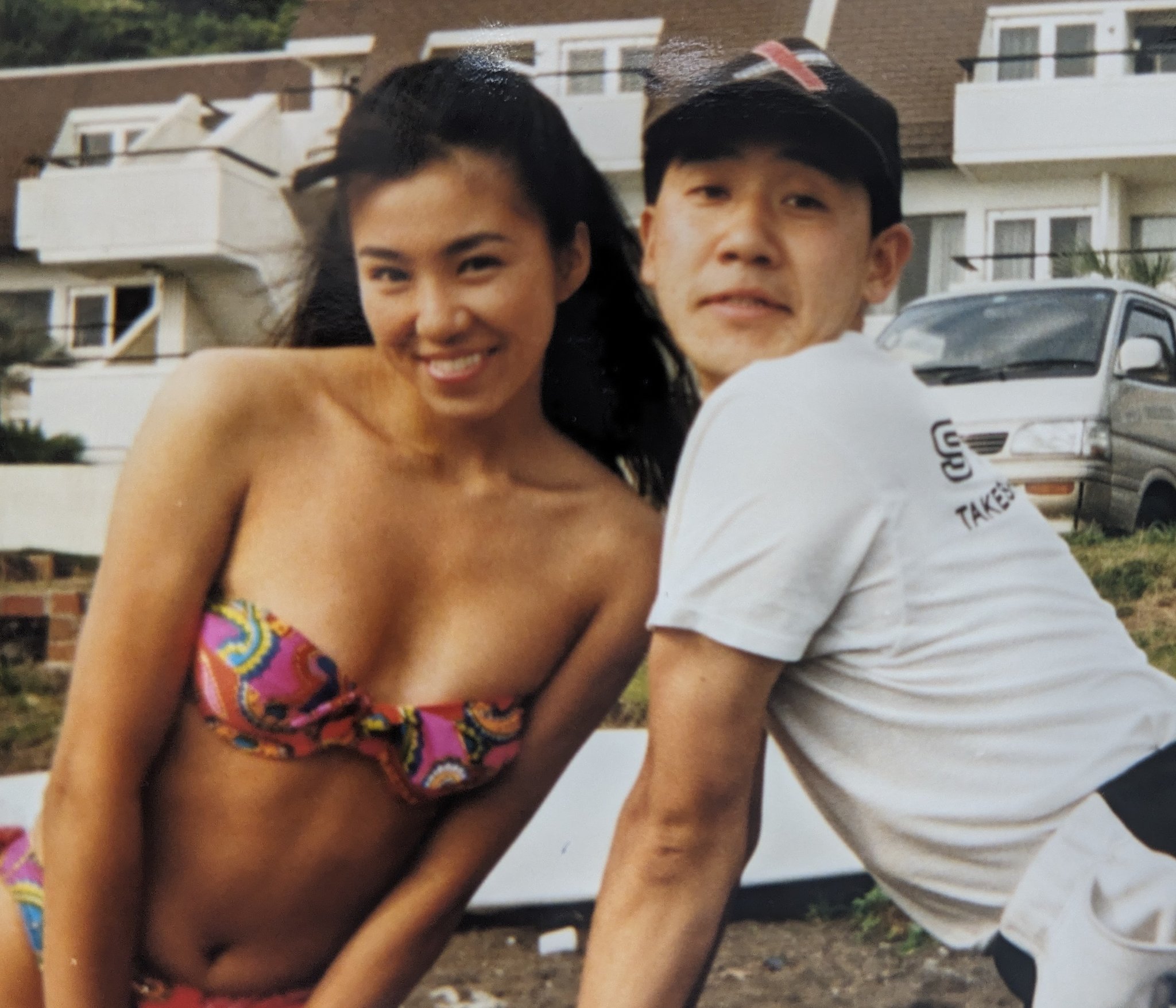
In March 1996, when "Gekisou Sentai Carranger" premiered, none of that reached the audience at home. On screen there was Pink Racer, brave, clumsy, "mischievous and pretty", as one fan would write years later, and inside her stood Nakagawa, invisible by contract and by calling.
Over the next ten years Nakagawa performed five female Pink heroes: Pink Racer, Ginga Pink, Go Pink, Time Pink and, on one last call, Bouken Pink. Outside Japan his name still circulates as "Motoo", a misreading of the characters that spell Motokuni, while Japanese fans settled on the title that host Shocker Ono made official on his web radio show in 2011: "Mister Pink", or, among the more precise, "the Mister Pink of the Heisei era".
The trade Japan calls suit acting, performing a character from inside a full costume, carries a rule of its own: the better it is done, the less anyone senses that a person is in there. Nakagawa took that rule to its limit and built a career out of disappearing twice, once inside the costume and once inside a craft that is already invisible by definition.
Onnagata: a tradition borrowed from kabuki
The tradition he inherited takes its name from kabuki: onnagata, the kabuki practice of male actors in female roles. In the first years of the color-coded squadrons, back in the 1970s, women worked inside the heroine costumes, and it was the oversized helmets and the acrobatic demands that pushed the roles toward small, heavily trained men. The Japanese press treats Michihiro Takeda, the Denji Pink of 1980, as the founding case, and he spent his nights in hostess bars studying how the women there moved. After him came Yuichi Hachisuka, who ran seven heroines back to back from the 1980s into the early 1990s and became synonymous with the specialty.
Everything started for Nakagawa in front of that man. In 1989, in his second year of training, cast as an extra playing a foot soldier on "Turboranger", the teenager watched Hachisuka's Pink Turbo up close and left the set converted. He remembers it this way:
"The cuteness, the beauty, the elegance... is there really anyone who can do that? A man, playing Pink Turbo... Hachisuka is a genius."
Motokuni Nakagawa, on what he saw in 1989Years later, when he designed the introduction pose for his own Pink Racer, he built it out of Pink Turbo's pose, a student's tribute hidden in plain sight.
The boy from Higashimurayama
Nakagawa was born on August 21, 1971, in Higashimurayama, on the western edge of Tokyo, and he is 1.67 meters tall, five feet six, small for a man and exactly right for a heroine. He joined the seventeenth class of the JAC, the Japan Action Club founded by Sonny Chiba, while he was still a teenager. His debut came at the open-air theater in the Korakuen amusement park, during the fall 1988 season of "Liveman": school on weekdays, and on Sundays and holidays a beating from the heroes. The initiation was finished off the following year with a dislocated elbow and a broken collarbone, and he was carried into the hospital still dressed as an evil foot soldier, where a nurse took him for a dancer.
Chance kept leaving clues. On "Fiveman" (1990) he remembers wearing, several times, the pink warrior of a fake squadron called, of all things, "Gingaman", eight years before he put on the real Ginga Pink. The first monster he ever played, Professor Telephone on "Dairanger" (1993), was, in his words, "a monster that was pink from head to toe".
"When I put the costume on, the feeling comes in"
Takeda studied women in the bars at night. Nakagawa's whole method fit into one sentence he gave an official series book in 1999: "When I put the costume on, the feeling comes in." The rest was watchmaker's work, checking his own silhouette in the reflection on the camera lens and correcting the angle of the mask and the tilt of the neck, "right up to the last second". The effect unsettled the people working beside him. Fan encyclopedias still record the shock of Shinji Kasahara, an actor on "Timeranger", when he watched a man climb out of the Time Pink costume, along with the verdict of Mika Katsumura, who played the character on camera: he was "more feminine than I am".
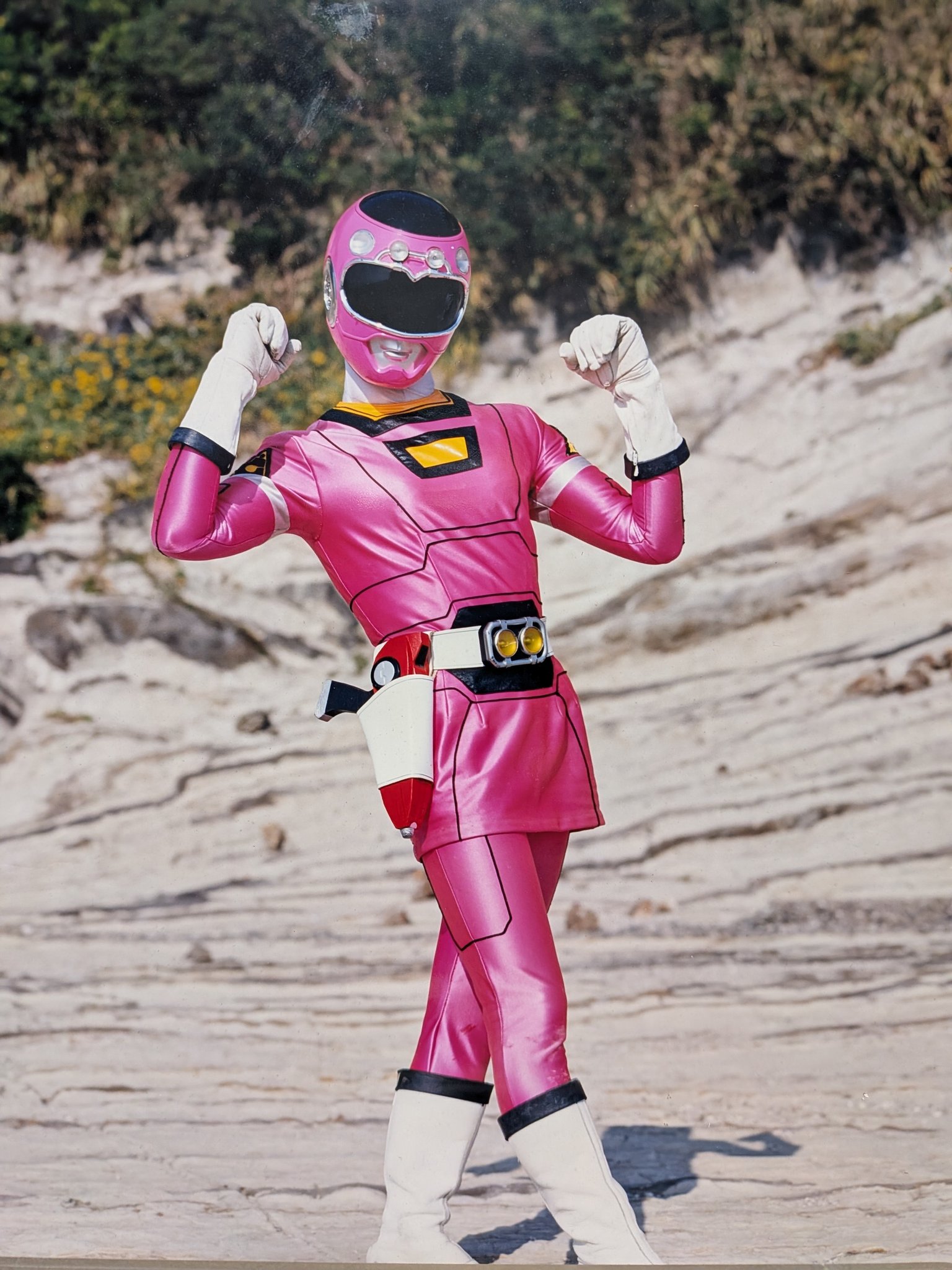
Completely different Pinks
Nakagawa rejected the idea of a generic Pink and put it in writing: "Carranger is Carranger, Timeranger is Timeranger. They are completely different Pinks." Of his Time Pink he wrote that she was "strong, first of all; with something solitary about her... cute sometimes?", and about playing her he concluded: "It was extremely hard." The Go Pink of "GoGoFive" is Matsuri, a paramedic on a rescue squadron whose "55V" ended up in the address of his blog and in his handle on X, motokuni55v. For her, Nakagawa invented an introduction pose of his own: the arms raised in front of the body are carrying, as he explained decades later, a child just pulled out of the rubble. He sums it up:
"It means: protect any life at all."
Nakagawa, on the pose he created for Go PinkAction director Takeda approved it on the spot: "Ahh, perfect. That is the one!" In 2025, on the anniversary of the series, Nakagawa looked back and summed it up: "A one-year job turned into twenty-six years of company."
The last call
In 2002 the assembly line changed. The masks got smaller and the heroine roles went, as a rule, to stuntwomen. He filled in as Hurricane Blue in the first two episodes of that year, by his own account. Nakagawa crossed back through the mirror and spent all of "Gaoranger" as the clown villain Yabaiba, played infernal gods on "Magiranger" and ayakashi on "Shinkenger", and by the time "Boukenger" came around in 2006, at thirty-five, he had decided that "the heroines were behind me". Cast first as Bouken Yellow, he ended up "pulled, somehow" into Bouken Pink, and the costume was waiting for him, cut on the mold of the body he had ten years earlier, the Carranger one.
On January 7, 2006, shooting scenes for the opening credits, he broke his right shoulder and left the studio in an ambulance. He missed the character's first months and came back with a metal plate screwed into his arm, removed a year later and kept ever since. About the plate, he wrote:
"For a year it limited how I moved, but it held my right arm up and fought alongside me. It is part of my body."
Nakagawa, in January 2026, posting a photograph of the plateThere was a symmetry in that cast, because Bouken Yellow was Hachisuka: two heroines, two men, the old guard taking its leave as a duet in Nakagawa's last regular posting as a hero. The tradition would wait until 2023 for another full-time heroine performed by a man, when Hachisuka himself, by then in his sixties, put on Papillon Ohger in "King-Ohger".
Kiryu, Monster X and the wrecked Diet building
A whole second career is packed into the margins of this story, and it lands with a heavier step. Between one squadron and the next, Nakagawa moved through nine Kamen Rider series, from "Black RX" (1988) to "Wizard" (2013), and at Toho he was Kiryu, the biomechanical Mechagodzilla of "Godzilla × Mothra × Mechagodzilla: Tokyo S.O.S." (2003). On "Godzilla: Final Wars" (2004) he stacked up three monsters, King Caesar, Monster X and Kaiser Ghidorah, and the last of those was a costume built for two, with Toshihiro Ogura at the back and Nakagawa at the front working the three heads in the close shots.
About Monster X, the official book reports, he spent the entire shoot believing the name was a placeholder. When he asked producer Shogo Tomiyama what the final one would be, the answer was: "That is the name." He keeps as a trophy the memory of wrecking the Japanese Diet building beside the Godzilla of Tsutomu Kitagawa, "a veteran somewhere above the clouds", and in that same year of 2003 his name turns up in the credits of "The Last Samurai". In 2017, a monster "general election" on TV Asahi put Kiryu in twelfth place, and Nakagawa, watching his own work again, said:
"Watching it now... that thing is nothing other than me. The human mannerisms are impossible to erase."
Nakagawa, on watching Kiryu again in 2017"Gabutyra does not move without me"
In 2013, "Kyoryuger" needed someone to inhabit Gabutyra, a red tyrannosaur close to four meters long, with no forward visibility and instructions that barely carried through to the man inside. The costume was rebuilt several times around his body, with him present from the first day of construction. Hiroshi Buta, the special effects director, put it plainly in the official series book: "Only Nakagawa can operate it." By then Nakagawa no longer belonged to JAE. He had left at the end of 2010, after twenty-two years with the company. When he heard about the casting, company president Osamu Kaneda assigned an assistant to look after him, a courtesy from an old boss to a distinguished soldier, and on his blog Nakagawa wrote:
"Gabutyra does not move without me. When he moves, I am there. If you want him to move, call me."
Motokuni Nakagawa, on his blogShy section chief, kindly father, samurai
Life after the costumes has been the life of a working Japanese character actor, invisible in a new way. Through the Takarai Project agency he became a warrior monk in the historical drama "Kamakura-dono no 13-nin" and a soldier coming home from the war in a television drama. "Shy section chief, kindly father, samurai", says his own agency listing, without ceremony, and in 2025 it still carried the line "Does theater and action at 53!". In 2020 he starred in a video for the Japan Patent Office, "Shohyoken", "The Fist of the Registered Trademark", playing the president of a company that makes the genuine article. In February and March of this year he was the prison guard Kanji Kuramoto in two episodes of NTV's "Punch Drunk Woman".
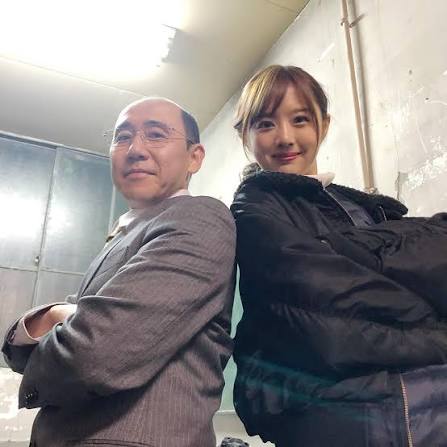
Not everything fit inside the choreography. After the earthquake of 2011 he organized charity drives and took hero shows to children in the devastated areas. Years later he wrote that former colleagues had spread a lie about him pocketing the donations, a charge he denied in public as having "no basis whatsoever". The man who found him in that coffee shop, Junji Yamaoka, died in 2021 with no goodbye, and in 2025 Nakagawa, calling him "my great benefactor", wrote that never getting to say it still hurt.
The archivist of his own disappearance
Here is the part no mask covers, the arithmetic that fails to add up. When the Japanese press celebrates the onnagata of tokusatsu, it celebrates Hachisuka, and it is right to. The book-length report on the profession, "The Pride of the Suit Actors" (2023), interviewed eighteen veterans. Nakagawa is not among them. The main recent article on the tradition of heroines performed by men, published in 2024, jumps from the 1980s straight to the stuntwomen of the twenty-first century, skipping the years when a single man wore almost all of them.
The monument to Mister Pink sits in fan encyclopedias, in the title of an internet radio show and, above all, in the archive he built himself. There are more than eight hundred posts on the motoblog across a decade, the memories he poured into note during the pandemic, and the account on X where he still corrects, one post at a time, who wore what in 1996, to the point that Japanese Wikipedia cites him as a primary source in the entries about him. The man whose job was to leave no trace became the archivist of his own disappearance.
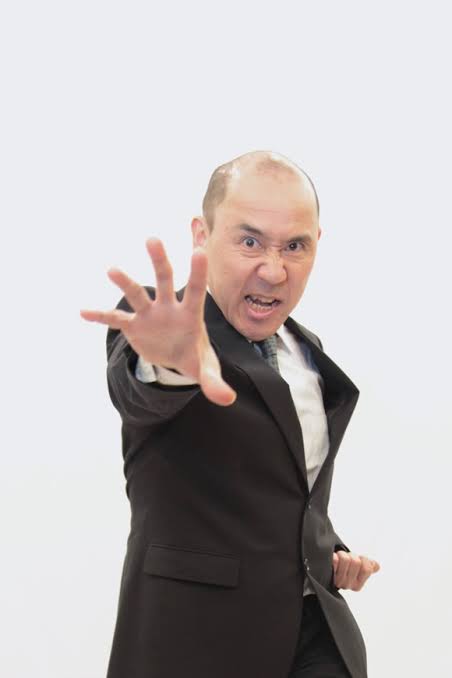
His own thesis is short. What makes a suit actor, he wrote, is "the pride and the responsibility of having been chosen" and a presence "able to knock down the idea that anyone will do once the mask is on". It is worth going back to the comic timing of Pink Racer, the melancholy of Time Pink and the maternal fury of Go Pink, because all of it is there, signed without a signature.
Call me any time you like
Motokuni Nakagawa turned fifty-five last Friday. This coming Saturday, the twenty-ninth, a monjayaki restaurant called Warabe, in the Oizumigakuen neighborhood, a short walk from the Toei studios where he took beatings, blew up and danced for three decades, closes its dining room at noon for an event named like a family reunion: the "Talk Circle Around Motokuni Nakagawa". In the invitation, posted to his account on X on his birthday, he recalled the thirteen-year-old who listened to the closing theme of "Uchuu Keiji Shaider", the one that promises "call me any time you like!", and complained to the television: "Call him how, when nobody knows where to find Shaider?" He closes the invitation this way:
"On the twenty-ninth, you will find Motokuni Nakagawa for certain. So call me any time you like."
The man who spent his whole life exactly where nobody could see himIn 2011, Motokuni Nakagawa sat down at the microphone of Shocker Ono, on the radio show Welcome to Shocker Ono's Secret Base, recorded shortly after the Great East Japan Earthquake. There he tells the story of the bread in Yokosuka, the bento that landed on Kazuo Niibori's head, the 15,000-yen audition in front of Sonny Chiba and the coffee shop where Junji Yamaoka handed around the colors of Carranger.
2011 archive · translated and adapted by Kyoudai Express · 12 blocks of conversation
Read the full interview →Read next
Kazuo Niibori, the Mr. Red who took a bento to the headHirofumi Ishigaki: the man who has been inside everythingGekisou Sentai Carranger: our entry on the Pink Racer series (in Portuguese)Kyuukyuu Sentai GoGoFive: our entry on Go Pink and the "55V" (in Portuguese)GoGo Sentai Boukenger: our entry on the last posting of Mister Pink (in Portuguese)Zyuden Sentai Kyoryuger: our entry on the series of Gabutyra (in Portuguese)Every profile and interview in the Suit Actors section (in Portuguese)Motokuni Nakagawa 中川素州 (b. 1971). Profile written from the actor's own accounts on his motoblog, on note and on the motokuni55v account on X, and from official books for the series mentioned.