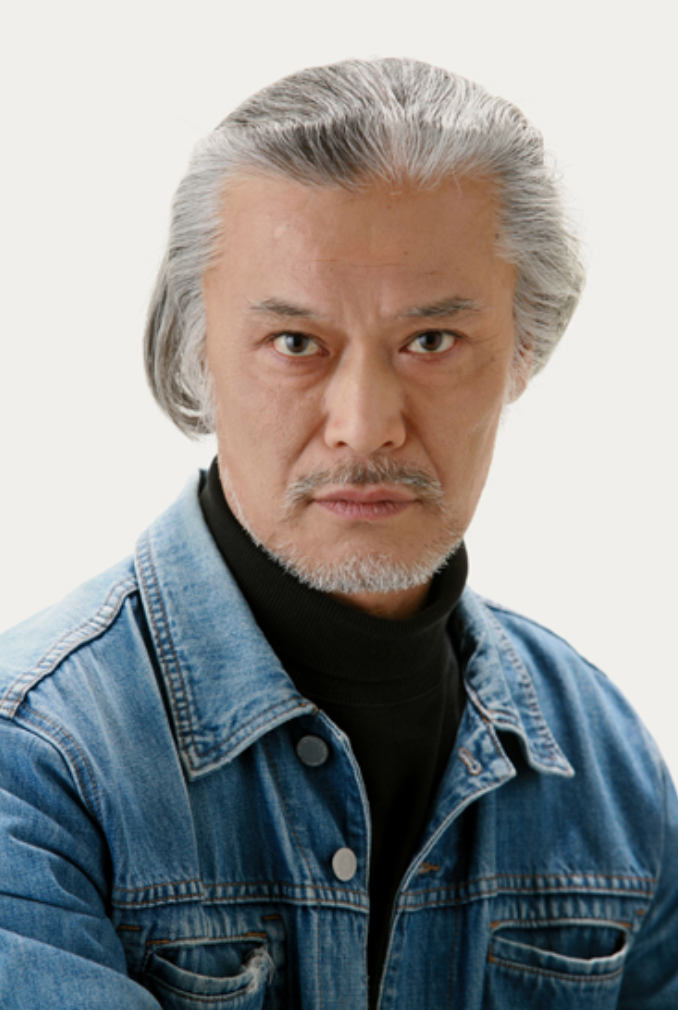
In the final episode of Chojin Sentai Jetman (Birdman Squadron Jetman), Kazuo Niibori walked into a church dressed as a priest, with no helmet, no explosion and no monster waiting for him. All he had to do was marry two people and deliver half a dozen lines, and that was when his hands and his legs began to shake.
By then Niibori had spent twenty years inside hero costumes, carrying armor that weighed far too much, repeating dangerous stunts until they came out right and passing whole afternoons inside masks with no ventilation. A handful of lines was what finally stopped him. The scene closes his run in the red uniforms and says more about the craft than any statistic: he had learned to act without a face, to lead without raising his voice and to move an audience with a silhouette, so being outside the mask was what left him exposed. To understand how a boy from Ibaraki ended up at the physical center of Super Sentai for nearly two decades, it helps to go back to the day he discovered that the most important bodies in Japanese cinema almost never appeared on the posters.
Behind the mask
For decades the Japanese hero came with two bodies working at once. One actor spoke the lines, carried the drama and turned up on the posters. The other put on the costume, saw the set through a narrow slit and had to get anger, courage, leadership and pain across to an audience with no help from his face. That second job is called suit acting, and the suit actor is the performer inside the costume who does the fighting. Kazuo Niibori was one of the few who took that division of labor and built a craft out of it, with rules of its own.
He was born on February 23, 1955, in Ibaraki Prefecture, and over his working life he was an action actor, a stuntman, a suit actor, a fight choreographer, an action director and a teacher of newcomers. Along the way he put together a number nobody has matched. He played Aka Ranger through the first stretch of Himitsu Sentai Gorenger (Secret Task Force Gorenger) and then wore thirteen consecutive red leaders, from Battle Japan in Battle Fever J to Red Hawk in Chojin Sentai Jetman. That makes fourteen red heroes on television.
The number tells far less of the story than the images he left behind. Niibori runs with his chest thrown forward and his arms cutting the air, and he draws a sword as though the movement had started before the blade cleared the scabbard. Standing in a formation of five, he holds the center without ever looking parked there. He tilts his body, waits a fraction of a second and only then strikes, on a beat that anyone who grew up watching recognizes long before learning the name of the man inside. Those choices are why he counts as one of the authors of the physical idea of "Red", the leader who organizes the group, holds the tension of a scene and reads as the one in charge before he opens his mouth.
The boy who wanted to land the blow
None of it started with a dream of stardom. In Ibaraki he was a restless kid raised among hills, street games and period films, and in the neighborhood chanbara duels, the sword fights every Japanese child copied from samurai movies, he made a point of rounding up the other boys so that he would always be the one landing the blow. Few families in the area owned a television back then, so the children crowded into whichever house had a set to watch samurai films, serials and Rikidozan's wrestling matches.
The profession only turned up as a possibility after he left the countryside for Tokyo. Still a teenager, he took a job helping out at a car repair shop next door to Mifune Productions. When his shift ended he would hang around watching the studio shoot at night, until he worked out, shot by shot, how the whole spectacle held together from the inside. Niibori remembers:
"I would see a man gallop up, stop the horse and dismount. Then, once the camera moved in closer, that man had turned into Mifune. The two of them wore identical clothes. That was how I understood that another professional handled the dangerous work. The first time a big fight scene was filmed right in front of me, I thought: 'That is what I want to do.'"
Kazuo NiiboriThe memory has everything of an origin scene, and what gives it away is where his eye went: straight to the man who took the fall, completed the jump and vanished the moment the camera came close. Long before he put on any mask, Niibori already recognized himself in the professional whose whole presence depended on nobody noticing he was there.
The forge of the Ono Ken'yukai
He came across an ad for a school tied to Nippon Television, passed the audition and borrowed money to pay for classes in dramatic reading, acting, mime and stage combat. That was where he met Kotaro Ono, founder of the Ono Ken'yukai, the group behind the action on several central series of the period, the first Kamen Rider shows among them. The house ran on a strict hierarchy, and for a newcomer talent alone opened no doors. Niibori remembers:
"When I joined, there were twenty or thirty senior members ahead of me. So I trained every day. During the day I practiced with the seniors who were free. At night I trained again with the ones coming back from shoots. Two sessions a day. I had nowhere to live, but there was an empty dormitory tied to Ono where I could sleep. That was luck: at least I was not out on the street."
Kazuo NiiboriHis start was the usual one on action teams, with enemy soldiers, monsters, last-minute substitutions and amusement park shows. He was a Shocker combatant and one of the six fake Kamen Riders before the live stage handed him the first lead of his life, Gekko Kamen. At the old Korakuen stadium the team put on as many as five performances a day, and it was in that routine that they spotted the quality that would define the rest of his career. At the close of Gekko Kamen his silhouette lit against the stadium pulled applause out of the crowd, and people started saying the young man had "a good presence from behind". For a suit actor that praise is worth a great deal, because it means he can communicate heroism with his face entirely out of the picture.
The day he wanted to quit
The climb had far less of a straight line to it than the list of characters suggests. On the Kamen Rider series he covered for more experienced performers and took over characters with no time to prepare. One of those jobs, on Kamen Rider Stronger, turned into a painful memory: he had to improvise the hero's introduction, choreography included, in the style of a period drama. Niibori remembers:
"I spent the entire morning getting it wrong. The men playing my opponents, veterans themselves, started losing patience: 'Again? Sort it out, Kazuo!' I kept thinking: 'I never asked to do this, I only came because there was nobody else.' I ended up working with tears in my eyes. I wanted to go home, and I seriously wondered whether the profession was for me."
Kazuo NiiboriThe episode matters because it ruins the image of an infallible "Mister Red" that nostalgia built afterward. Before he commanded a team, Niibori was the rookie who froze during an introduction, held up the entire set and cried inside the mask. The physical authority that would show up in the years ahead was built on top of that embarrassment.
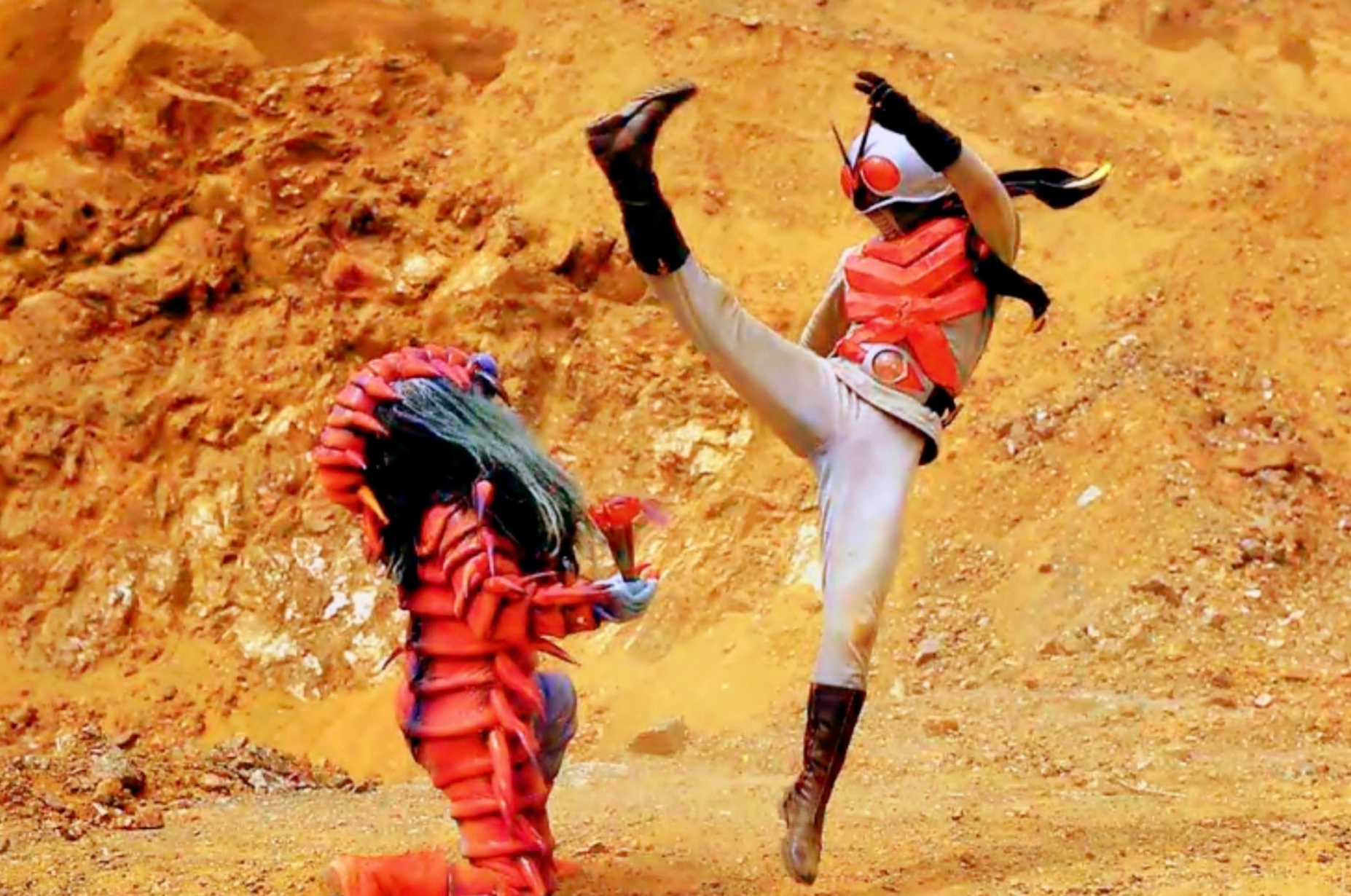
After standing in for colleagues on Kamen Rider X, he was cast from the start of Kamen Rider Amazon. The character asked for the opposite of the usual heroic posture: a low center of gravity, attacks with claws, biting and grappling, the whole body shaped by the idea of the jungle. Niibori spent entire days crouched, legs under tension and chin tucked in, until his thighs hardened and the weight of the mask punished his neck, and he had to unlearn a good part of the repertoire that had carried him that far. Amazon fixed a principle he would keep for the rest of his career: every costume imposes a weight, a geometry and a personality, and the suit actor's work is to turn those limits into language.
Up to that point Niibori's career was that of an apprentice fighting for room among older professionals. Some days a combatant at the back of the frame, other days a substitute called in at the last minute, always the body that had to vanish so the star's illusion held. Gorenger changed the route at once, because for the first time the young man used to standing in for other people would have to teach an audience how a new kind of hero occupied the center.
Aka Ranger: the youngest leader in the room
In 1975 Gorenger proposed a turn and traded the lone hero for five colored figures sharing the action. Niibori assumed he would get a secondary member, and when they told him he would wear red and that red was the leader, he was stunned. At twenty he would have to command, on camera, colleagues who ranked above him in the Ken'yukai hierarchy. He remembers:
"In rehearsal I would point and say what the script called for: 'Blue, Green, move in!' The veterans would answer: 'Why don't you go yourself?' I would get flustered, say yes and charge in alone. It was their way of joking. They did it so I would relax and lose the embarrassment of giving orders to men with more experience."
Kazuo NiiboriThe memory explains a great deal about how the first red leader in Super Sentai was created, because the authority of Aka Ranger was learned live, by a young man forced to give orders to his own seniors. Those men needled him so he would take the center without asking permission, and it worked. Niibori played Aka Ranger from episode 1 through episode 66, in a leather suit that tore easily and a large mask that got in the way of his vision. That is where the visual grammar Sentai still uses was born, with red giving the signal, steadying the formation and starting the collective movement.
The weight of a giant: Daitetsujin 17
After Gorenger came a problem of another kind, playing the giant robot of Daitetsujin 17 (Giant Iron Man 17). Niibori had to give up human agility and invent a walk capable of carrying scale and mass. The armor was so rigid that he could not sit down properly, and the joints scraped his arms and legs, cut into his armpits and even hurt his ears. He started with the most basic element, the walk, controlling the timing of each step to suggest a body much larger than his own, and locked inside all of that he could lose around three kilos in a day of shooting. On the waiting inside the costume, he says:
"The worst part was waiting inside the costume. In summer I reached my limit. Once I thought: 'If the suit breaks, they will have to call it a day.' In rehearsal I made 17 fall as part of the performance and snapped the long antenna on the forehead on purpose. I pretended I had slipped. The crew said it could not be repaired that day and moved on to shooting only the monsters. I was sent home early."
Kazuo NiiboriThe story shows the real cost of the work, because that steel hero who looked invulnerable on screen depended on a man overheating inside, cut at the armpits and unable to sit down between takes. Niibori learned to suggest the weight of a machine while carrying, underneath it, the weight of a costume that spent all day trying to push him out.
A month in a kitchen and the call that changed everything
After starring as Aka Ranger and as 17, he was back to playing soldiers and secondary robots. The sequence discouraged him, he left the group and decided to give up action work for good. Since he liked to cook, he signed on as an apprentice at a restaurant in Numabukuro, planning to open a place of his own. The retirement lasted about a month. Issho Takahashi, one of his teachers, was putting together a new series called Battle Fever J and kept saying that the only man he could picture as Battle Japan was his former student. Niibori remembers:
"He shot back: 'You spent all those years learning this trade. Are you going to throw it away for a month in a kitchen?' My own boss at the restaurant backed him up: 'If you really love action, go back. The kitchen will still be here.' So I went back. Something competitive woke up in me too: I wanted to show the action I learned at the Ken'yukai in the middle of the JAC professionals."
Kazuo NiiboriThe decision changed the history of Super Sentai, because from then on the ritual repeated year after year. When Battle Fever J ended, the producer called him for Denziman. Near the end of Denziman, somebody told him to go and try on the Sun Vulcan suit. As Sun Vulcan approached its finale, Goggle V was already waiting for fittings. Niibori never belonged to JAC or to JAE, the stunt organizations whose people surrounded him on set, and that position of the man always slightly on the outside fed a productive competitiveness in him. He carried the dramatic interpretation he had learned at the Ken'yukai. At the same time he was picking up the more acrobatic techniques from Kenji Oba: trampoline, landings on the mat and high falls.
Fourteen reds, one archetype
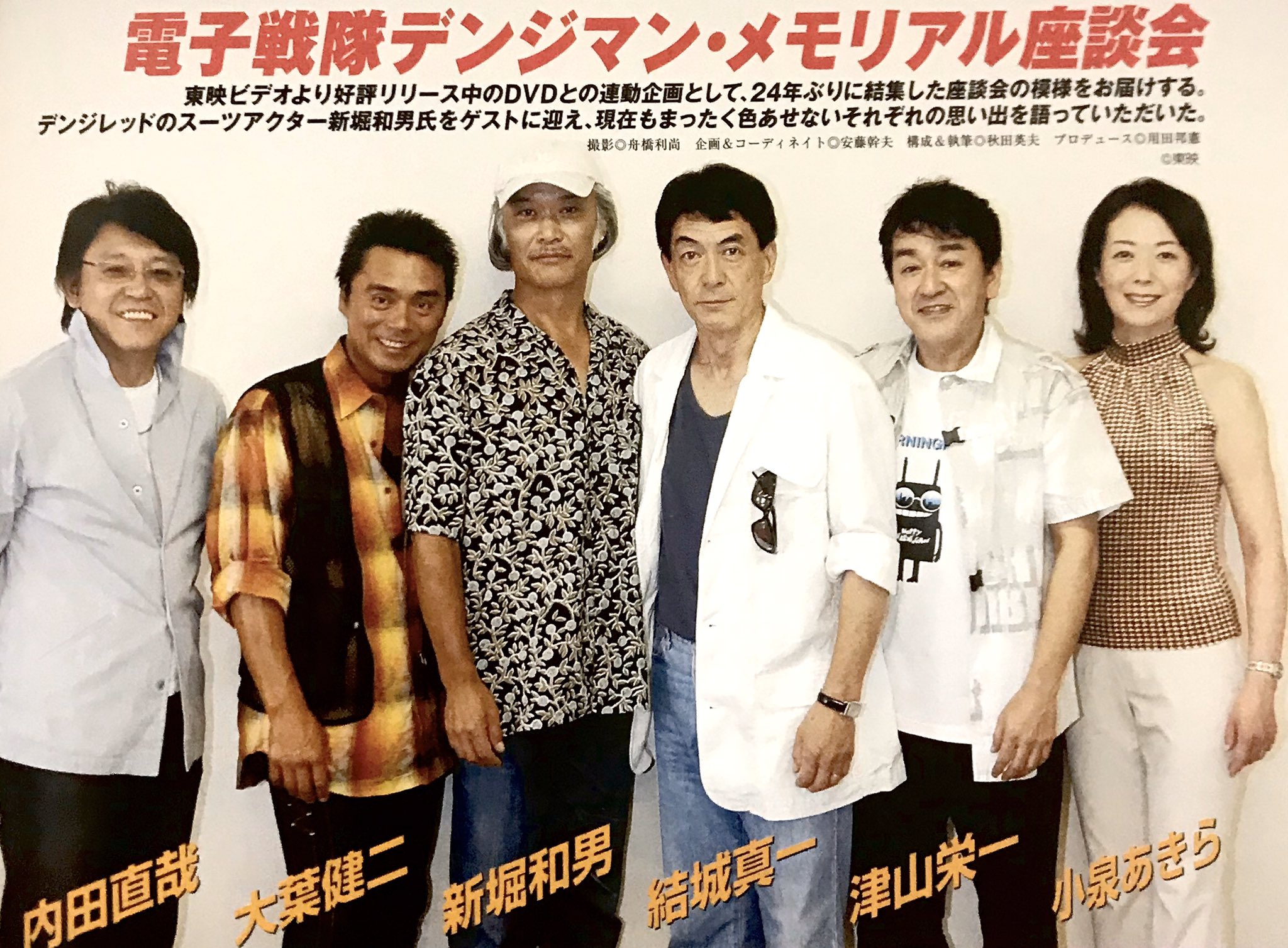
The television run is striking when it is written out in a line: Aka Ranger, Battle Japan, Denzi Red, Vul Eagle, Goggle Red, Dyna Red, Red One, Change Dragon, Red Flash, Red Mask, Red Falcon, Red Turbo, Five Red and Red Hawk. There were occasional interruptions along the way, such as the injury that kept him out of part of Sun Vulcan, and even so, from Battle Fever J to Jetman he was the main suit actor of thirteen consecutive reds. Repeating the post was a long way from repeating the character, since every season brought a new helmet, fabric with different mobility, different weapons and a set of poses of its own.
His philosophy started from an idea that comes up less often today: after the transformation the hero becomes almost another form of existence, so instead of copying the gestures of the unmasked actor, Niibori built an ideal transformed figure. The mask took the most obvious resources away from the performer and pushed feeling into other places: the windup before a punch, the tension in the shoulders, the pause before an answer. That is why his work holds up when you watch it again outside the glow of nostalgia. Red looked like a leader because he watched the rhythm of the other four, looked furious because the blow began emotionally before contact, and looked certain because the line of his body stayed readable in the middle of the chaos.
The run, the sword and the pleasure of a silhouette
A few signatures crossed the seasons, and the best known of them was the run. Niibori got letters from viewers asking to see him running more often, and in some scenes the motorcycle arrival written into the script became an entrance on foot. On Maskman, at an empty racing circuit, Red Mask's head comes up first, then the neck, then the whole body advancing down the track. The crew shot at high speed to play the movement back in slow motion, which forced the actor to repeat the run for two days. It looked beautiful on screen, and the cost showed up in his body, with Niibori ending the shoot ill.
He also stood out with a sword, influenced by the cinematic sweep of actors like Hiroki Matsukata. In episode 52 of Changeman his Change Dragon faces Booba in a duel filmed at sunset, with director Takao Nagaishi placing the camera far back and waiting for the exact light before rolling. The silhouettes, the landscape and the accumulated rivalry give the confrontation a weight that depends on no effect at all, and there the action works as the dramatic resolution of the story itself.
Red Falcon and the responsibility toward children
On Liveman, Niibori put on Red Falcon with a fairly competitive motivation, because Daisuke Shima, who played the unmasked lead, already had a name as a singer and an actor, and he stepped into the suit determined not to fall behind. During a 2009 interview, the host read out a message from a fan who had fallen seriously ill at four years old and spent months in the hospital, at risk from every injury, and who gathered courage from the weekly broadcast of Liveman. Grown up and recovered, that man thanked Niibori for a Red Falcon who had helped save his life.
The story gives the measure of what sits behind the costume. For the professional, a take meant heat, pain and repetition on a workday like any other, while for a hospitalized child that same red body was the weekly proof that it was worth going on. The anonymity of the suit actor always came with a bond that reached the audience before the name did.
Jetman: shaking in front of a line
Niibori closed his regular run of reds with Red Hawk on Jetman, at a point when he could feel that his leg no longer came up on the same line as before and preferred to leave while he still met the standard he demanded of himself. In the final episode several suit actors got small unmasked appearances, and his was the priest who marries Ryu and Kaori. He says:
"My heart was racing, I did take after take and my legs shook. I had done so many dangerous scenes without a tremor, and there I was, terrified of a few lines."
Kazuo Niibori, on the final scene of JetmanIt is a fitting farewell, because for nearly two decades he had communicated everything with his face hidden, and it took only having to use his voice and his expression in front of his own crew to set his legs shaking. The priest in Jetman works as the moment when the man behind the red crosses through the mask and steps unprotected into the same frame he had spent so many years holding up.
From the body to the method
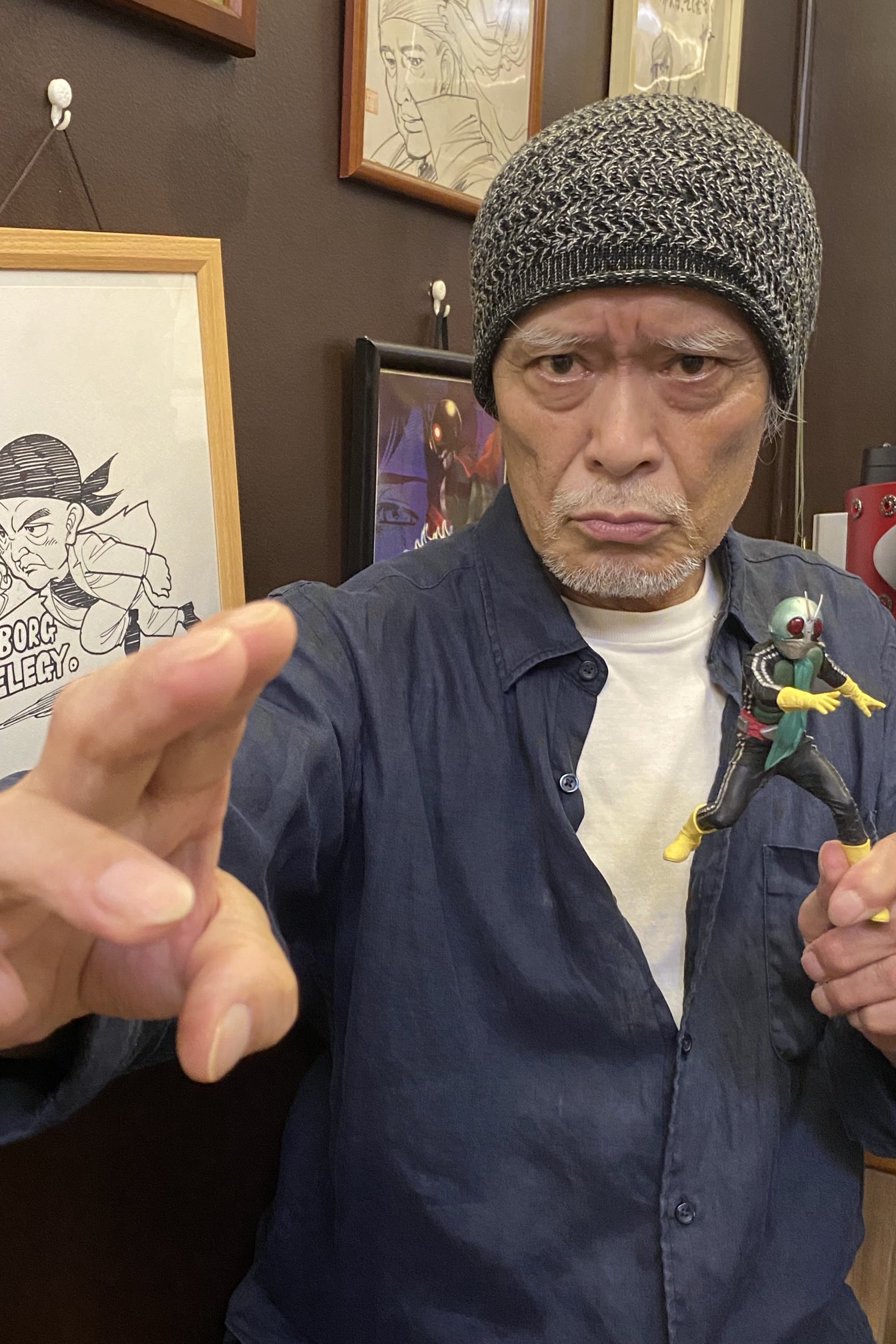
Leaving the post of regular red did not end his influence on the genre. Niibori became the action director of Zyuranger and worked on many later productions in Super Sentai, Metal Heroes and Kamen Rider. He created the Red Action Club in 1982 and, in 2006, set up Red Entertainment Deliver, devoted to representing and training action performers. He also went back into the suits now and then: he took up Red Falcon again in Gaoranger vs. Super Sentai, played the enormous Kamen Rider Arc in the Kamen Rider Kiva film and, in 2015, received a special contribution prize at the Japan Action Awards.
His contribution fits in one sentence: the mask forces the actor to act by other means. Feeling migrates from the face to the axis of the body, leadership becomes a position in space, and personality starts to show in the way a man runs, stops, draws a weapon, takes a hit and returns to his stance. Niibori turned those choices into a continuous line that runs through characters, teams and whole decades.
The real meaning of "Mr. Red"
It is tempting to reduce Kazuo Niibori to the record of fourteen reds, and the nickname "Mr. Red" encourages that reading, as if his importance came down to lasting longer than anyone else inside the central uniform. His greatness sits somewhere else, and it shows when you look at the whole path. The boy from Ibaraki who always wanted to land the blow learned that stage fighting means building an image together with a partner. The rookie who cried after botching the Stronger introduction learned to command veterans as Aka Ranger. And the cook of one month went back to the set to create a run of characters that carried an entire generation. Asked why he never left the trade, he answers:
"I thought I had walked away for good myself when I went to work at that restaurant, but I could never leave this line of work. I cannot explain why. It is fun."
Kazuo NiiboriThe career of Kazuo Niibori was born out of fascination with a movement seen from a distance, on a night shoot in Tokyo, and it survived all the suffering because somewhere between the fall, the pose and the applause there was still pleasure in it. For years new actors, new stories and new uniforms filled the screen, and at the center of them stood the same man, teaching red how to move.
The quotes here come from the conversation Kazuo Niibori had with Shocker Ono on the radio show Welcome to Shocker Ono's Secret Base, episode 16, in 2009. It is the first time he sat down at the microphone to tell the whole career: Ibaraki, the hierarchy of the Ono Ken'yukai, the month in a Numabukuro kitchen, the forced diet of Daitetsujin 17 and the terror of a single line in Jetman.
2009 archive · translated and adapted by Kyoudai Express · about 25 minutes of reading
Read the full interview →Read next
Osamu Kaneda, Mr. Action: from the stuntman who wanted the money to the action directorTsutomu Kitagawa: the blue heroes and the Godzilla of the Millennium eraMotokuni Nakagawa, the Mister Pink who took a lunch box to the head from NiiboriHimitsu Sentai Gorenger: our entry on the series that created Aka Ranger (in Portuguese)Chojin Sentai Jetman: our entry on the series where Niibori said goodbye (in Portuguese)Yuki Yajima, the Yellow Four who vanished from BiomanEvery profile and interview in the Suit Actors sectionKazuo Niibori 新堀和男 (b. 1955). Profile written from interviews and accounts by the actor himself about his career as a suit actor, action director and teacher of new generations.