In 2016, Osamu Kaneda stood in front of a burning set, getting ready to bring back Kamen Rider 1. On the other side of the camera, Hiroshi Fujioka was playing Takeshi Hongo again, the hero who launched one of the biggest franchises on Japanese television. Kaneda asked the crew to make the fire big. A legend was coming back to life, and the picture had to match that.
Forty-five years earlier the two men had shared a set, with Fujioka carrying Kamen Rider as its star. Kaneda was a beginner at the newly formed Japan Action Club, sent in as a foot soldier, a monster or a stand-in, and too shy to start a conversation with the lead actor. On one early attempt he blew a landing, hit the ground hard, and watched the crew rush over to ask first whether the mask had survived. By 2016 that anonymous kid was directing Fujioka. The gap between those two mornings holds half a century of Japanese screen action: the worker hidden inside the costume became a director, an author and the president of the company that trains the next generation of action performers.
None of it was planned. Kaneda grew up far from heroes and far from movies, and he took the job because he had heard that dangerous work paid well. The calling arrived later, somewhere among the blown jumps, the airless costumes, the shoots with real fire and the discovery that a fight staged for a camera is a piece of acting.
The boy between the sea and the mountains
Osamu Kaneda was born on August 31, 1949, in Niigata Prefecture, and grew up in Itoigawa, at the far edge of the prefecture near Toyama, on a strip of land pressed between the sea and the mountains, a long way from the entertainment business in Tokyo. His childhood was physical: fishing, skiing, gymnastics, general mischief and, in summer, stolen tomatoes and the occasional scolding when he got caught. Television, movies and any thought of acting stayed outside the frame, and years later he would say that he barely watched films as a young man.
School held no appeal either. When he finished junior high he thought about going straight to Tokyo to look for work, and his parents pushed him to sit the high school entrance exam. He went to check the results certain he had failed, and found his number on the list. At school he picked the ski club on the theory that summers would be free, and got the opposite: running, a staircase of several hundred steps and hard training all year. The boy trying to dodge effort built there a good part of the physical base his profession would demand.
After graduation, college and a desk job were still out of the question, and a vocational design school became the way forward: Kaneda moved to Tokyo and enrolled at Tokyo Designer Gakuin. Tuition ran to about 100,000 yen and weighed on the family budget, so he had to work. In his second year he landed in the Ginza nightlife as a bartender, though he hardly drank, drawn by the people and the traffic through the room, and he treated the job as a school of human behavior. Spending a whole life behind a counter, though, was no more appealing than the rest.
"I wanted the money"
The move into stunt work started with arithmetic that did not add up. The bartending money never stretched far enough, and Kaneda heard that stuntmen were paid well for taking on dangerous situations. His older brother had done bit parts around names like Yujiro Ishihara, the only bridge available, and Kaneda figured that Toei would know where stunt performers came from. He called, was passed from contact to contact, reached the wrong outfit, and came away with the phone number of the Japan Action Club, founded by Shinichi "Sonny" Chiba. He says:
Young people today watch the heroes on television and think, "I want to do that kind of work." It was different for me. I wanted money. I did not want to study, I did not want to repeat the same thing every day, and I did not want to be a salaried man who comes in at nine and leaves at six.
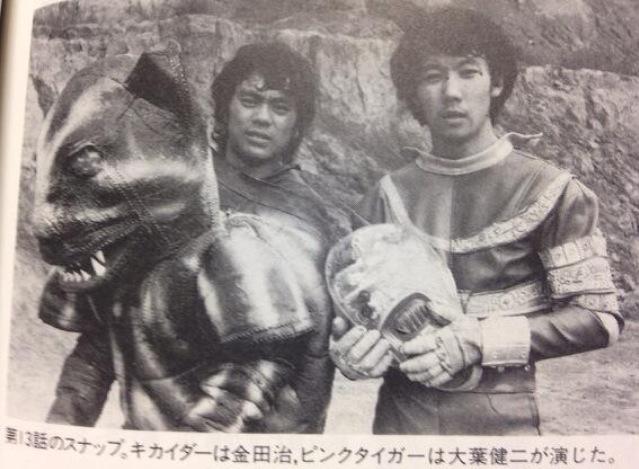
Osamu KanedaKaneda was twenty or twenty-one when he joined the JAC in 1970, and he was embarrassed to be starting later than several of his classmates, so he told people he was nineteen. He was still working nights and warned the club that for a few months he would miss some of the training. The group, which was just organizing itself as a company, offered daytime sessions. The JAC was small then, and Chiba wanted more than a pool of doubles for movie stars: he wanted to prove that Japan could stage action at the level of American pictures. That ambition took a while to reach Kaneda, who had come looking for a paycheck.
The necessary humiliation
One of his first jobs took him to a production in the orbit of Key Hunter and Kamen Rider, probably on Miyakejima, where the shot called for a fall or a jump through a window onto a trampoline rigged outside. The veterans treated it as routine. Kaneda said he was not confident, was told the setup would take care of him, and discovered when the camera rolled that nobody could do it in his place. He got it wrong, said things he should not have said in front of experienced professionals, and went home certain that no one would call him again.
Out of that came the first professional decision of his life: train seriously or get hurt. A second discovery followed, because the early pay was nowhere near the fortune he had imagined and barely covered living costs. What kept him in the work was the variety, a different location every day, a different crew, a different problem. He began to take pride in the invisibility of the stunt performer, since the scene existed at all because somebody outside the frame had accepted the risk.
The first Kamen Rider, and a mask worth more than the man inside it
In 1971, during a training session, somebody handed Kaneda a mask and told him to jump, and the call came soon after: the next day he would be working on Kamen Rider. He did foot-soldier action, falls, trampoline hits and the Rider's own movement in specific shots, and on one of them he went for a forward somersault, lost the landing and drove into the ground. The crew came running, and the first question was, "Is the mask all right?" He still gets a laugh out of the memory in interviews, and it lays out the material hierarchy of the set: the kid's body had replacements available, while the costume piece was expensive and hard to repair.
Kaneda did not even know what time the show aired. He understood how big it was only when people told him that children cleared out of the streets and ran home when Kamen Rider came on, and the newcomer who never watched television had walked into a cultural phenomenon without noticing. At the makeshift Ikuta Studio he watched Hiroshi Fujioka from a distance, a man who carried the aura of a lead, while Kaneda was one of the bodies used to build enemies, crowds and moments of danger.
Robot Keiji: the body the costume tried to erase
In 1973 he was cast as Robot Detective K for the fight scenes of Robot Keiji, the first major costumed lead handed to him and the hardest physical job he had taken on. The suit was thick, heavy and stiff: the arms and legs barely lifted, and every movement cost him what he estimated at ten times the normal effort. He was already thin, and he lost about six kilos over the shoot. None of that reached the screen. Inside the costume he felt enormous movement and saw a slow character on the monitor, while the people in charge kept telling him to do more and do it bigger. Kaneda says:
I thought I was already doing everything I could, and they kept telling me to make it bigger. Then I looked at the footage, and the action still did not read as big. That was when I understood that the movement felt by the person inside is not the movement the audience sees.
Osamu KanedaOne fire sequence took the improvisation to its limit. On a construction site, Kaneda and another performer ran through a wall of flame, and between the heat, the noise and the narrow field of vision neither of them could judge what was happening. After the cut they found that Kaneda's suit had caught fire, and the two of them, stripped to their under layers and dreading what the costume department would say, considered running away. They walked about a hundred meters to a vending machine, bought drinks, argued about whether to abandon the set, and went back. The story plays as comedy and sums up the working day of a suit actor in that period. It also left a lesson Kaneda carried for the rest of his career: the intention has to travel through weight, stiffness, heat and a face that cannot move.
Action is acting
Over his first five or six years Kaneda performed in Kamen Rider, Kikaider, Robot Keiji and Message from Space, plus foot soldiers and small parts in films such as Gekitotsu! Satsujinken, Wolf Guy and Kenka Karate: Kyokushinken, always in positions nobody could identify on screen. His run as a regular performer was short. He showed up to training every day, helped the others, and little by little people started asking him to organize movement, explain falls and lay out fights. The actor who was still learning to control his own body was put in charge of guiding everyone else.
That transition produced the central idea of his working life: action earns its place when it expresses a dramatic situation, and a fall on its own settles very little. You have to know why the character fell, what he wants, what emotion arrives before the punch and how he gets back up, because a double is standing in for an actor and has to keep the character alive through the sequence. Decades later, as president of the JAE, Kaneda would keep saying that the company is a talent agency, which is why its training covers line reading, diction and acting. The mask forces the body to produce the face by other means.
Condorman: running a department nobody had named yet
In 1975 the action on Seigi no Symbol Condorman was handed to Kaneda's group. He was the oldest of the people available, so they told him the fights were his. He had only a rough idea of what taking charge of the action meant, and the early work ran on instinct, with Gekko Kamen, an earlier creation by the same writer, as a general reference. Building a fight took more than knowing the moves, because he had to tell the camera operator what needed to be visible and work out how the framing changed the movement. Camera crews and directors kept correcting him: "From that side it will not read"; "Shift the position and it works better".
Kaneda began studying shot breakdowns, editing and the way one take pulls the next one into place. He started reading whole scripts: what the situation was, what the scene had to communicate, where the beat sat that the audience could not be allowed to miss. Once that core was clear, the choreography assembled itself around it, and the action director emerged as the translator between body, script and camera.
When "tate" got a new name
In the Japanese tradition, tate was the word for designing and staging stage combat, and for most of the audience the credit explained very little. As action series multiplied, and around Space Sheriff Gavan in particular, the complexity of the sequences pushed the job into another dimension, and the term "action director" said plainly that somebody had imagined those scenes and run them. Kaneda took pride in that recognition and treated hero shows as serious work, hunting for an image, a use of an object or a movement that had never been done quite that way.
In a 2021 interview he explained that as an action director he thought about the camera more than about the action itself: you could push the frame in closer, drop frames to change the impact, or choose a pose that would stay in the memory. The choreography was only finished once the footage was cut.
Gavan: building the future out of fluorescent tubes
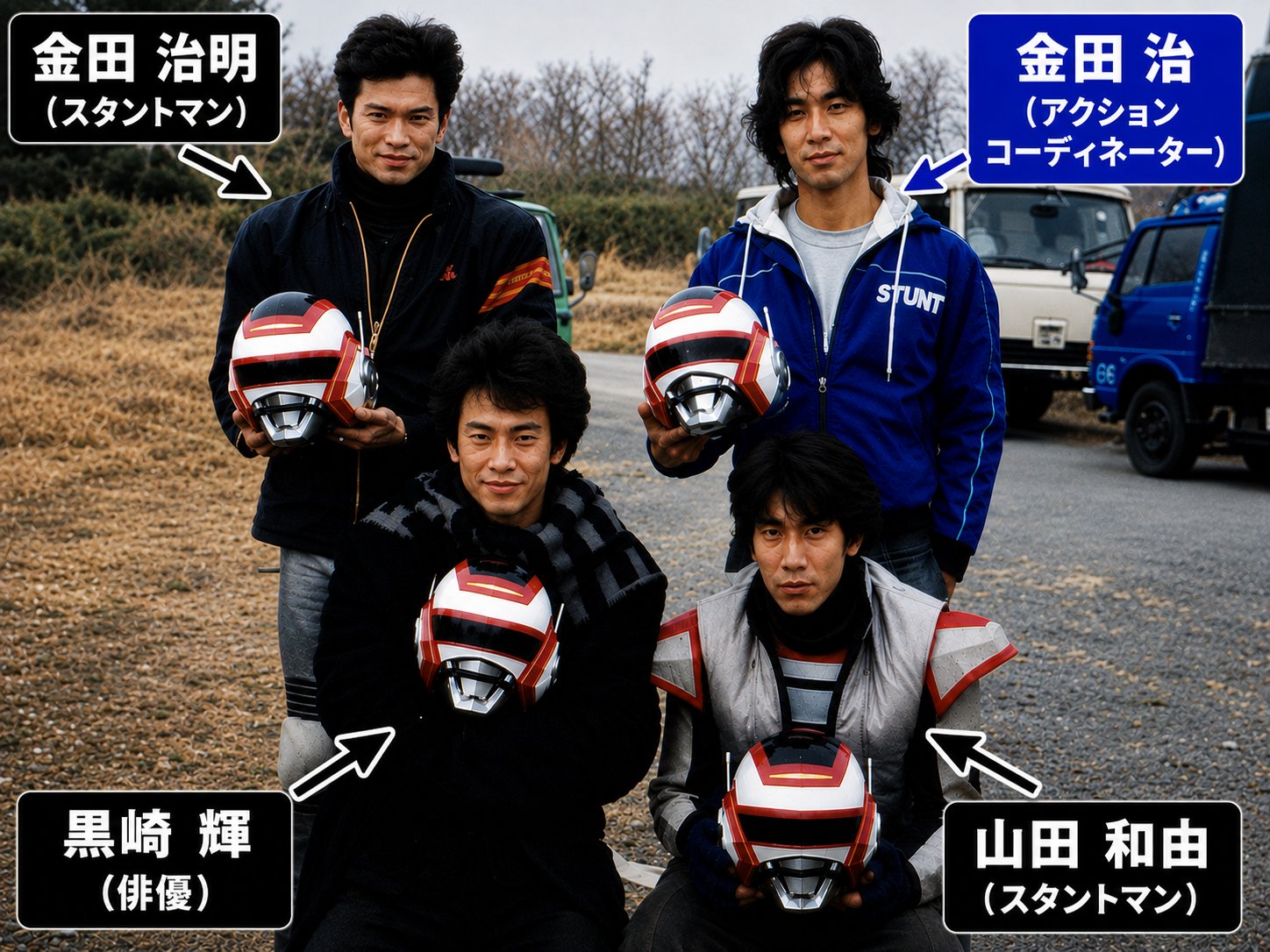
Space Sheriff Gavan, from 1982, sits at the center of Kaneda's career and of the visual history of the genre, because the show had to separate itself from Kamen Rider and Super Sentai. It needed metal armor, battles in another dimension and a Laser Blade that all looked like pictures of a future nobody had built yet, and the budget would not cover optical compositing on demand. Its henshin, the transformation sequence in which the man becomes the armored hero, was built on a vapor deposition effect. For the Maku Space scenes the crew worked with a half mirror, miniatures and paintings, among them the rings of Saturn, with the alignments solved on the set itself, and the camera could barely move, because any shift collapsed the illusion. On how they got around that limit, Kaneda says:
Gavan was entering a different space. Changing the color of the image was not enough. We did not have the money to use effects freely, and shooting it all the ordinary way would have been dull. We had to invent something the audience had never seen and then work out how to pull it off right there.
Osamu Kaneda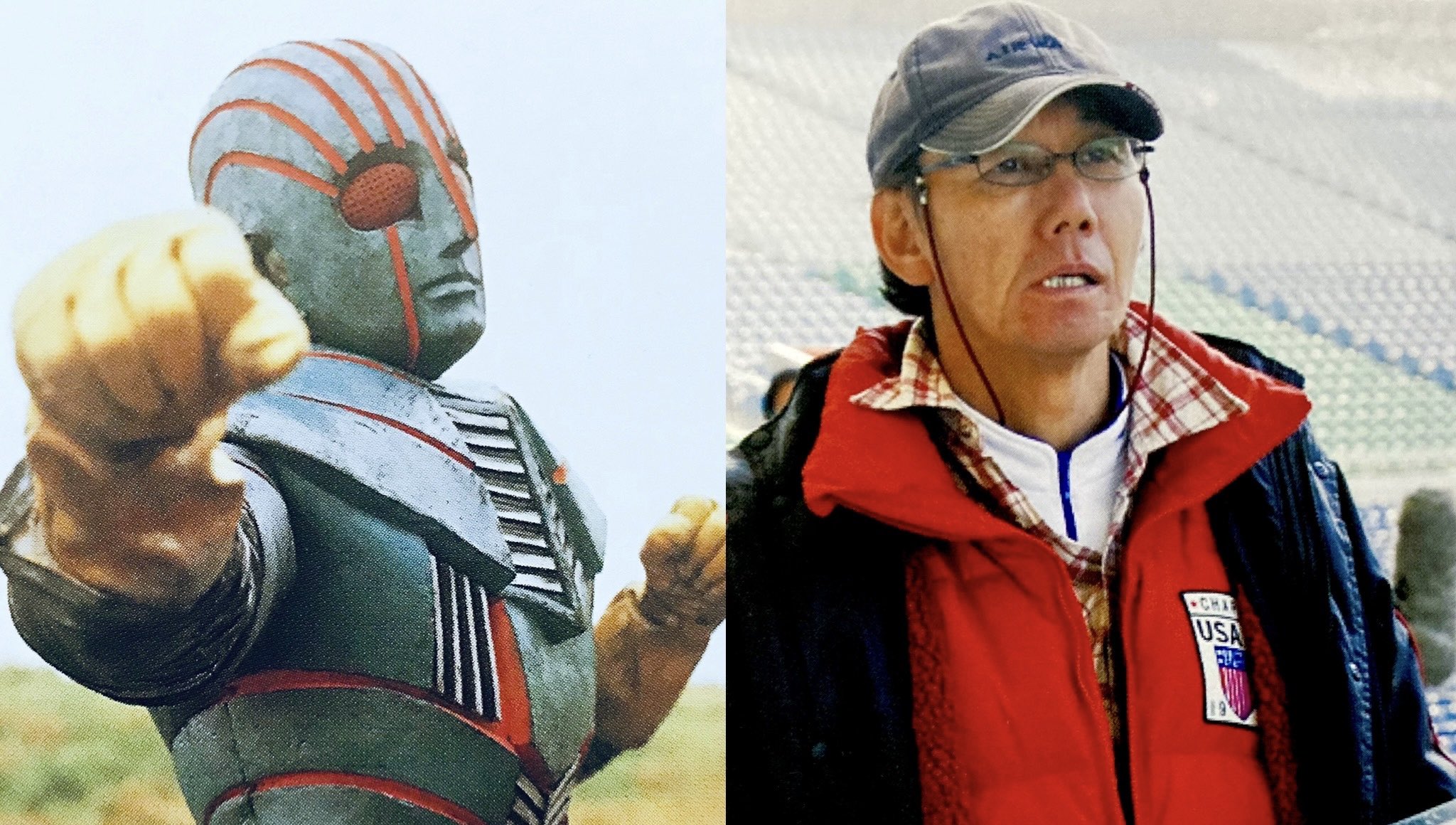
The Laser Blade came out of a solution just as handmade. Instead of compositing the whole blade, the crew used a fluorescent tube. Kaneda resisted at first, since a conventional sword has a point and a clean edge and the tube was round and thick, with wires running through the suit and out through the legs, switched on at the right moment while smoke and framing hid the mechanism. Those limits gave the show its identity, and Gavan looked futuristic partly because of the tricks invented to get around the missing money. Kaneda went on to run the action on Sharivan, Shaider, Juspion and Spielban, and helped fix the body language of the Metal Heroes.
The instant the hero stops
On Kamen Rider BLACK, Kaneda came back as action director to a franchise he had first met as a beginner, and what interested him was the instant right after the blow. He says:
The final pose had to be beautiful. The action could go by fast, and the frame where the character came to rest had to stay in the heart of whoever was watching. Every week the audience met the hero again through those images.
Osamu KanedaMovement acquires meaning because of that suspended instant in which the viewer recognizes the hero, and the closing pose works as the dramatic signature of the fight. The work continued on BLACK RX and on the opening episodes of shows like Jiraiya and Jiban, while other professionals, Michihiro Takeda among them, took on growing responsibility. The job Kaneda had helped consolidate was already passing to a new generation.
Nobody goes home without appearing
Kaneda carried into directing the memory of being called to a set as a green performer and then swapped out for someone better prepared. He knows that dangerous action does not go to people without the technique for it, and he argues that there is almost always a safe task that lets a newcomer be part of the shot. In his view everyone called to the set is a performer, whether or not they belong to his company, and a director can push hard during the action and still respect the person in front of the camera.
That ethic showed up on Super Hero Taisen, which put 485 characters into one enormous battle, with hundreds of suit actors working through snow, wind, cold and mud. The crew could have shot small groups and multiplied them digitally, and Kaneda refused the shortcut on principle: if hundreds of people were there, hundreds of people would be on screen. He organized clusters, some running, some entering at the back, some fighting in the foreground, even when a given performer lasted half a second in the frame. He explains:
I wanted to be able to say honestly, "Everyone is in there." If 300 people came, we had to show them. Part of the pleasure of making the scene comes from knowing that we did not cheat the audience and did not waste anyone's presence.
Osamu KanedaKaneda also pushed to get everyone into the credits, since on older productions dozens of stunt performers worked a shoot and only a few names reached the end roll. On Super Hero Taisen, the radio host Shocker Ono recalled with some pride the list of 394 action professionals. The scale of the battle was in the number of characters and in the will to show a collective that the film business had kept out of sight.
Training to manage the risk
The JAC became known for punishing training camps, with sessions on Hachijojima that mixed running, karate, diving, horseback riding and jumping into the sea. Kaneda accepts that some of the demands of that period would go too far today, and he defends the collective purpose: in a group of a hundred people the levels never even out, and a camp does not manufacture a hundred identical athletes. What it creates is a shared will. The training exists to give the body resources for handling a dangerous situation when one shows up.
Action runs on trust: the person jumping believes in the person holding the pad, the person falling depends on whoever secured the line, and the person fighting has to know the partner controls the blow. A take shows two actors while forty or fifty professionals work outside the frame, and the group thank-you that JAC and JAE members give after a stunt acknowledges a simple fact: no body reaches the ground on its own.
Takarazuka and Bunta Sugawara: action that starts from the person
Outside the hero shows, one of his most important jobs was the collaboration with the Takarazuka Revue between 1980 and 2010. The first time he walked into a rehearsal room he found about 120 performers who stood up to hear the man sent from Tokyo introduce himself. The company's all-female cast staged combat inside productions that also demanded singing, dancing and complicated blocking, and their speed at memorizing choreography impressed him. The bigger lesson was his own: turning them into copies of stunt performers would have wrecked the language of Takarazuka, so he built the action inside the company's own bodies and aesthetics. Adapting, in that room, was the same thing as directing.
Another important encounter came on Keishicho Satsujinka, with Bunta Sugawara, where Kaneda took the gito credit and was brought in to build hard-edged action in the Chiba tradition. Sugawara already had a powerful screen image, and showing another side of him took work, especially because the actor expected Kaneda to say clearly what he wanted, and that trust raised the pressure. Kaneda stayed on set after his own part of the day was finished and left only when Sugawara's work was done. Takarazuka and Sugawara taught him the same thing from opposite directions: action starts from the person, from the genre and from the work itself.
Janperson: acting as though he knew
For years producers and colleagues told him he could direct whole episodes, and Kaneda kept turning them down, since he had never studied for it and found it presumptuous to take the chair of the director he was pitching action ideas to. When the invitation became a firm offer, the joke stopped working, and his television directing debut came with episodes 45 and 46 of Tokuso Robo Janperson, broadcast in December 1993. (A later Toei Video promotional page credits the debut to Juko B-Fighter, which conflicts with the Janperson credits and with Kaneda's own account. B-Fighter, in 1995, was his debut as a film director.) Kaneda says:
I never thought I could take a director's place. Once they gave me an episode, I could not turn up unsure of myself and ask how everything was done. I acted as though I knew. I thought about the image I wanted and learned as I shot.
Osamu KanedaThe crew knew him and cut him some slack, because he still could not estimate shooting time precisely, and the transition was smaller than it looked. For decades, as an action director, he had been reading scripts, planning frames and thinking about the cut, and now he was also answerable for the silences, the dialogue and the stretches between fights.
The director who introduces himself as a beginner
Kaneda dislikes being called a master. On every production he introduces himself as a first-time director, and the line has a practical meaning: one job ends, the next one gathers familiar faces alongside people who have never worked together, so the relationship with the crew has to be built again from scratch. Experience gives you more to work with, and it settles nothing in advance. After Janperson he directed episodes of Juko B-Fighter and B-Fighter Kabuto, and in 2000 he returned to Kamen Rider as a director on Kuuga, followed by Agito, Hibiki, Den-O, Decade, OOO, Gaim, Drive and Ghost. On Sengoku Danshi, in 2011, he was the lead director of a series for the first time, and in 2012 he joined Super Sentai as a television director on Go-Busters.
From JAC to JAE: keeping a profession alive
The artistic climb arrived with business responsibility, after the original JAC went through changes in structure and control. In 1996 Kaneda helped create a new, independent Japan Action Club and took over as president, and in 2001 the company adopted the name Japan Action Enterprise. The JAE manages actors, stunt performers, directors and coordinators, produces films and live shows, runs training and maintains its own facility, the JAE Factory, opened in 2007. As an executive, Kaneda tried to keep the tradition he inherited from Chiba without freezing it, and he held on to the idea that an action professional is a performer who deserves a career, a credit and proper preparation. In 2019 he launched NINJACTION, a project meant to turn the company's physical skill into cultural entertainment. The man who joined the JAC chasing a better paycheck ended up responsible for building the conditions that let other people make a living at it.
Thirty years later, Gavan again
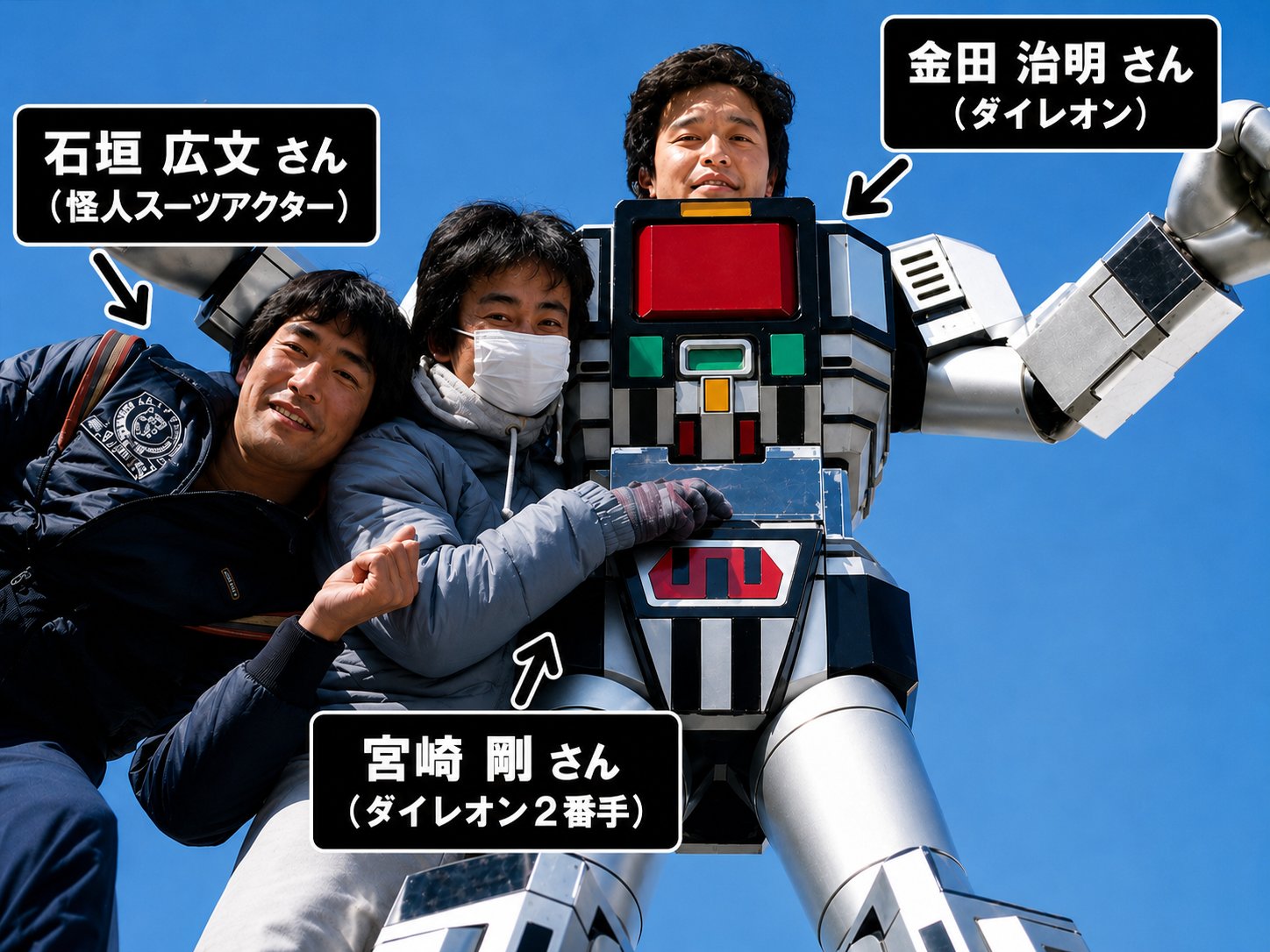
In 2012 Kaneda went back to Space Sheriff Gavan as a film director, with Yuma Ishigaki as Geki Jumonji and Kenji Ohba returning as Retsu Ichijoji. The reunion carried a delicate problem. Modernizing too aggressively would erase the original atmosphere, and copying the 1980s without any change would land as imitation. The modern metal armor held up to close-ups on almost any part of it, and it mirrored the camera, the lights and the crew through a full 360 degrees, so the answer was to shoot freely and paint most of the reflections out digitally. CGI made it possible to build Dol and stage impossible images, and Kaneda kept the whole film from turning into effects work: whenever it could be done, objects and bodies moved for real in front of the lens. The picture was conceived as a handoff, with Kaneda directing the successor to a hero whose language he had helped invent thirty years earlier.
Kamen Rider 1: closing the circle without ending the story
Four years later the career closed another circle: Hiroshi Fujioka returned to the role of Takeshi Hongo, and Kaneda was handed the direction of Kamen Rider 1. The project went past a reproduction of 1971 television, because Fujioka's body, the heavier design of the Rider and forty-five years of history had to add up to a contemporary Hongo. The meeting between the veteran and Takeru, from Kamen Rider Ghost, stayed clear of a manufactured quarrel between generations, and Kaneda read the relationship as instant recognition. On the message he wanted the film to carry, he says:
Saying that we should value life sounds simple, almost obvious. It is also where a human being starts. A simple word can reach children and adults alike. Anyone can speak in a complicated way; what matters is getting it across so people understand.
Osamu KanedaWhen Fujioka stepped out in front of the flames, Kaneda was directing the rebirth of a character and, in the same shot, the image that connects the anonymous kid from the JAC to the man now responsible for a whole tradition.
What action director really means
It is tempting to sum up Osamu Kaneda by volume: the first Kamen Rider, Robot Keiji, Condorman, the Space Sheriff trilogy, Kamen Rider BLACK, the Den-O films, the crossovers that gathered hundreds of heroes, the return of Gavan and Kamen Rider 1. The filmography is impressive and accounts for only part of why he matters. The legacy is in the way he joined positions the industry kept apart: the body inside the costume and the man arranging the bodies, the anonymous worker and the director, Chiba's student and the president charged with training the next professionals. The same line runs from the craftsman lighting a fluorescent sword through hidden wires to the filmmaker using digital tools to erase a crew reflected in a suit of armor.
The sequence describes someone who turned every failure into a professional question: how to make a movement reach the camera, how to use everyone who was called in, how to protect the person doing the jump, how to distinguish a character under an immobile mask, how to honor the past without shooting a copy of it. At the center of the answers sits the same conviction: action is drama, the blow reveals character, the fall has a reason, the pose holds the memory of the hero, and the costume does not erase the actor.
"Kaneda got into the business because he wanted money, and he stayed because he found something worth more than the original promise: a body in motion tells a story. He spent his life making the industry, the camera and the audience see who was telling it."
Kyoudai ExpressThe quotes gathered here come from Osamu Kaneda's conversation with Shocker Ono on the radio show Welcome to Shocker Ono's Secret Base, episode 61, recorded on October 27, 2012. Across fifteen segments, Kaneda covers joining the JAC for the money, his childhood in Itoigawa, the Robot Keiji suit that caught fire, Condorman and the turn toward action directing, the fluorescent tube inside the Laser Blade, the 485 heroes of Super Hero Taisen, Takarazuka, Bunta Sugawara and his return to Gavan as a film director.
2012 archive · episode 61, October 27 · about 53 minutes out of a 102-minute edit
Read the full interview →Read next
Kazuo Niibori, Mr. Red: the suit actor behind fourteen red heroesHirofumi Ishigaki, the man who has been inside everythingSpace Sheriff Gavan: our entry on the series Kaneda helped invent (in Portuguese)Robot Keiji: our entry on the suit that cost Kaneda six kilos (in Portuguese)Janperson: our entry on the series where Kaneda made his directing debut (in Portuguese)Shirakura on how Toei built Gavan and the Metal HeroesEvery profile and interview in the Suit Actors section (in Portuguese)Osamu Kaneda 金田治 (b. 1949). Profile written from interviews given by the actor himself, among them the one on the radio show Shocker Ono no Himitsu Kichi e Yokoso!! (ep. 61, 2012), and from his filmography as a suit actor, action director, director and president of Japan Action Enterprise.