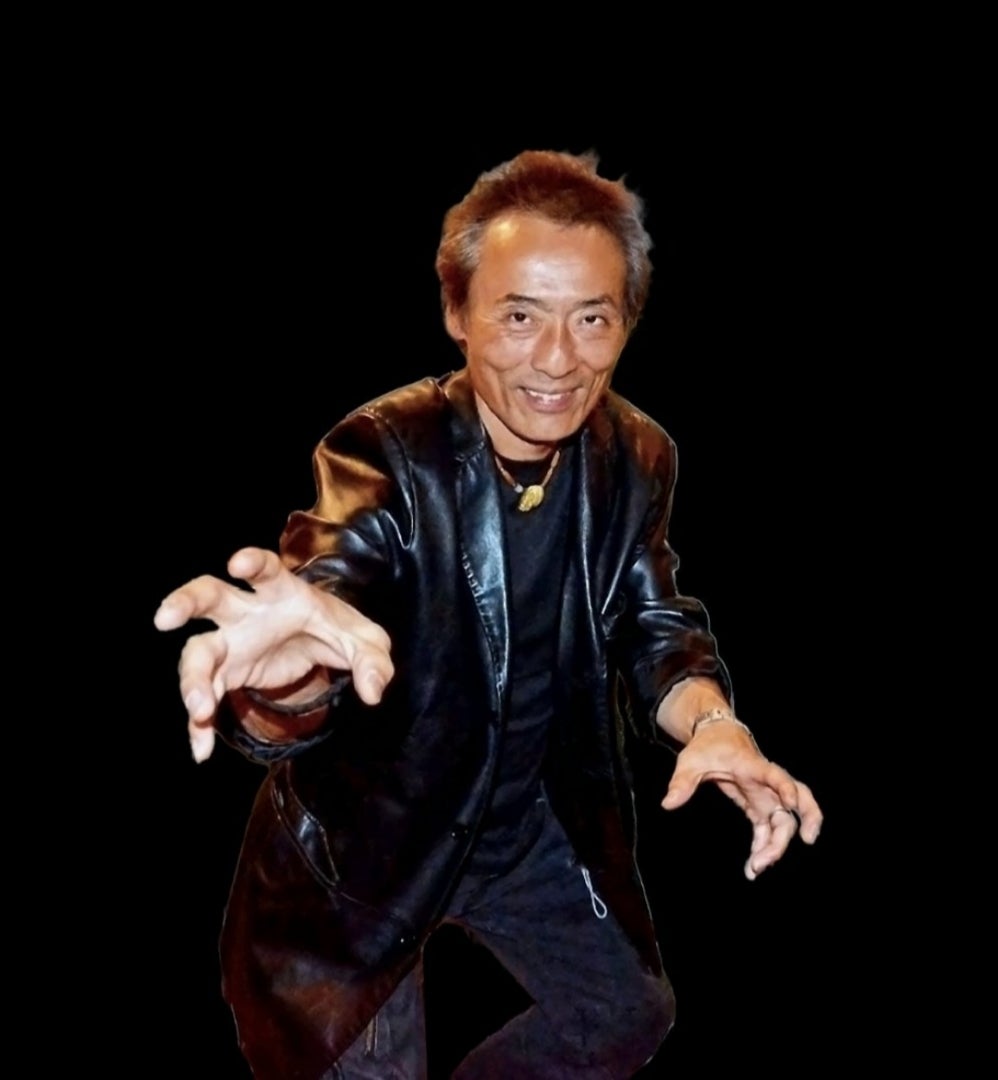
On the Monday of the worst cold snap Tokyo had seen in forty-eight years, in February 2018, a sixty-year-old man was due on a set in Takadanobaba at two in the afternoon. He thought about driving until his wife, who knows the trade from the inside, warned him it would turn into a blizzard, so he took the train. Work finished at seven that night, the Yamanote Line barely moving and Shibuya impassable, and a one-hour trip took three and a half. Days later, on a radio show, he told the story with no heroism in it: when snow cancels a shoot there is some relief, and the trouble is the day nobody cancels and you go anyway.
The man packed into that train was the Godzilla, the performer inside the suit for five of the six films of the Millennium era, from 1999 to 2004, the last stretch in which the most famous monster in movies had a pulse, sweat and a human being under the rubber. The scene says everything about the place Japan set aside for Tsutomu Kitagawa, now sixty-eight: the most important body in his generation of Japanese pop culture rides home standing up, holding a strap, recognized by nobody.
Recognizing him is the test that matters, because there is no ready standard for judging the work of an actor whose face almost never reached the screen. The job even has its own name in Japan, suit actor, the performer who wears the costume and lends the character a body. The verdict came from the least suspect jury available. When Toei gathered hundreds of its heroes for an anniversary film shot in the cold of Mount Iwafune, Kitagawa's son saw a promotional image on television, pointed at one masked figure in the crowd and said: that's you. It was.
The boy knew his father had played NinjaBlack twenty years earlier, but he knew nothing about that shoot, and he picked him out by silhouette and by the way he moved, the way anyone recognizes a handwriting. Authorship in tokusatsu, the Japanese tradition of masked heroes and rubber-suit monsters, comes down to that: whatever survives the mask. By the most demanding standard there is, a child's eye, Kitagawa is an author, and what follows is a review of his work.
The sandpit
It starts in a sandpit in Kudamatsu, the industrial town in Yamaguchi Prefecture where Kitagawa was born in 1957. His school had no gymnastics club, so the boy who wanted to be Ultraman signed up for track and field to get at the long jump, or rather at the sand you land in, and there he taught himself somersaults and pulled classmates and older students into a use of the equipment that Japanese physical education had never planned for. The spark came from television, from the Four Leaves, the idol group whose stage tumbling showed a generation of Japanese boys that a body could be a spectacle.
In high school, pushed by his father toward a school strong in gymnastics, he met the other side of the enchantment: six pieces of apparatus, dozens of freshmen cut down to two in a single week, a lunch of udon followed by sleep through the afternoon classes, and the banana, egg and beef shake his mother put through the blender. Six months in, he looked in the mirror and did not recognize his own torso, the first of many times in this career when the body changes before the person catches up.
The Olympic dream died over money, on a line from a teacher that sounds brutal today: gymnastics does not pay. Six universities wanted him, and it was then that he did a different sum, the one a boy does when he would rather not weigh on his parents, and decided to turn acrobatics into a salary.
Fate took the shape of a photograph. His coach, who had been at physical education college with Sonny Chiba, showed the boy a sheet listing the action clubs working in Japan. Kitagawa picked the Japan Action Club because he remembered a magazine picture, probably from Boken O, tied to the hero Barom-1, with the words "Action Club" printed on it. He admits how contingent that was: had he seen a childhood photo of the tall Toho actors who played Ultraman, he might have tried the other road, so a printed image decided which side of tokusatsu history that body would land on.
The school of falling
The welcome at the JAC, in January 1975, was grudging, because only Chiba knew he was coming and everyone else sized him up as if to ask who on earth he was. Then came the verdict that would organize the next two decades, delivered to an eighteen-year-old: the JAC does not do Ultraman, and a short guy like you will never be the lead.
The account he gives of those training years works as a documentary of the bottom of the Japanese entertainment pyramid. In falling practice the newcomers jumped from three meters, and Kitagawa, a prize-winning gymnast, would walk around the line and rejoin it at the back, hoping the drill would end before his turn came. The shy boy could not get his voice out during exercises and found it easier to shout "die!", because the insult comes out with the energy of the blow, and today he teaches embarrassed beginners and understands every one of them.
He spent a full year training every night without a single job, until he learned that the trick was to be first to lean into the window of the coordinator's car. On his first big location shoot, climbing the mountain with the crash mats on his back, a senior man dropped a prop weapon down the slope, looked at him and said nothing. Kitagawa went down to fetch it, and the teaching of the house fit into one sentence:
"If it hurts, learn to fall in a way that does not hurt."
The JAC method, 1975What does a school like that teach besides falling? Kitagawa's answer, spread across forty years of interviews, amounts to an ethic. He talks about risk like an engineer: a man who has safely jumped from fifty meters can take thirty, a man who has only tested twenty has no business trying thirty, and nothing gets done on the grounds that there has never been an accident before. He treats refusing a stunt as an act of professional courage, and he speaks from experience.
On Kon Ichikawa's Phoenix, released in 1978, the agreement was that he would pass through a burning tree, and on the day they told him to stay inside it, wrapped in wet cotton, while the prop melted around him. On another production, a staged subway suicide, he set his own body alight and the man on the extinguisher froze, taking the shouts of "put it out, put it out" for acting.
There is also his own theorem about height: up to about twenty-five meters somebody may always order the stuntman to jump, while at fifty everybody knows nobody will, which makes the high edge psychologically easier than the middle one. That logic is why the five Maskmen posed on the lip of a Shinjuku high-rise with no railing and a helicopter beating wind at them, and he did not find the shot frightening, because no jump was planned. If the wind pushed, a step backward was enough.
The best second man in the format
The 1980s made him the best second man in the format. For two years he stood in for Kenji Oba's Denzi Blue and learned from a master who corrected even the position of the fingers in a pose, and Oba put the challenge like this:
"Nobody can imitate me. Surpass me, and the moment you do, I will surpass you again."
Kenji Oba, the masterKitagawa doubled for heroines in the dangerous scenes, among them Miss America in Battle Fever J, a part he shared with a young suit actress named Eiko Onodera, whom he married in 1985, a couple who met inside the same costume.
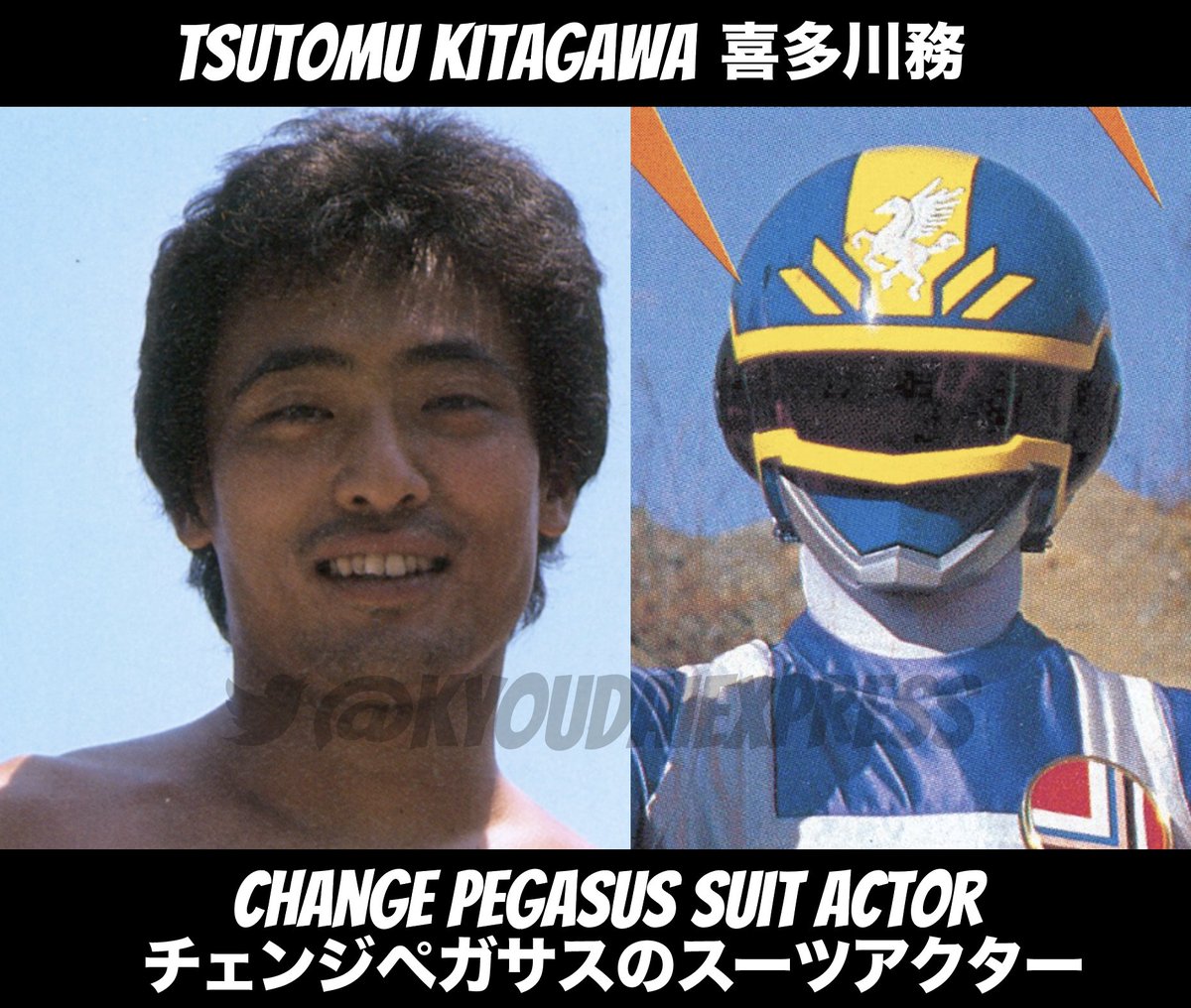
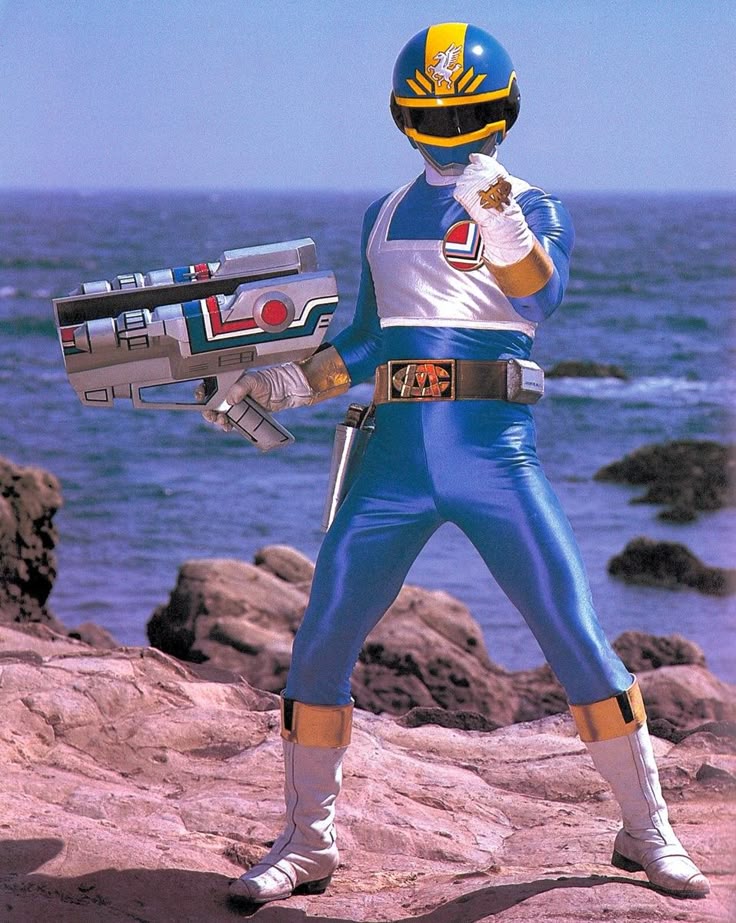
Then came the parts that were his alone: Blue Three in Bioman, a name Japanese speakers pronounce as "Bruce Lee", Change Pegasus in Changeman, Bun in Flashman, Akira in Maskman, and later the Chinese ninja in Jiraiya, the green ShishiRanger in Dairanger, which he considers the role that let him express the most, and NinjaBlack in Kakuranger, whose fights crossed the Pacific inside the third season of Mighty Morphin Power Rangers. Red belonged to another caste, and Kitagawa held the specialist's post, the man who does what the lead does not.
One detail from Bioman shows how he treated that post: with two broken fingers pointing the wrong way, he taped them together, pulled the glove on over them and finished the fight. The explanation he gave decades later is about the fear of being replaced:
"Blue Three was my role, and I wanted to be the one performing his action as well."
Kitagawa, on fighting with two broken fingersThat is the suit actor's terror: the character is yours for as long as the body holds up.
The noodle man
The turn of his career came from an instant noodle commercial. In the House Foods spot for Wang Fu Mian, starring the singer Fei Fei Ouyang, Kitagawa played a Bruce Lee style Kung Fu Man who took a fall out of cartoon physics, the body toppling stiff and straight, the legs hanging in the air for an instant. It was the accidental summary of everything he knew: a gymnast's precision, a comedian's timing, real kung fu put to work on something ridiculous. Buster Keaton would have understood it at once.
The man who did understand it was Shinichi Wakasa, the sculptor behind Toho's kaiju, the giant monsters Japanese cinema builds out of foam and latex. Wakasa kept that image in his head for years, and when the effects director Kenji Suzuki needed a young Cretaceous King Ghidorah that could run, he went looking for the noodle man's phone number. The traditional Ghidorah weighed around two hundred kilos and depended on wires, and Kitagawa took the job on Mothra 3 for the plainest reason in his repertoire: this was King Ghidorah, and it would be a memory for life.
The following year the phone rang again: may we ask for your help once more? Of course, which character is it? Godzilla.
He says he was stunned, that he thought "is this really something I can do?", and that he asked for time before answering, the only hesitation on record in half a century of work, a hesitation that does the character credit. Godzilla, he explains, is a symbol of Japan, and nobody puts on a symbol of Japan without asking for a few days.
Seventy kilos and five shots a day
What he did with that symbol between 1999 and 2004 is the part of the work that time has treated best. The apprenticeship was humiliating in the terms he chose himself: the Godzilla 2000 suit weighed around seventy kilos, walking ten meters wore him out, twenty years of stunt technique "were of absolutely no use", and he only found the right way to walk three days before the shoot ended. A day of Super Sentai produced a hundred shots, and a day of Godzilla produced five. He lost three to five kilos in sweat per shift and arrived at a theory of performance: watch wild animals, where the head moves first and the body follows.
Kitagawa's Godzilla attacks because he is attacked, and from the second film, Godzilla vs. Megaguirus, he decided to do it his own way and let the speed off the leash. He wanted to drop onto all fours like a real animal and was told by the effects director that it was too much. He paid the prices of the trade, the worst of them included: in a water tank scene the oxygen tube came loose while the crane lowered him, he shouted that he could not breathe, and they kept pushing him under. His summary of that day was that he never wanted to do it again.
The era ended with Godzilla: Final Wars, the testament film of 2004, built around the first suit in franchise history made to the actor's measurements, fed by data he prepared "like a Formula 1 driver", with Kitagawa credited as action consultant as well. Japan split over it. Director Ryuhei Kitamura himself estimates that sixty to seventy percent of the audience hated that fighting Godzilla. Twenty years, a 4K reissue and a reappraisal later, an anonymous Japanese viewer left on Eiga.com the review that closes the biography of the man inside: it plays like a Bruce Lee movie in Godzilla form.
The verdict of the digital age
Here is the verdict the digital age hands down: Kitagawa's Godzilla traded liturgical weight for the readiness of an organism, and that trade carries a real cost. Anyone who misses the leaden step is missing something that was genuinely there, and the welcome given to Mansai Nomura's solemn Godzilla in Shin Godzilla showed how many people miss it. Reducing the Millennium era to lightness gets the author wrong, because it was Kitagawa who opened Godzilla vs. Megaguirus by recreating the 1954 walk gesture by gesture. It was Kitagawa who wore the original Godzilla in the prologue of Godzilla Against Mechagodzilla in 2002. Nobody has altered the tradition while knowing so precisely what he was altering.
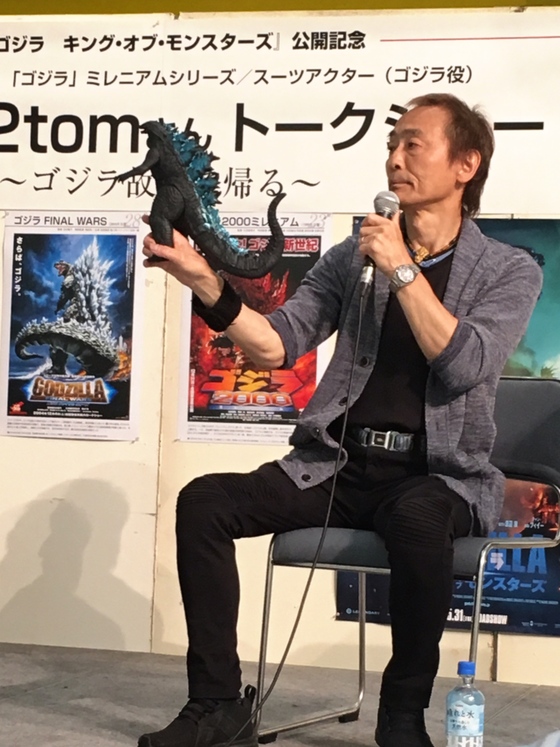
History has proved him right in the most ironic way available: today's digital Godzillas do, with no limit on how they bend, the physical cinema he was proposing with seventy kilos on his back. At an event in Tokyo in 2024 he took up the subject and added an old master's challenge:
"When I see the CG Godzilla, he performs the way I wanted to perform, and that makes me very happy. But now that he can move like that, let them go beyond the image we have had until today."
Kitagawa, at an event in Tokyo, 2024The wrong name
There remains the matter of the name, almost a fable about this profession. For decades television credits wrote the kanji for Tsutomu wrong, and he describes what that was: a professional shock, seeing his own name swapped out on screen. He thought about taking a pen name during the Godzilla years and was told no, on the argument that the man playing a symbol of Japan should carry a Japanese name. The pun he signs today, 喜多川2tom, "two Toms", was suggested by his colleague Kazutoshi Yokoyama and also serves American fans, who can pronounce Tom. Half the western internet, meanwhile, still writes 北川勤, a name that is not his.
The man whose body a son can pick out at a distance, in a crowd of masked heroes, is the same man whose name the world has never got right.
The body has already told the essential part
He is still working, the last of the three great suit Godzillas still on his feet, taking small on-camera parts in a Sunday morning series and turning up at events with the electric guitar he bought for ten thousand yen and learned to play after fifty-five, in dressing rooms between takes. On stage he reads no sheet music, memorizes the songs, more than fifty of them, and finds his positions by the markers on the neck of the instrument. It is the method he has always used: when reading is impossible, the body memorizes. Signing off from the 2018 interview, he left a warning:
"I still have plenty of stories I never got to tell."
Kitagawa, signing off from the 2018 interviewLet him tell all of them, because the essential part needs no worrying over. The body has already told it.
The quotations here come from the conversation Tsutomu Kitagawa had with Shocker Ono on the radio show Welcome to Shocker Ono's Secret Base!!, in February 2018. He reached the studio days after the heaviest snow Tokyo had seen in forty-eight years and told the whole career: the sandpit in Kudamatsu, the falling drills at the JAC, the Kung Fu Man of the noodle commercial and the call from Toho he needed time to think about before accepting.
2018 archive · about 1h21 of radio · translated and adapted by Kyoudai Express
Read the full interview →Read next
Kazuo Niibori, Mr. Red: the man who taught red how to moveHirofumi Ishigaki: from Yamagata to Power Rangers, the man who was inside everythingChoudenshi Bioman: our entry on the series that gave him Blue Three (in Portuguese)Dengeki Sentai Changeman: our entry on the series of Change Pegasus (in Portuguese)Gosei Sentai Dairanger: our entry on the series of ShishiRanger (in Portuguese)Michiko Makino and Sumiko Tanaka remember the Bioman set (in Portuguese)Every profile and interview in the Suit Actors sectionTsutomu Kitagawa 喜多川務 (b. 1957). Profile written from interviews and statements by the actor himself about his career as a gymnast, stuntman, Super Sentai suit actor and the Godzilla of the Millennium era.