"I Could Never Leave
This Line of Work"
The suit actor behind fourteen reds sits down at the microphone and tells, in his own way, a whole life spent inside the mask: Ibaraki, the terror of a single line of dialogue, the "Daitetsujin diet" and the phone call that pulled him out of a restaurant kitchen.
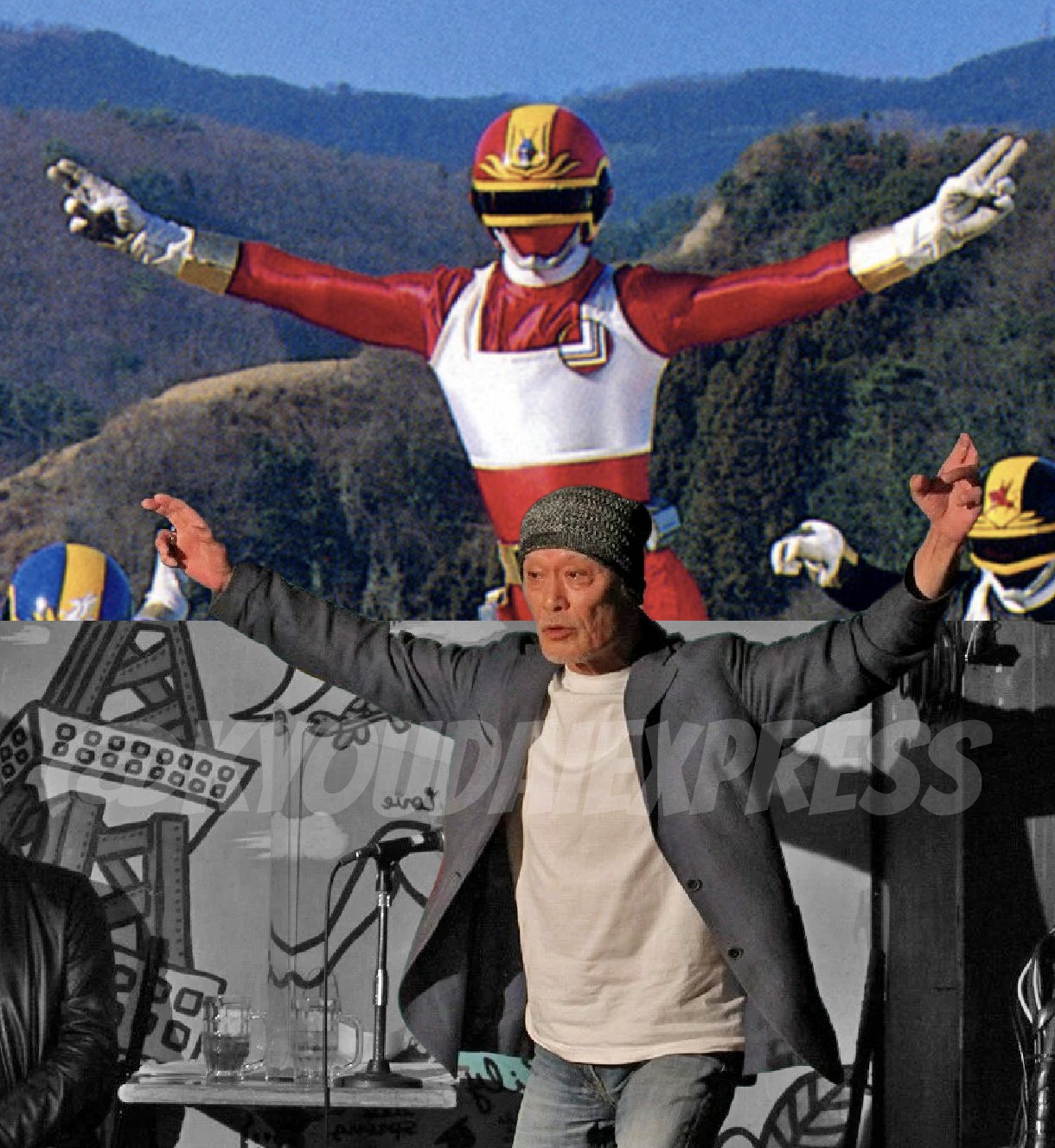
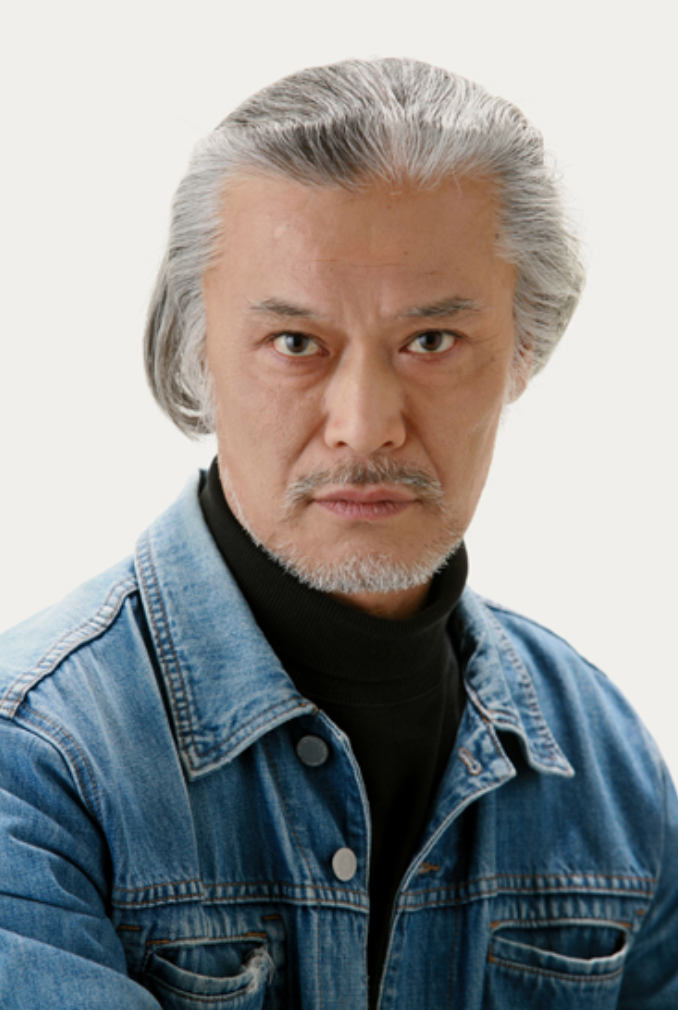
"Mr. Red" gave his body to fourteen red heroes, from Aka Ranger (1975) to Red Hawk (1991). "As a rule, professionals like today's guest do not turn up on the radio," Shocker Ono warned at the top of the show. "They tend to be men who would rather act than talk." What follows is the conversation he insisted on turning into "radio you can see".
You were born in Ibaraki. What were you like as a boy?
Looking back, I think I was a handful. My family says I lived covered in dirt, running around and getting into fights. Mostly we played chanbara, those sword duels. I would round up the neighborhood kids and always wanted to be the one landing the blows. I did not enjoy playing the one who loses. The other parents would sometimes come to complain: "Kazuo hit me."
Out in the countryside few houses had a television, so we would go to somebody else's home to watch period films and Rikidozan's wrestling matches. Everyone gathered at the house of whoever had the money for a set. And I had enough sense not to fight with the son of that house, or I would lose my seat. Becoming an actor? It never crossed my mind. I stayed a handful for years, until I left the countryside for Tokyo.
And it was in Tokyo that the movies turned up.
I took a job at a car repair shop practically next door to Mifune Productions. I helped out until around five in the afternoon and, since the studio shot at night, I would stand there watching. At first I could not work out how any of it fit together. I would see a man gallop up, stop the horse and dismount, and then, once the camera moved in closer, that man had turned into Mifune. The two of them wore identical clothes. That was how I understood that another professional handled the dangerous work, the riding, the trampoline, the falls, and the famous actor took over from the closer shot.
"The first time a big fight scene happened right in front of me, I thought: that is what I want to do."
Niibori, on the men who doubled for Toshiro Mifune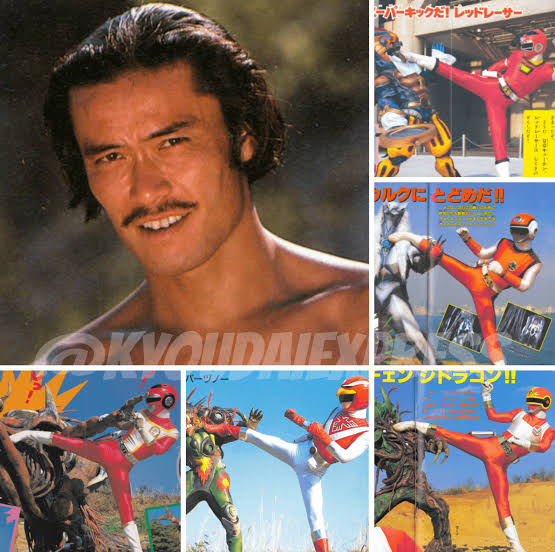
You answered an ad for a school connected to Nippon Television, and there you met your teacher, Kotaro Ono. What were the early days at the dojo like?
I studied dramatic reading, acting, mime and stage combat. It was in one of those classes that Ono himself invited me to train at his gym. When I joined, there were twenty or thirty senior members ahead of me. In an organization that hierarchical, chances were hard to come by. So I trained every day: with the seniors who were free during the day, and at night with the ones coming back from shoots. Two sessions a day. I had nowhere to live, but there was an empty dormitory tied to Ono where I could sleep. That was luck, and at least I was not out on the street.
Like every newcomer, I started as an enemy soldier, one of the combatants in Kamen Rider, in those masks with the long necks. On television I began as a Shocker soldier, then I was one of the six fake Riders. In a photo of the six of them lined up you can spot one with a particularly long neck. That is probably me. I also filled gaps: I shot isolated Kamen Rider V3 cuts when Nakayashiki was not available, appeared as Riderman, played Tsukinowa in Henshin Ninja Arashi. Nobody was handing me a whole series yet.
In a double bill of Kamen Rider and Gekko Kamen at the old Korakuen stadium, Niibori would appear as Rider at the highest point, disappear so Nakayashiki could come up on the lower stage, then run to change costume and star in Gekko Kamen. Around five shows a day, with the line wrapping two or three times around the stadium.
At the end of Gekko Kamen I would climb a platform with a character in my arms. People started saying I had a good presence from behind.
A listener remembers the open-air theater at Korakuen, and the first hero he ever saw there: Red Tiger.
I played Red Tiger too. He had a two-stage transformation, starting out white and then turning red. I played the white form, alongside Nakayashiki, with the lower half of my face exposed, almost like Riderman. At Korakuen, Red Tiger came in standing on top of a moving roller coaster. I was the first to do that. It was dangerous, because if you were thrown clear the accident would be a serious one. We filmed the shows on 8 mm to study every position afterward.
There was one job that was especially rough: standing in for Nakayashiki on Kamen Rider Stronger, out in the countryside.
Before we even reached the hotel, they decided to shoot a cut near a bridge. I had come along only as a stand-in and suddenly I had to deliver the introduction, "The sky calls, the earth calls, the people call...", along with the action, in a period-drama style. I spent the entire morning getting it wrong. The men playing the enemies, veterans themselves, lost patience: "Again? Sort it out, Kazuo!" I kept thinking, "I never asked to do this, I only came because there was nobody else." I ended up working with tears in my eyes, and I seriously wondered whether the job was for me.
That is hard to picture. We only know the experienced Niibori, the one who looks like he is saying "leave it to me".
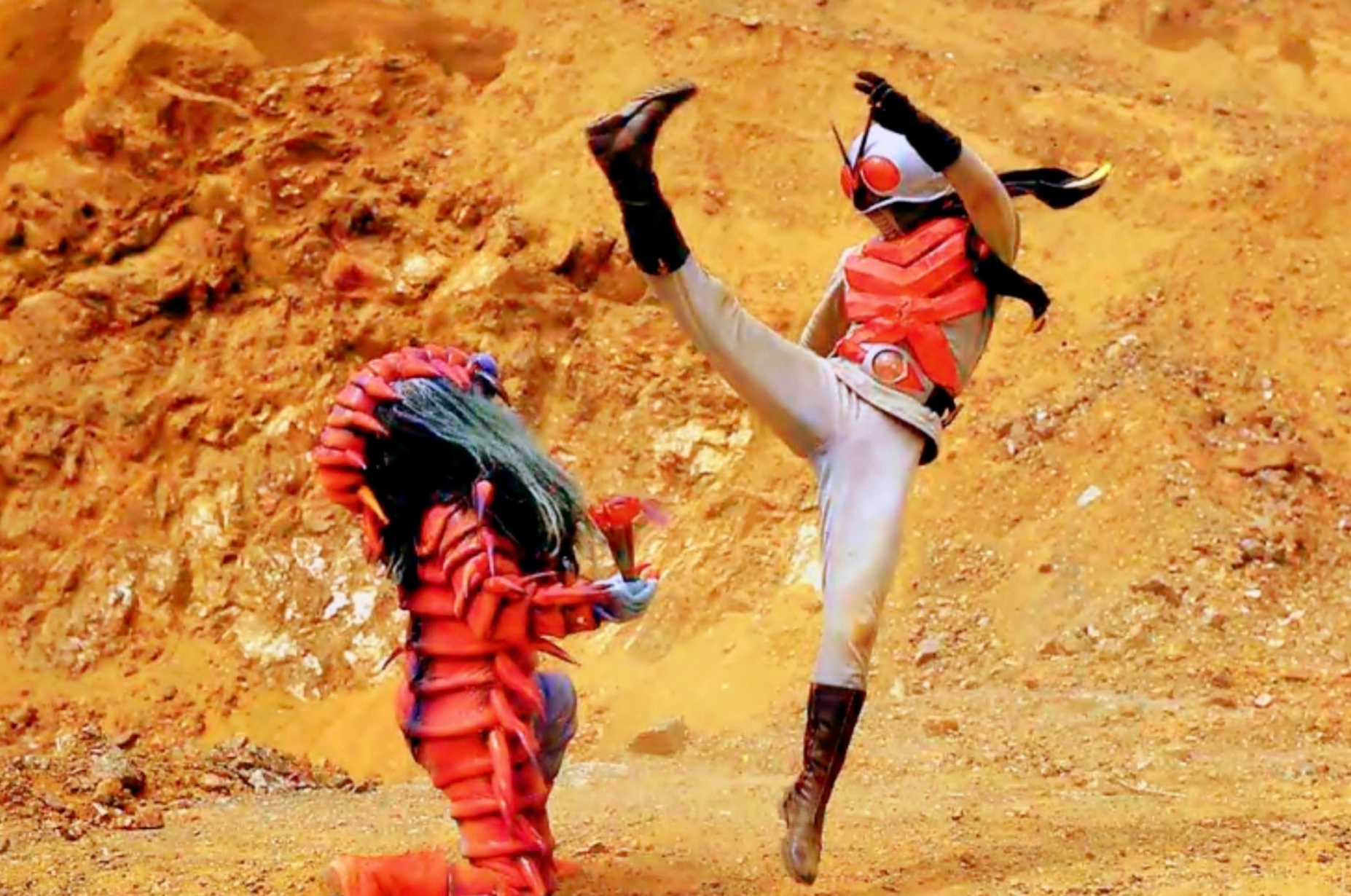
Right after that came Amazon, completely different from Ken'yukai action. There was almost no punching or kicking. The character bit, clawed, grabbed and fought with his center of gravity very low. At first I wanted to do the traditional Rider action, but that wild behavior had no precedent. I spent whole days crouched, legs under tension, and my thighs would harden and my back would ache. Because I kept my chin tucked in, it was not only the shoulder that hurt, it was my whole neck.
On Gorenger you were handed the central role, Aka Ranger. Did you see it coming?
I assumed I would be a secondary character. I asked which color I would be doing and they said, "Red." I asked who the leader was. The answer was, "Red is the leader." I was stunned. Everyone around me was a veteran, men like Nakayashiki, Fumiya Nakamura and Maeda, and I was the youngest, and now I had to give them orders on camera.
In rehearsal I would point as the script said: "Blue, Green, move in!" The veterans would answer, "Why don't you go yourself?" I would get flustered, say yes and charge in alone. It was their way of joking me out of the embarrassment of commanding men with more experience. When the camera rolled for real, we played the scene properly.
After Gorenger came Daitetsujin 17, a giant robot. The armor was so rigid that I could not sit down normally, and the pieces scraped at the joints and cut into my armpits and even my ears. Sweat pooled inside. I used to joke that it was the "Daitetsujin diet", because on a shooting day I could lose around three kilos.
"I thought: if the suit breaks, they call it a day. In rehearsal I snapped the forehead antenna on purpose and pretended I had slipped."
Niibori, on the "sabotage" inside Daitetsujin 17, which got him sent home early that dayAfter 17 you actually left the profession. How did you come back as Battle Japan?
After 17 they had me doing nothing but Dada robots and enemy soldiers. Going back to that took the wind out of me, and I left the Ken'yukai. I went to work in the kitchen of a restaurant in Numabukuro. The plan was to learn for about five years and then open a place of my own. Within a month or so I was already handling the fryer, the grill and the fish. That was when Issho Takahashi started turning up at the restaurant. He would come in, eat and leave, without so much as a drink. He did that three or four times, until the owner told me to go and talk to him. He was putting together Battle Fever J and said that for the central role he could only think of me.
"He shot back: you spent all those years learning this trade. are you going to throw it away for a month in a kitchen?"
The phone call from Issho Takahashi that pulled Niibori out of the kitchenSomething competitive woke up in me, because I wanted to show Ken'yukai action in the middle of the JAC professionals. Big Action left Battle Fever J, JAC took over, and the producer asked me to stay. When it wrapped, they invited me onto Denziman, my second straight year in red, with Kenji Oba as Denzi Blue. I decided it was time to widen what I could do. The Ken'yukai rarely cast me for big falls, so I started learning on the set itself, from Kenji: trampoline, landings on the mat, high falls. I began doing far more of the risky work myself.
Near the end of Denziman they simply said, "Niibori, go and try on the next suit." It was Sun Vulcan. When Sun Vulcan was heading for its finale, the Goggle V suit was already waiting. And it went on like that, series after series.
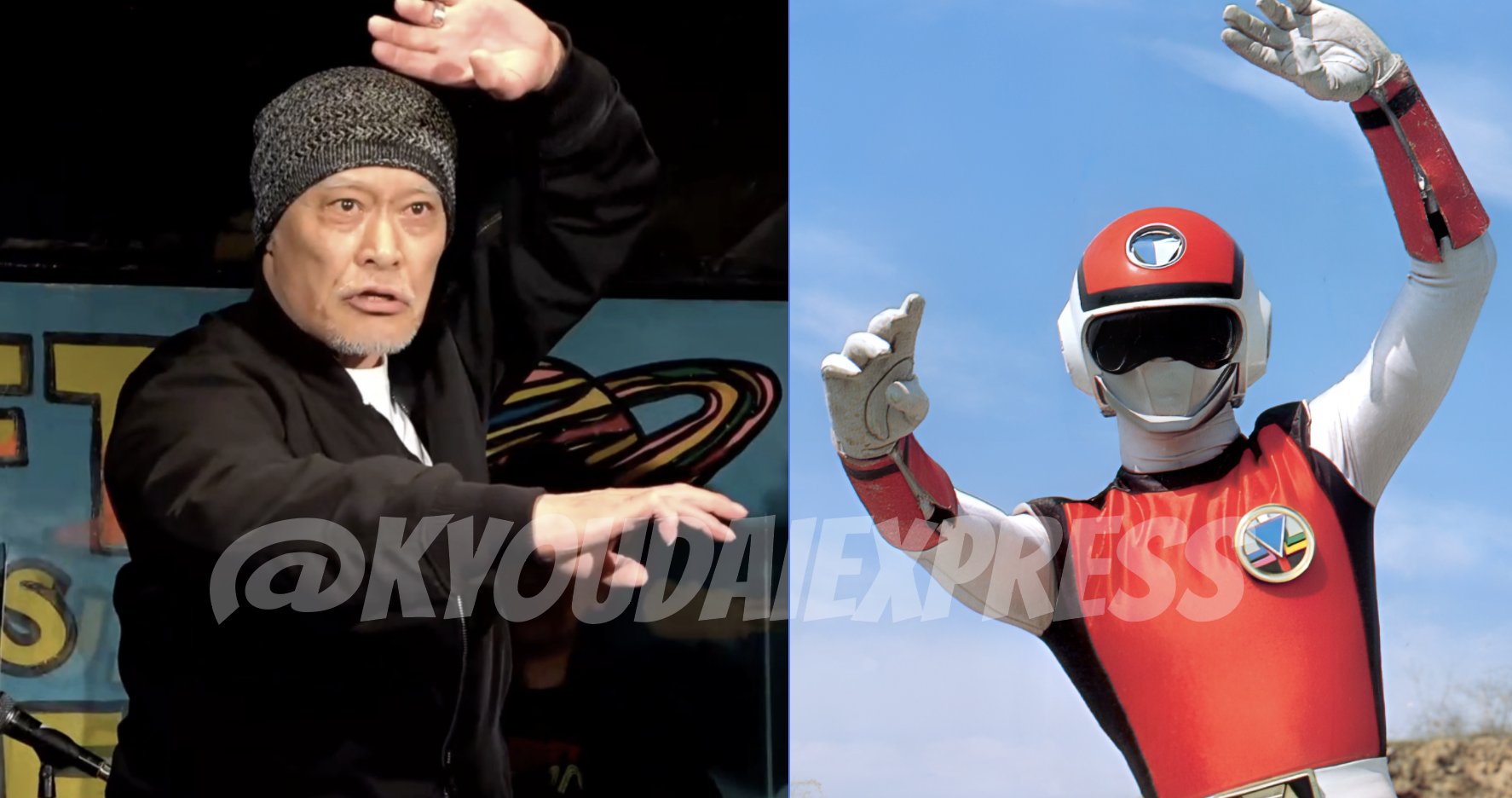
The first time I met you was on Denziman. I was a rookie at the M Project agency, called in as an enemy soldier for a shoot in a cave, somewhere around episode 41. That morning I saw you at Oizumi-Gakuen station and thought, "That's Niibori!" To us, you people were almost mythical figures.
At a show in Tama Center the crowd was so big that one performance had to be stopped. They announced the real men inside the suits, and you came out as Denzi Red wearing a cap, your face showing, something unthinkable today. At the end I did the team introduction standing beside you, "Denshi Sentai Denziman!", and I cried inside the mask because I was posing next to you. When I had to give up shooting for family reasons, you invited me for a drink in Oizumi-Gakuen, poured my beer and said, "Don't lose heart, do your best as a working man." I never forgot it.
I thought I had walked away for good myself when I went to work at that restaurant, but I could never leave this line of work. I cannot explain why. It is fun.
People talk a great deal about how beautiful your run was as the red hero.
Letters came in asking them to show more of Niibori running. Sometimes the script had the hero arrive by motorcycle and the crew would change it: "Today Niibori comes in running." I would ask whether the bike had broken down, and they would say the audience liked my run. On Maskman, at a racing circuit, they shot at high speed to play it back in slow motion, so instead of a vehicle appearing on the horizon, first my head came up, then my neck, then my whole body running down the track. It looked good on screen. After two days of running like that, I was ill.
You also worked outside the hero shows, on films like Toho's E.S.P.Y.
The criminals were part JAC, part Ken'yukai, all of them with their faces showing, dressed in black. When I came running in dramatically, the whole set started laughing. To this day I do not know why. I was supposed to look like a man under the villain's control. I hid at the back trying to work it out: "Why did they laugh at me, of all people?"
And on your days off, what do you do?
Nothing very special. I watch a lot of video, mostly old samurai and swordplay films. For me that counts as study. Modern action does not have to erase what came before it, and I think about mixing the old and the new. I go out drinking when friends call. In fact I drink almost every day, though I know I should not.
In the last episode of Jetman, at the wedding of Red Hawk and White Swan, you appear without the mask as the priest, your farewell as a red.
In that episode several of the suit professionals got face appearances, and Black Condor's double played the man who stabs Gai. When they gave me the priest, I said I could not do it. There were a lot of lines and I had never played a clergyman. The director answered, "I'm going to be on camera too, so you can't say no." The problem was that the wedding guests were almost all crew. Every time I started, they would snicker. My heart raced, I did take after take and my legs shook. I had done all those dangerous scenes without a tremor, and there I was, terrified of a few lines.
You also did comic roles with your face showing, like Dracula and Hattori Hanzo.
Dracula was fun. Every summer somebody would turn up saying, "Niibori, a job came in for you," and hold up the vampire teeth. I played him several times.
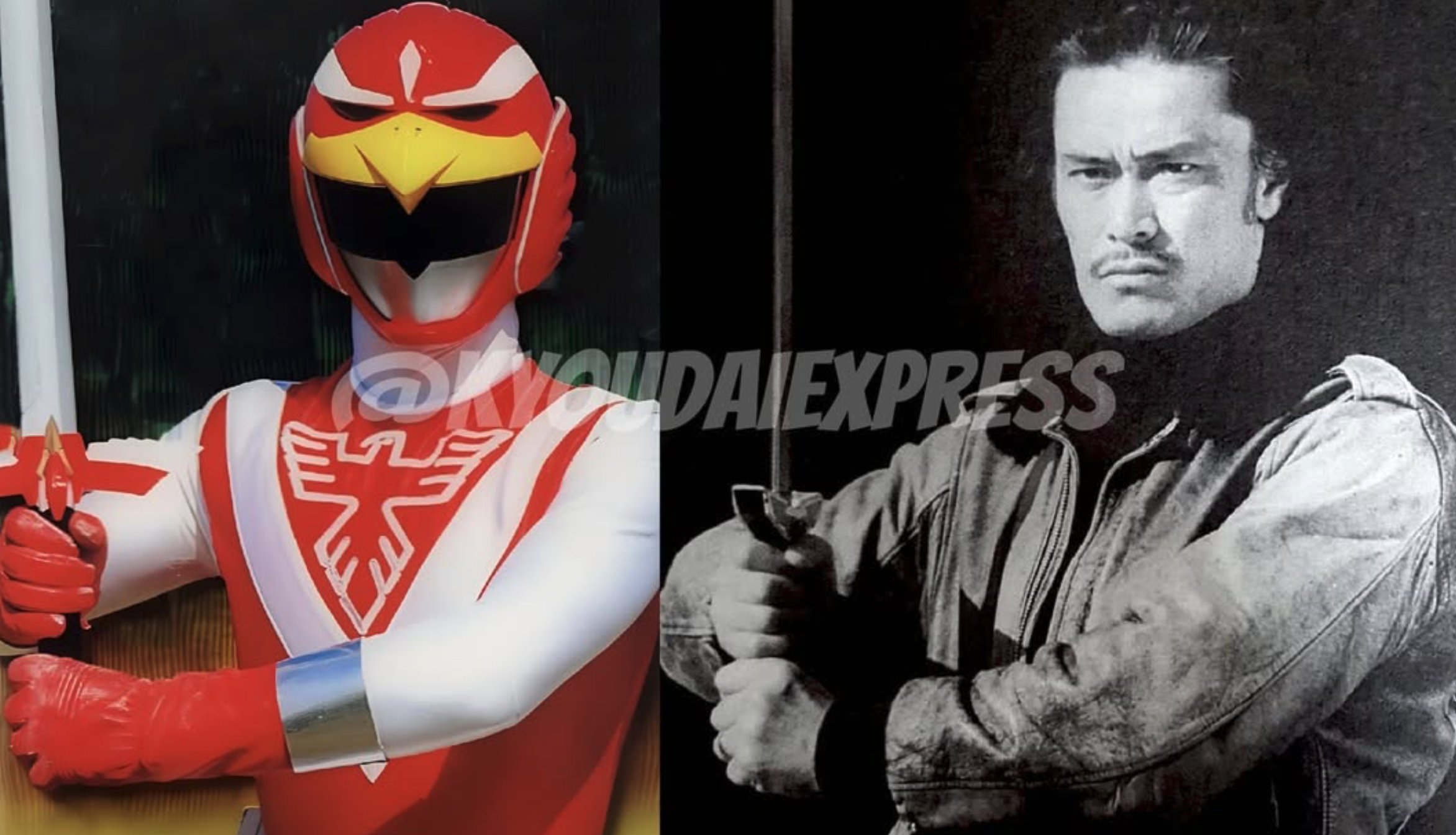
A listener writes that Red Falcon, from Liveman, was his first hero. Hospitalized at four with a serious illness, he found courage in the weekly broadcast, and he considers Red Falcon a hero who helped save his life. He thanks you.
Is he well now? What a relief. On Liveman, Daisuke Shima was already a successful singer and actor. I watched him and thought, "I am not going to be outdone by this young man." I put the suit on ready to match his energy. It was a series I worked on with a lot of resolve.
Later you created the Red Action Club and Red Entertainment Deliver, and started training the next generation, with students like Hirofumi Fukuzawa, who went on to play Go-on Red.
What matters is that they get a chance to show what the training produced. At the time we were preparing the third graduation performance, a play called "Fukushu o Koete". And now and then I still put a suit on. I played Kamen Rider Arc in the Kiva film, a Rider about four meters tall, at a size strangely close to human, which is exactly what makes him frightening. I also came back as Red Falcon in a special for the 25th anniversary of Sentai.
You set the record by playing red in fourteen series. Nobody has passed you. Thank you for sharing your story.
I am the one who should be thanking you. I still have plenty of work ahead of me!
The conversation above is the main source for our career profile of Niibori: the fourteen reds, the hierarchy of the Ono Ken'yukai, the Daitetsujin 17 robot, the run that became a signature and the priest in Jetman, all laid out in order, with photographs and a timeline.
Profile · Suit Actors section · about 20 minutes
Read the profile →