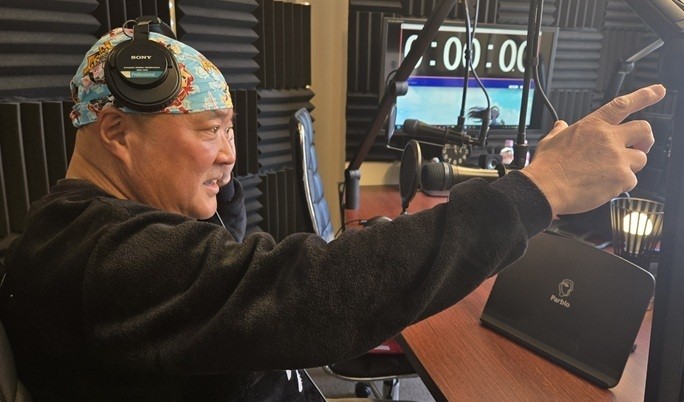
Forty-six years after his debut on a department store stage, Shocker Ohno talks to Kyoudai Express about Kazuo Niibori, Kenji Ohba, Shotaro Ishinomori, the birth of Aniki and the future of Super Sentai.
Hiroshi Oono was born and raised in Yokohama. He had no siblings and both his parents worked, so he sank into the world of television, a television kid in the fullest sense of the phrase. In that setting, the hero shows, nearly all of them with Shotaro Ishinomori's name in the opening credits, became the compass for an entire life. In 1980, still a student, he stepped into an enemy soldier suit for an Ultraman 80 stage show in Higashimatsuyama and, the same day, ended up holding the microphone as the boss of the villains. Through the M Project agency he worked Ohno Kenyukai and JAC sets, where he made his voice acting debut in the first episode of Kamen Rider Super-1, and served as a stuntman, soldier and monster on Denziman, Goggle-V, Dynaman, Bioman, Gavan and Sharivan. On the variety shows of the day, among them Oretachi Hyokinzoku, Hachiji Da Yo! Zenin Shugo and Ikinari Friday Night, he wore the suits of heroes such as Gekko Kamen, Kamen Rider, Kaiketsu Lion-Maru and The Return of Ultraman. He also worked on the special Birth of the 10th! Kamen Riders All Together!!, where Masaru Okada greeted him with a compliment on his fighting.
Oono spent years working at Shotaro Ishinomori's home as manager to the creator of Kamen Rider, and it was on the radio, alongside Akira Sakuma, that the nickname Shocker found an audience and then a godfather. From there the career branched out: publishing sales rep, broadcast writer, television and event producer, voice actor trained by Akira Kamiya, action choreographer, talent manager and author. His first book of essays, Rider Kick wa Itakatta (The Rider Kick Hurt), came out in 1988 and opened the way for the 1989 manga Nekketsu Hero Nikki, about the daily grind of hero shows. Cult Quest: Kamen Rider Hen, the Encyclopedia of Every Monster and Villain, the Super Hero Show Encyclopedia and a history of the Korakuen hero shows followed.
The microphone became the most visible part of that path. In the late 1980s he hosted the hero shows at the NS Building in Shinjuku under Kazuo Niibori's supervision, learned the craft by watching Hiro Narita at Korakuen, and in 1997 gave Ichiro Mizuki the nickname Aniki. In 1999 he proposed Super Hero Spirits, the first concert devoted entirely to tokusatsu songs, and he still hosts Super Sentai Spirits, which returns to Tokyo and Osaka in November 2026. With the manga headed for a crowdfunded Brazilian edition, the conversation below takes in Denzi Blue's fogged-up visor, a dawn of pork cutlet curry with Kenji Ohba, the photographs that rescued the encyclopedia and the night he had to speak about the end of Super Sentai in front of a hall full of fans.
01A television kid
When you were a child growing up in Yokohama, what did tokusatsu mean to you? After working in this world for 46 years, what has it come to mean?
Both of my parents worked, I was an only child, and back then there were no video games and no internet. So I inevitably became a "television kid". Among all the shows, the tokusatsu hero programs were a very important presence, one that gave me courage and hope.
In high school, in the middle of the anime boom that started with Uchu Senkan Yamato (Space Battleship Yamato), I fell for the rerun of Cyborg 009, and from there my passion exploded for Ishinomori's work, Kamen Rider above all, and for the tokusatsu shows I had watched as a child. I set off down the road of tokusatsu, which began in the world of action, and along the way I gained many friends and companions who took the place of the siblings I never had. Before I knew it, I had spent most of my life working in tokusatsu, to the point where people started calling me a legend.
02The debut in Higashimatsuyama
At your first Ultraman 80 stage show you were supposed to play an enemy soldier, but you suddenly ended up taking the microphone as the boss of the villains. How did you pull it off in front of hundreds of children?
It was at the Maruhiro department store in Higashimatsuyama, in Saitama Prefecture, near Yoshimi Hyakuana, a spot well known as a filming location.
During rehearsal, out of nowhere, the man playing the villain boss said: "Lately everything I say on stage is the same old routine. I'm sick of it. Got any new material?". I told him about a Ken Shimura gag I had seen another team use, and he threw it right back at me: "Then you do it!".
I had always loved hero shows, and that worked in my favor. I got through it on stage presence and improvisation. That was my debut.
03Denzi Blue's fogged-up visor
In January 1981 you played Denzi Blue at a stage show wearing a suit made for filming. For the person inside, what is the difference between a filming suit and a stage suit?
That was at the Tobu department store in Utsunomiya, in Tochigi Prefecture.
In Super Sentai, from Denshi Sentai Denziman (the 1980 series) onward, the filming masks normally have a clear visor. The stage masks have that part made of FRP, fiberglass-reinforced plastic, dotted with small air holes, so you can see well.
Under normal conditions the filming visor doesn't hurt your vision much either. The trouble is that once you put the mask on and start doing action, it fogs up completely and you can barely see a thing.
That's why, before a take, the younger JAC members would apply an anti-fog treatment. Since they usually used shampoo, they called it "men-shan", something like "mask shampoo".
That day, though, nobody expected a filming mask to show up. It fogged the moment I put it on, and I did the whole fight blind. I couldn't judge the distance, so my punches kept landing on the senior guys who were working the fight with me! [laughs]
In April of the following year, at a Taiyo Sentai Sun Vulcan (the 1981 Sentai) show during the Musashino Traffic Safety Festival, I played Vul Eagle. There was a scene where I fought on top of a small hut, jumped down to the ground and ran to the main stage doing action along the way.
Even with the anti-fog applied, the mask clouded over from the heat while I waited on the roof behind the hut. Once again I jumped without seeing anything. I couldn't tell when I was going to land, and I sprained my ankle.
04Who taught him to fall
At the stage shows of the 1980s you jumped from considerable heights onto cardboard boxes standing in for mats. How did you learn to fall? What did Kazuo Niibori teach you about it?
I learned a great deal from Niibori, starting with bearing and how to carry myself on set, and also acting, the sense of distance between bodies in a fight and how to work a stage show or an event. But the people who taught me action directly were the senior members of my own agency, M Project.
I learned fight choreography from Yoshitake Iwaizumi, who played Kamen Rider X in the final episode of Kamen Rider (the 1979 series, known as Skyrider), Skyrider himself in the Kamen Rider Super-1 movie (1981) and, among other roles, the Ultraman 80 of the scene where the hero turns himself into a lightning rod, in the Medan monster episode of Ultraman 80 (1980).
Stunt work I learned from Shinichi Yoshida, who played Kamen Rider Amazon both in the final episode of Skyrider and in the Super-1 movie. He also handled trampoline shots whenever Hiroshi Ueda of Ohno Kenyukai was busy.
05Kenyukai and JAC
During the same period you worked with both Kenyukai and JAC. How did each team go about its work? What did a newcomer notice was different between a Masaru Okada set and an Osamu Kaneda set?
Basically, the sets we worked on revolved around the fight choreographer or the action director, so the differences came down to each one's way of working and personal style. But I never felt anything like: "Whoa, this is completely different!".
One thing that made me very happy happened on the first day of shooting Birth of the 10th! Kamen Riders All Together!! (the 1984 TV special that introduced Kamen Rider ZX alongside the nine earlier Riders). Okada said to me: "Ohno, I hear you're good in a fight, huh? I'm counting on you today!".
As it turns out, Okada and the president of our agency, Masao Mizuta, had been close friends for many years. I think that's why he said it. I was so grateful!!
With Kaneda I worked on Uchu Keiji Gavan and Uchu Keiji Sharivan. Like Okada, he cast a stuntman who had come in from another agency exactly as he cast his own JAC members. A quarter of a century later, director Kaneda came to me himself: "I want to shoot a comic scene with the foot soldiers, so get in there, Ohno!", for the film Super Hero Taisen Z (2013).
Last January I asked the two of them, Okada and Kaneda, for their first joint appearance in the history of the business, at the Shocker Tours presents Legend Suit Actor Special Talk Show. Everyone around us was tense, wondering how it would go. On Kamen Rider, which was Kenyukai's job, the trampoline work was done by Kaneda, Junichi Haruta and other members of the newly formed JAC. Okada paid tribute: "Kin-chan and his guys did the trampoline for us!", and Kaneda answered: "no, no, it was because you were all there spotting us that I could jump without worrying!". It moved me to see how solid their friendship had been all the way back then.
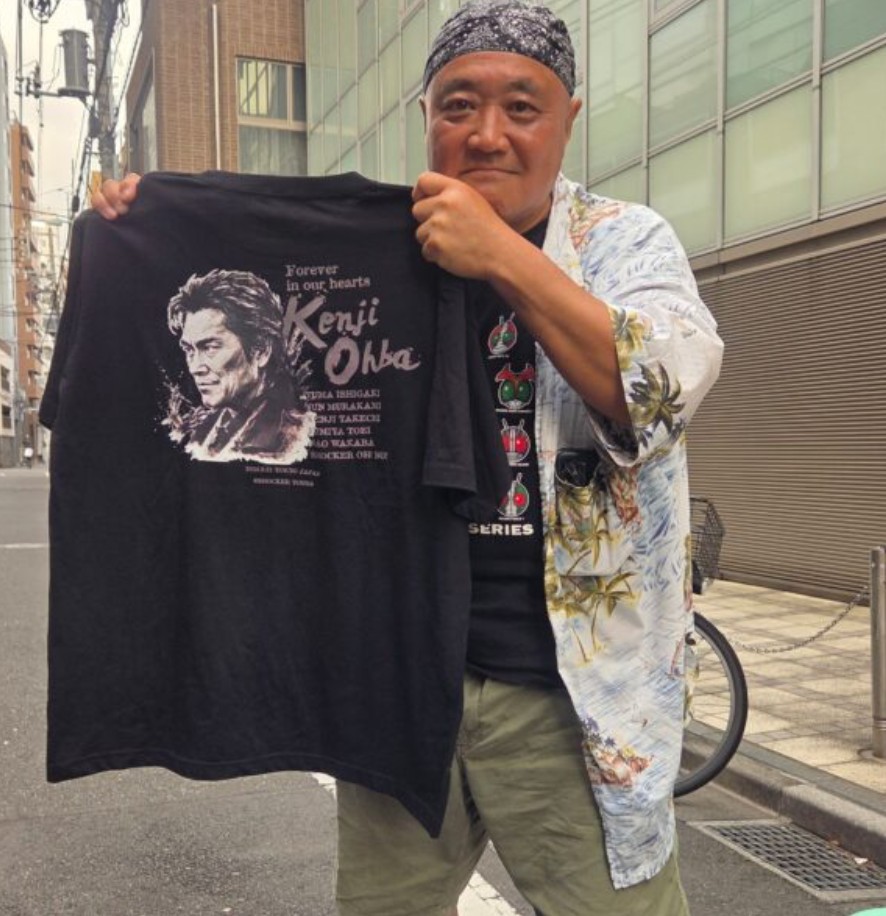
06Kenji Ohba
You met Kenji Ohba on the set of Gavan. What was he like in the day-to-day of shooting? What is your favorite memory of him?
Actually, our first meeting was when I took part in the shooting of episode 41 of Denshi Sentai Denziman, on location at Yoshimi Hyakuana.
I was still a rookie, and the first surprise was finding out that Kenji himself was the suit actor for Denzi Blue. Then I was floored watching him do a hand-assisted somersault inside a cave with a low ceiling.
On Gavan there were often child guest actors, and Kenji, who loved kids, would play with them whenever there was a break. I remember thinking: "What a kind man!".
Personally, I have a lot of memories of drinking with him. Even a few days before he collapsed, we stayed out together until morning.
But the memory that stands out most is a night of torrential rain in Shinjuku. Around eleven at night I met up with Kenji, who was coming from a Korakuen wrap party, and we went bar-hopping around Omoide Yokocho. Next thing I knew, it was just the two of us, eating pork cutlet curry at half past five in the morning!!
"Kenji, it's morning! The rain has stopped too!", I said, waking him up. We said goodbye at Shinjuku Station after the rain and I went home. When I got there, the ground floor of my building was covered in mud.
It turned out that day would later be recognized as the first officially recorded "guerrilla downpour", one of those sudden, localized torrential rains.
In other words: on the day the "guerrilla downpour" was born, I was out drinking and eating pork cutlet curry until morning with Gavan!
You started as a nameless presence inside an enemy soldier suit, and today audiences know your face and your voice. What was that change like? Do you ever miss being on the "invisible side"?
In recent years a fan will occasionally stop me on the street to say "I go to Super Sentai Spirits!", but that's very rare. I haven't felt any particular change.
07Master Ishinomori
You worked for years at Shotaro Ishinomori's home and had your stage name approved by the master himself. What was he like day to day? How did that conversation about the name go? Did he take an interest in the hero shows and in the actors who wore the suits of his characters?
I can't talk about the life I have today without starting with Master Ishinomori.
In my early elementary school years, my favorite work was Cyborg 009 (Ishinomori's manga about nine cyborgs, adapted into an anime in 1968). In fifth grade I discovered Kamen Rider. Then came Suki! Suki!! Majo Sensei (the 1971 series about a witch schoolteacher), Henshin Ninja Arashi (the 1972 transforming ninja), Jinzo Ningen Kikaider (the 1972 android hero Kikaider), Inazuman (the 1973 insect hero)… Every one of the tokusatsu hero shows I watched so passionately carried the credit: "Original work: Shotaro Ishimori"!!
I kept wondering: "What kind of person could he be?".
In high school I joined a group called Circle Terebikko Center. Through it I learned about the Shotaro Ishimori fan club and signed up. At eighteen I finally met the man who would be my master for life, at the Rattan coffee shop in Sakuradai, where he used to work out the rough drafts of his stories.
Around the same time, I mentioned that at the Cyborg 009 fan club we were shooting a live-action version of the opening of the black-and-white anime. He asked me, very kindly: "Are you the one playing 009?".
He was a great master, the creator of so many extraordinary works, and yet there was no arrogance in him at all. He was a gentle person. From then on, besides being a fan of his works, I became a fan of the man he was, and I got involved in the fan club's activities.
The Shotaro Ishinomori fan club, with more than sixty years of history and a long fanzine tradition, brought together many veterans who were already working professionally at the time: writers, scriptwriters, producers and editors, among them Kensho Ikeda, one of the pioneers of tokusatsu writing. Some of the people I met there are still so close to me that our bond is stronger than that of brothers.
When I started appearing on radio shows with Akira Sakuma, the creator of the Momotaro Dentetsu game series, we were working on Attack!! Hokuto no Ken, a program promoting the Fist of the North Star animated film (1986).
During the show, Sakuma said: "We've got a Shocker here too!".
Sakuma ran the "Jump Hoso Kyoku" readers' section of Shonen Jump, which was selling more than four million copies at the time. His show was number one in the ratings, so that mention of "Shocker" got a huge reaction from listeners.
At that point I felt that, even if it was the name of a villain organization, I couldn't just keep using it on my own. I went straight to Master Ishinomori for advice, and he settled everything with a single sentence:
"Ohno, if I'm the one who names you, there's no problem, right?".
Since then I've been using this name for more than forty years. All thanks to Master Ishinomori!!
08The sudden farewell
In January 1998, on the day Shotaro Ishinomori died, you ended up at the center of the storm, and it was Toru Hirayama, the Kamen Rider producer at Toei, who told Hiroshi Fujioka to turn to you. What happened that day?
It came completely out of nowhere. I had finished a medical check-up that morning and was having a late lunch at a soba place near my home when I got a call from Makoto Aoyagi, president of the Shotaro Ishinomori fan club, an Ishimori Pro alumnus and at the time the deputy editor of a weekly magazine: "word has come in that Ishinomori-sensei has died. Is it true?". I answered: "no, I was on the phone this morning with a younger colleague at Ishimori Pro, a managing director, and he didn't say a thing. It must be a rumor, right?". It was not something I could believe, so I said that and hung up.
Then a senior writer who was sorting photographs at Toei headquarters called: "a rumor came in that Ishinomori-sensei… The whole of Toei is in an uproar right now. Is it true?". The same news reached me from two completely different directions, one right after the other, and I thought: so this is it. I called the Ishimori Pro colleague I had spoken to that morning, and he said: "actually…". With no press announcement yet, it was strictly confidential. "I'm sorry I couldn't tell even you, Ohno." It was a bolt from the blue.
I hurried home, and a network's afternoon show broke the news with a phone interview with Hiroshi Fujioka, who at the time was a huge hit as Segata Sanshiro, the character from the Sega Saturn commercials. From that moment my home phone did not stop ringing. Everyone was asking whether the news was true, and since I could not speak out of turn I kept saying: "ask Ishimori Pro". The answer was always the same: "Ishimori Pro's line won't go through at all!".
In the end I spent four and a half hours that day answering the phone. Just as things were starting to settle, it rang once more: "hello, this is Hiroshi Fujioka". It was the man himself, the one I had just watched in that phone interview on television. Fujioka had learned of the death during that very interview, and the newsrooms that watched the program began calling him nonstop. Some even asked him to hold a press conference, which made no sense at all.
Fujioka was the lead actor of Kamen Rider and was everywhere because of the commercial, but none of that had anything to do with Ishinomori-sensei. At a loss for what to do, he turned to Toru Hirayama, who had produced Kamen Rider back when he was at Toei. Hirayama's advice was: "when you're in trouble, ask Shocker Ohno". And that is how my phone rang.
I called my Ishimori Pro colleague again and learned that the sensei's sons would hold a hastily arranged press conference that same evening at the Keio Plaza Hotel. I passed the word to Fujioka, and we managed to calm the press down.
Some time later Hirayama told me about it with a laugh: "you know, that day Fujioka really was in trouble and I had no idea what to do, so I said: when you're in trouble, ask Shocker Ohno. You handled the whole thing properly, and ever since then Fujioka has trusted you!".
Hirayama was the same age as my own father and their birthdays fell close together. I lost my father early, and he looked after me as the father I had in this business. Years later, on the tokusatsu series Voicelugger, which I produced, I asked him to serve as general director. And that series turned out to be the final work of my master, Shotaro Ishinomori.
09The NS Building and Hiro Narita
In the late 1980s you started holding sessions where the performers talked with the audience after the shows at the NS Building in Shinjuku. Where did that idea come from? Do you think today's talk show culture began there?
The NS Building hero shows had been running since the days of Dai Sentai Goggle-V (the 1982 Sentai), and at first they were staged by Ohno Kenyukai.
The man in charge of planning and producing them was Tadashi Koizumi, president of K Production. He had worked as production coordinator at Ikuta Studio on shows like Kamen Rider and Inazuman, and later at Toei Kikaku Promotion.
Through those connections he was close to Okada of Kenyukai, and his time at Toei also let him deal with the studio and make it possible for the actors to appear.
Later the team passed from Kenyukai to Toei's business division and finally to the Red Action Club, founded by Kazuo Niibori. That was when they called me in to host the shows.
This was a long time before Korakuen Amusement Park started staging performances with the actors from the series.
Niibori and I shared the idea of "putting on a show you couldn't see anywhere else". JAC also gave its full cooperation, saying: "If Niibori is doing it, count us in".
So we put together a team that is still legendary among tokusatsu fans: the actors who played the heroes before transformation, the very suit actors from the shooting, Yamamoto Onkyo handling the sound, as it also did at Korakuen, Shocker Ohno as MC and Kazuo Niibori in charge of structure, direction and action direction.
For eight years those shows were a Golden Week fixture at the Shinjuku NS Building. In an era with no social media, we drew more than two thousand people a day.
It was so much fun!
You learned a great deal from Hiro Narita, the celebrated Korakuen host. What makes a good hero show MC? How has that job changed between 1980 and today?
When people talk about the face of the Korakuen open-air theater and Sky Theater, they're talking about Master Hiro Narita, "Hiro-chan".
For about thirty years, from the Denshi Sentai Denziman shows through the final Engine Sentai Go-Onger (the 2008 Sentai) performance, he was the key figure connecting children to the heroes.
His ability to pull the two thousand people in the open-air theater together in one stroke was extraordinary. And above all, there was never a wasted word in what he said!!
In a show of under thirty minutes there was action, drama, stunts and huge set pieces. Guiding all of that along so naturally was an art form.
I watched his shows dozens, hundreds of times and studied them in depth. We also went out drinking a lot.
He called me by my real name, Hiroshi, and would joke: "You're more of a Hiro-chan than I am!".
One unforgettable memory is the finale of the second Super Sentai Spirits, in 2006. Hiro-chan appeared as a surprise, and master and apprentice got to do our "See you laaaater!" together!!
When I looked out at the audience, some people were pumping their fists and others were crying. Everyone was so happy! It was wonderful.
That's why, to this day, I keep hosting Super Sentai Spirits in tribute to Master Hiro. ☆☆☆
This year, 2026, we have two days of shows in Tokyo, on November 7 and 8 at Zepp DiverCity, and the Osaka show on November 15 at Namba Hatch!!
10Super Hero Spirits and Aniki
Super Hero Spirits grew out of an idea of yours in 1999. What was the first edition like? How did you bring MoJo back to the stage?
MoJo wasn't in the first edition. That's when I met Akira Kushida and Takayuki Miyauchi.
It all started when Tatsuji Yamagishi, president of Birthday Song, asked me: "We're putting on a two-day event called Anime Japan Festival. One day will be Super Robot Spirits (the concert of robot anime songs). Got any idea for the other?".
If I was going to propose something, I wanted to do a concert devoted exclusively to tokusatsu show songs, something nobody had done before. That's how I suggested Super Hero Spirits.
On the day, there were so many people that when I walked out for the opening, the audience was still filing in.
When the intro of the first song, the Uchu Keiji Gavan opening theme, started up with Kusshy [Akira Kushida], the roar, the excitement and the cheers from the crowd were unbelievable!
Except that during that first song, Kusshy's microphone was off!!
Normally a problem like that would have everyone wondering: "What happened?". But nobody noticed. Why? Because the entire audience was singing Gavan in chorus!
Back then the staff were still inexperienced. The microphone they had handed Kusshy was labeled "Ichiro Mizuki".
Super Hero Spirits was such a hit that the autumn tour, with shows in Tokyo, Osaka and Nagoya, which would normally have been Super Robot Spirits, was replaced that year by Super Hero Spirits. That was the tour where MoJo made his first appearance.
We met just before the show, in the backstage area by the stage at Shibuya On Air East, now O-East.
When he said: "Hi, I'm MoJo", I thought: "He really exists!".
To me he was the singer of Battle Fever J (the 1979 Sentai), the series that got me hooked on Sentai, and also of the themes of Dai Sentai Goggle-V and Kagaku Sentai Dynaman (the 1983 Sentai), productions I had worked on as an action performer.
He has treated me with great affection ever since. Later, for about ten years, I also handled the planning, structure, song selection and hosting of his own concerts.
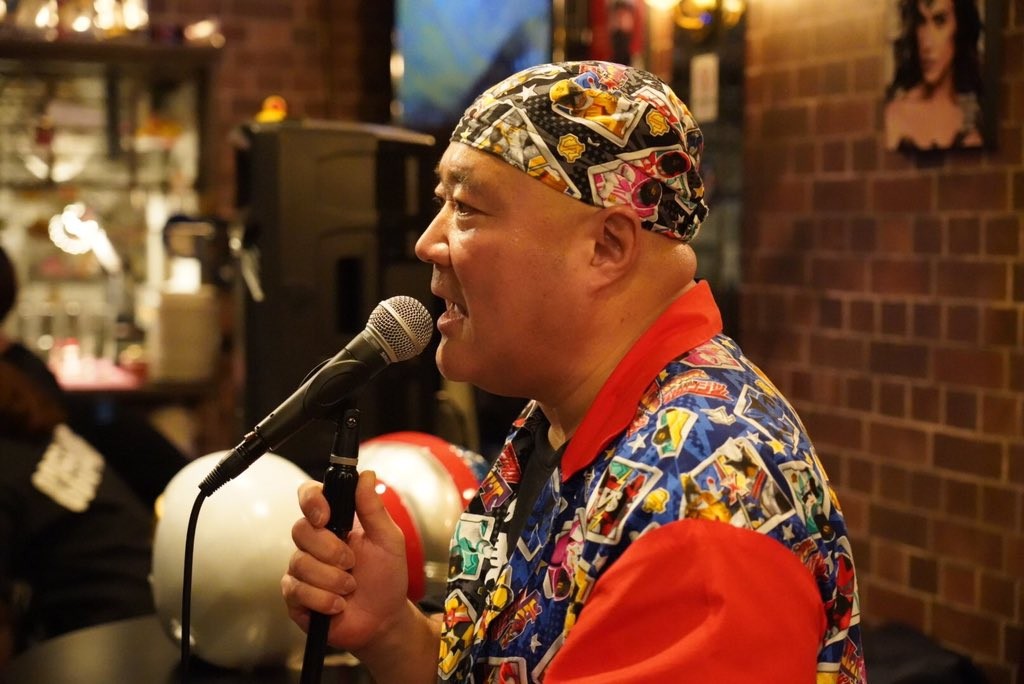
They say Ichiro Mizuki's nickname "Aniki" was born at a concert you hosted in 1997. What was that moment like? What was it like working with him for 25 years? From 2018 you were also in charge of the structure and the song selection. How did you choose the songs, and which one was the hardest to make happen over all that history?
For the first song of Robonation Live, the forerunner of Super Robot Spirits, a band of 22 musicians struck up the intro to the Mazinger Z theme (the 1972 giant robot anime, sung by Ichiro Mizuki).
Hearing the brass, I found myself crying in the wings.
Ichiro Mizuki walked out to a huge ovation!! When the song ended, there was endless applause and loud cheering.
As the MC, I heard a lot of people calling out: "Mizuki!". Some said "Professor Mizuki!" or "Master!". There were many students from his vocal school in the audience, so I think that explained some of those calls.
That's when I said:
"Of course Mizuki is a giant, and given his career I understand calling him professor or master. But he's a much more approachable person than that. Isn't Ichiro Mizuki the big brother of all of us?".
The crowd answered with deafening applause and a huge "Yeeeah!".
"Then let's call him 'Aniki' together! One, two, three!"
"Anikiiii!!"
And Mizuki, as if that put into words exactly what he felt, answered:
"I'm Aniki, zeeeeetto!!"
That was the moment Aniki was born.
After that, we traveled all over Japan together, from Hokkaido in the north to Kyushu in the south, and did many events. But what stayed with me most was being the general MC of the Ichiro Mizuki 24-Hour 1,000-Song Live, which was also broadcast nationwide by Fuji TV.
And that goes beyond Aniki. Working and spending time with Isao Sasaki, Mitsuko Horie, Hiroshi Fujioka, Takeshi Sasaki, Daisuke Ban, Hiroshi Miyauchi, Yoshinobu Kaneko and so many other people I had watched and listened to with such passion on television since I was small…
Sometimes I want to tell the boy I was: "The day will come when these people you love so much will be counting on you!".
11The Kamen Rider miracle
You have written about the history of the Korakuen hero shows. What surprised you most during the research? If there is a backstage story from the open-air theater you would like to tell, please go ahead.
Just as with Super Robot Spirits, when the project for this book came up and they offered me the job of writer and interviewer, I thought: "Good thing they came to me!".
The younger writers could cover JAC, but they seemed to struggle with the Ohno Kenyukai period and with interviewing the people from that time. That was exactly where I could help.
Besides figures like Masaru Okada, Tetsuya Nakayashiki and Kazuo Niibori, I also managed to interview my voice acting master, Akira Kamiya, who had narrated the commercials for many years!!
And speaking of voice acting, around that time I went to an animation studio for work. When I greeted a voice actress there and handed her my business card, she asked:
"You're Shocker Ohno? Are you connected to Ohno Kenyukai?"
"Well, we're practically family."
"Do you know Tetsuya Nakayashiki?"
"Do I know him? He's a senior I'm very fond of, and he has always been enormously kind to me!"
"It's just that I've loved Kamen Rider since I was a child. In junior high I went to Korakuen Amusement Park practically every week. The Kenyukai people got to know me and treated me so well, especially Nakayashiki and his wife…"
Can you believe things like this happen?!
I got in touch with Nakayashiki, and the two of them met again after fourteen years. To this day they keep up a friendship that includes both families.
The voice actress was Yuko Kobayashi. Since then we've been friends as fellow Kamen Rider fans too. Every now and then we still get together for drinks in Asakusa in a group called "Shonen Kamen Rider Tai", the "Kamen Rider Youth Squad".
The group also includes Shinichi Wakasa, the creature and suit producer of the Heisei Godzilla films; Shigekazu Tajiri, action director of the theater company Gekidan Shinkansen; and Motokuni Nakagawa, who wore the suits of the pink heroines of Super Sentai and of Mechagodzilla in the Heisei films.
At the time we were right in the middle of editing the Super Hero Show Encyclopedia, and there was a problem we couldn't solve: we had very few photographs of the open-air theater, especially of the Kamen Rider shows from the Ohno Kenyukai period.
The younger colleagues were close to giving up: "So much time has passed… It's going to be hard to gather those photos, isn't it?".
That's when it came back to me:
"Yuko, you went to the Kamen Rider shows at Korakuen so often… Did you ever take pictures?"
"Oh, my dad took pictures every time. If I go to my parents' place, they should still be there!"
And so, in one go, we got precious photographs from the days of Kamen Rider V3, Kamen Rider X, Kamen Rider Amazon and Kamen Rider Stronger that we never imagined we'd be able to include.
Now that was a "Kamen Rider miracle"!!
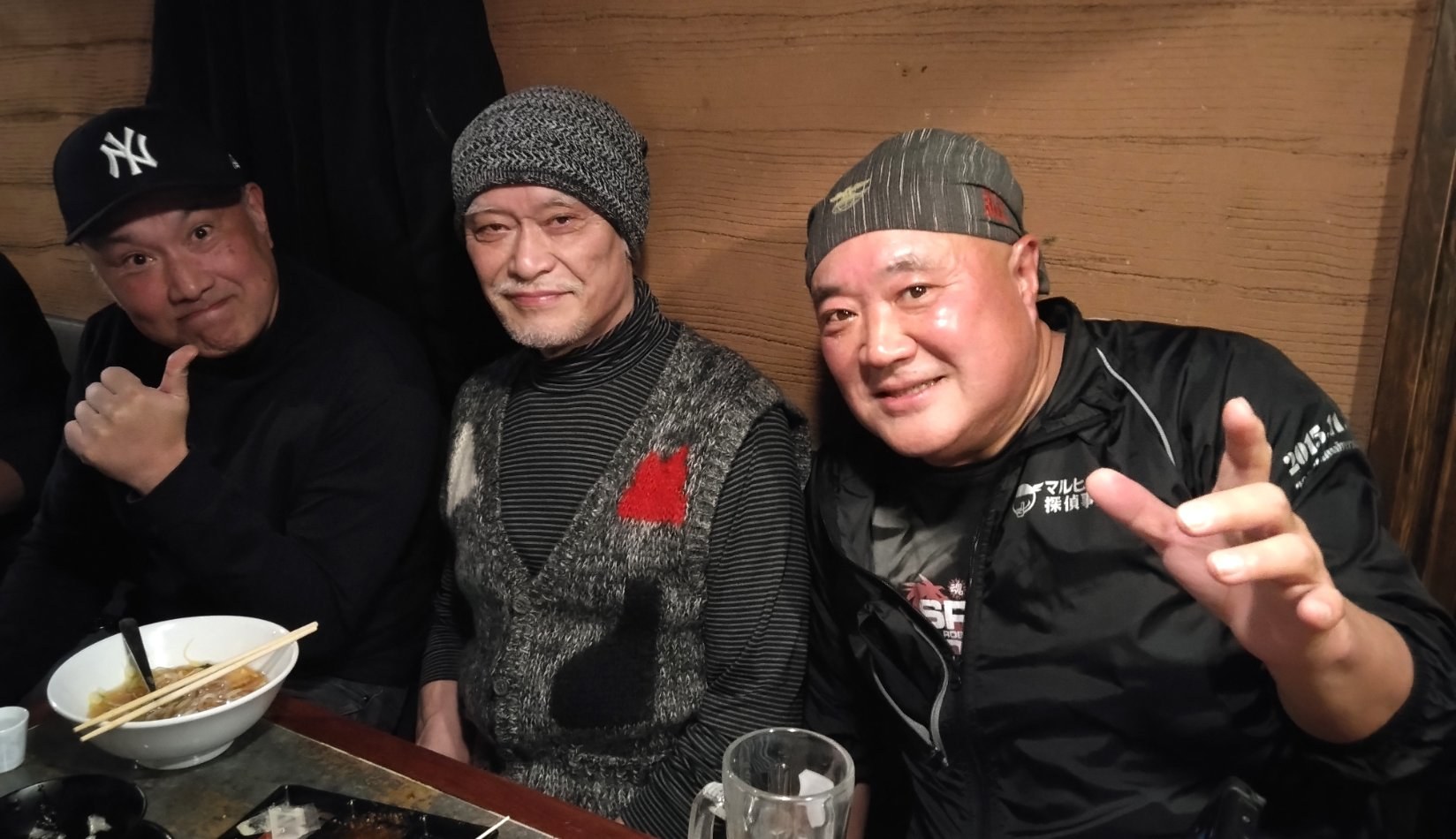
12The end of Super Sentai
What is your honest opinion about the end of the Super Sentai series?
Two days before last year's Super Sentai Spirits, NewJack Takuro, who sang the theme of Gosei Sentai Dairanger (the 1993 Sentai), asked me:
"Shocker, by now you must have some information about the next Sentai, right?"
"No. Two or three days ago I was talking with director Noboru Takemoto and we said: 'Normally there'd be an announcement by now. If nothing has come out yet, could it be that…?'"
After that conversation I went home, looked at my phone and… there was that unexpected news story on the internet!!
But since there was no official announcement yet, I decided to wait and see.
Then came the first day of Super Sentai Spirits. The Columbia Records representative told me: "Our company hasn't received any information about this either, so please don't touch on the subject during the show".
But even if the performers agreed, if I said nothing at the opening, the people in the hall and everyone watching the stream would be left uneasy, wouldn't they?
So I asked the Columbia representative: "How far can I go?". I looked for the limit of what could be said.
Of course, with no official statement, I had no intention whatsoever of speaking out of turn. But I couldn't believe that something built up over fifty years would "just end".
So I mentioned a single fact: "Next year Ultraman turns sixty and Kamen Rider turns 55. And both of them are on the air right now!".
My intention was for everyone to enjoy the show to the fullest after that. And then, out of nowhere, these magic words came to me:
"In the hard times and the sad times of our lives, wasn't it the Super Sentai songs that stood by us and gave us strength? Tonight, let's lose ourselves in those precious songs and celebrate with everything we've got! After all, we're celebrating fifty years of existence!"
That's why this year's show is also called Super Sentai Spirits Forever.
From 1980 to today you have watched tokusatsu from the inside. What has changed the most, for better or for worse, on the sets, at the shows and in the audience?
I think one piece of good news is the growing number of young women fans who say: "I love tokusatsu!".
I'm glad to see this world reaching more and more people. And I think it's especially wonderful to be able to connect, through tokusatsu, with all of you on the other side of the planet and with people all over the world.
13The ultimate Kamen Rider show
It was producer Hirayama who brought you close to Hiroshi Fujioka. What has that friendship been like, and is there one show that stayed with you?
It was through producer Hirayama that I came to know Hiroshi Fujioka well, and having him call me a comrade in arms is an enormous joy. In fact, a few years before that we had already done a Kamen Rider show together in Yokosuka, in Kanagawa Prefecture. Jo Yamanaka, a friend of Fujioka's and the singer known for the theme of the film Ningen no Shomei (Proof of the Man), held a concert every Christmas for the children of the institution where he himself had grown up, and Fujioka was going to take part. Hearing about it, the staff went to Niibori: "since Fujioka is coming, couldn't we do a Kamen Rider show?". And the offer came: "Ohno, will you play the villain boss?".
At the venue in Yokosuka, the young action performers who looked up to Niibori all gathered, among them Seiji Takaiwa of the Heisei Kamen Rider series, who would go on to become a major figure in Japanese action. On the orders of the villain boss I played, they fought Fujioka, Takeshi Hongo himself, and then the transformed Kamen Rider 1, worn that day by Mizuho Yoshida, who would later work on Zeiram and the Heisei Godzilla films. The children loved it and Yamanaka thanked us warmly.
Once I began working with Fujioka in earnest, we did events in Tokyo, all over the Kanto region, in Nagano, Nagoya, Osaka, Kyushu and many other places around the country. At the Fukuoka International Hero Film Festival I handled the structure and hosting of the event for his 40th anniversary in the business.
Right after the Great East Japan Earthquake in 2011 we went together to the disaster area in Ishinomaki, Miyagi Prefecture. We did a talk show in front of the station and walked through the shelters. Watching him encourage the survivors one by one, I was moved: "ah, this man really is the champion of justice, Kamen Rider himself!". Of course we returned to Ishinomaki after the recovery, and on the day the Ishinomori Mangattan Museum reopened we rushed there together and did a talk show. Seeing children and everyone else smile because of an event is what makes me happiest.
And speaking of smiles, Fujioka and I have run into each other in all sorts of places. When we do, we both break into a grin, naturally. That day we were doing a Showa-era Kamen Rider show at a town festival in a city in Chiba Prefecture. Why Showa era? Because we had not been booked for a children's show, but for the thank-you party for the festival staff, with the Junior Chamber of Commerce and Industry as the client. It was a Kamen Rider show for adults, after the festival had closed, with 1, V3 and RX as the heroes and a Shocker monster and Shadow Moon on the villains' side. For that kind of show they call in performers of my generation rather than the young ones, and since everyone is squarely from the Kamen Rider generation, the whole thing builds itself out of improvisation while we rehearse the fight, script or no script.
The standard pattern would be Shocker attacking the venue, 1 and V3 entering in turn, the audience game section in the middle, 1 and V3 returning, Shadow Moon putting them in a tight spot, RX appearing for a one-on-one with Shadow Moon and, at the end, 1 and V3 finishing off the Shocker monster. That day we decided to change it up: V3 and RX first, with 1 coming to the rescue at the end. When the rehearsal ended I went to have a look at the hall and, would you believe it, there was Fujioka!
I called out to him quietly and he was startled, though so was I. It turned out he was the main guest of the town festival, had given a talk at another venue during the day and was supposed to head straight back to Tokyo. But the mayor, a huge fan of his, and this sort of thing has become extremely common lately, insisted, so he came over after the talk on the condition that he could only stay as long as time allowed.
"What on earth are you doing here?" "Today I really am Shocker!!" "Hahaha, so I get to see Ohno's Shocker! Ah, but listen, with the schedule I can only stay partway through." He was all warmth and smiles. I went into that show fired up.
"This hall now belongs to us, to Shocker…" As I gave the villain boss's opening speech, there at the edge of my vision was Fujioka's smile. Out came the ad lib: "I don't know why, but I'm feeling tremendous pressure from this audience today". Everyone from the Junior Chamber knew he was there, and the whole room roared. Fujioka even stayed through the audience game section, which is the villain boss's big moment, smiling the entire time.
Then came "attack the hall, charge!", "hold it right there!", and V3 and RX enter, only for the Shocker monster and Shadow Moon to leave them in a hopeless spot. The host asks: "everyone, call for Kamen Rider!", "Kamen Rideeer!". It was the after-party and the drinks were flowing, so the city hall people threw themselves into it. And then came the roar of the Cyclone: "vroooom!". "No, that can't be… he was right over there a moment ago… he's gone?" Fujioka had left for his next commitment.
And from the back of the hall came Kamen Rider 1, played by Kazutaka Shiina, an Ohno Kenyukai veteran who also played 1 in the film Super Hero Taisen. Honestly, with no prior arrangement at all: the structure that happened to leave 1's entrance for the end, Fujioka coming over from another venue at the mayor's request, and the exact moment he slipped out in the middle of the show. Everything that day felt like divine intervention. It really was the ultimate Kamen Rider show.
14Hero
Stuntman, publishing sales rep, broadcast writer, manager, television producer, voice actor, MC and author. Looking back, what connects all of that? Is there one of those roles that makes you think: "This is who I am"? Which work are you proudest of? Is there anything you would like to do over?
As I also wrote in Shocker Ohno's Nekketsu Hero Nikki, which will soon have a Portuguese edition, the answer is simple: "HERO".
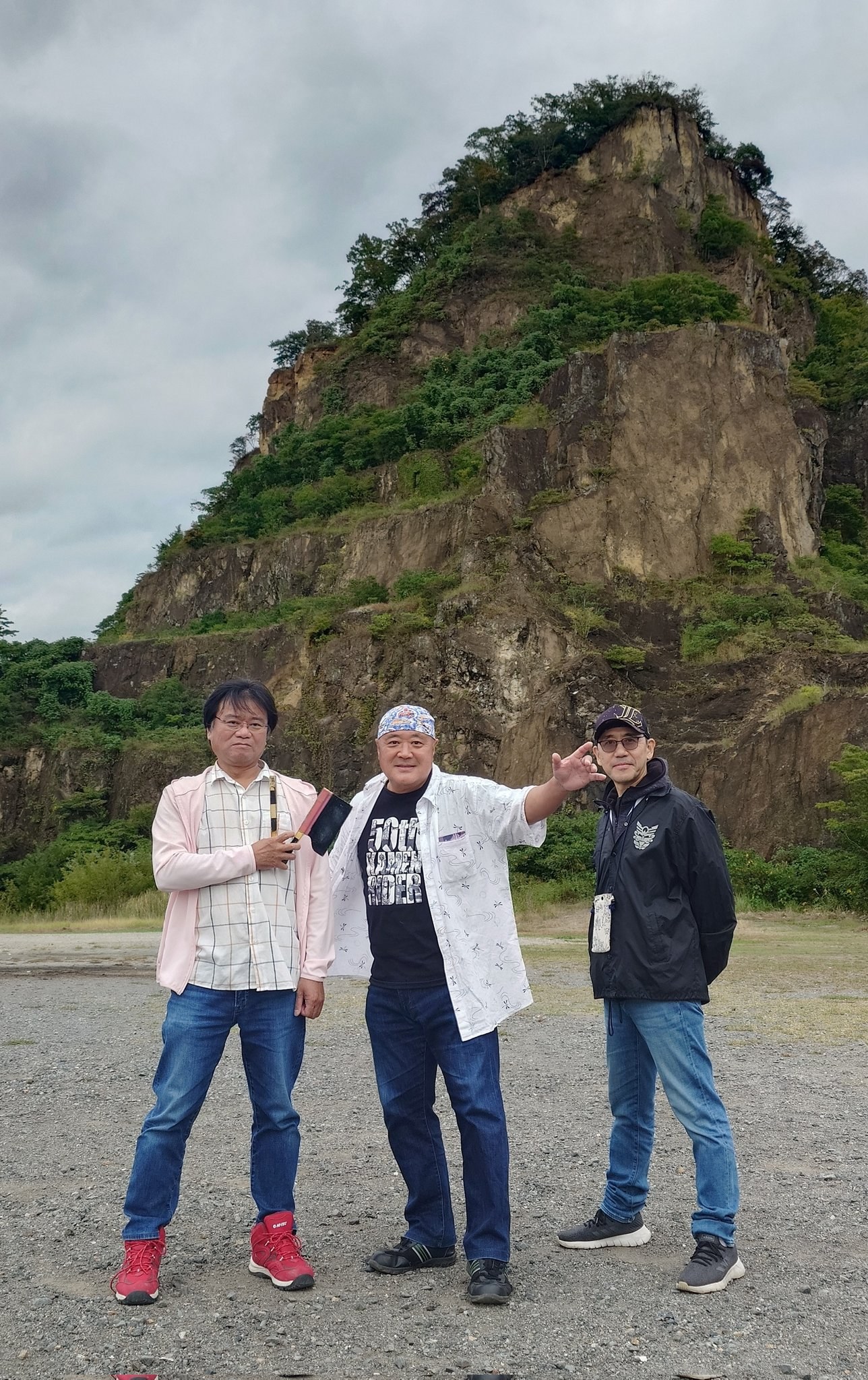
In Brazil, many people grew up watching Jaspion, Changeman, Jiraiya and Sharivan, productions you were close to. What message would you like to leave for those fans?
Please keep supporting Japan's tokusatsu heroes!
Between October and November, about twenty people are coming from Brazil to Japan on a "tokusatsu tour". The program includes Super Sentai Spirits and an explosion experience in Yorii. I'll also be guiding a tour of landmark tokusatsu locations in Tokyo.
But next time I want to go to Brazil and personally thank the "amigos" who recently supported the crowdfunding!