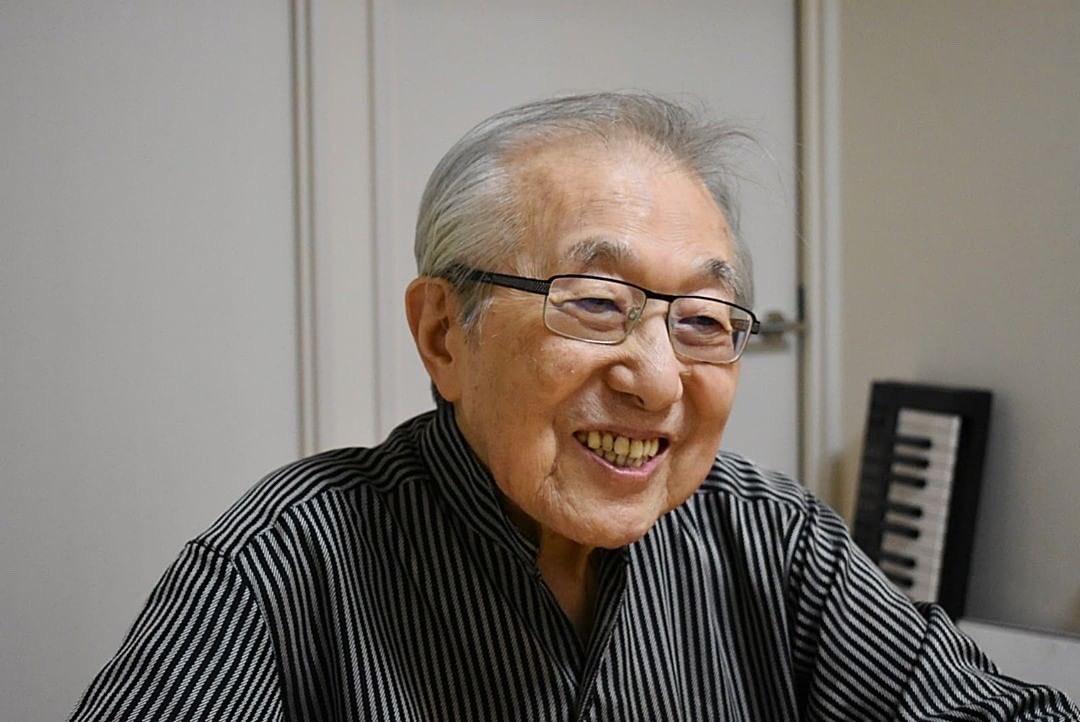
Chumei Watanabe gave this interview to Shocker OH!NO!, a radio writer and host who also emcees the Super Robot Spirits and Metal Hero Spirits concerts, on his web radio show Welcome to Shocker OH!NO!'s Secret Base. It was episode 65, recorded on February 27, 2013, with co-host Reina Kaibara. Watanabe was 87 at the time, six months shy of his 88th birthday. Over 87 minutes, the man who wrote the music for Ninja Butai Gekko, Kikaider, Mazinger Z, Gorenger, Denjiman, Space Sheriff Gavan and Jaspion walked through his life in order, from a childhood in Nagoya with no interest in music at all to the soundtrack album he paid for out of his own pocket.
01Nagoya
At last, Professor Watanabe in the Secret Base. You come to all of our shows, and this New Year's you were on stage at Metal Hero Spirits next to Kenji Ohba, the original Gavan, with the crowd going wild. The trouble with live events is that there is never enough time, so today I want to hear your whole story at a comfortable pace.
If you let me talk, I'll talk.
These are the things we never get to ask you at events. To begin at the beginning, where are you from?
I'm from Nagoya. Under the old school system, which was nothing like today's, you did six years of elementary school, five years of middle school and three years of a preparatory high school before you could enter a university. I went through all of that in Nagoya, and I only left when I went to college in Tokyo.
Nagoya is fried-shrimp country, isn't it? You must have grown up on all of that.
I grew up on exactly what the city is famous for: fried shrimp, the flat kishimen noodles, and miso katsu, which is a breaded pork cutlet served with a miso sauce. That was what people ate there, and it still is.
What kind of boy were you? Was music already part of your life?
As far as music goes, I had no interest whatsoever. These days almost everyone who works in music started piano at 3 or at 6, and nothing like that happened to me. I had a fairly ordinary childhood for the time I was born into, which was shortly before the war and which, at least in my memory, was a peaceful period. Japan was already a militarist country, but you didn't see it in the streets, and once the war in China started, all we heard was news of victories.
The only musical memory I have from those years is from kindergarten, when we played the traditional circle games, the warabe-uta. The children formed a ring around one child and sang, and at the end the child in the middle had to guess who was standing behind them. Beyond that, there was no music in my life at all.
Then came the singing classes in elementary school, with the songs the Ministry of Education distributed to every school in the country. There was a printed book with the lyrics and the sheet music for each song, and nobody ever taught us to read that sheet music. The teacher played the melody on the organ and we sang along. Most of my classmates liked it, because children like to sing, and I thought music class was the dullest thing in the world.
That's surprising, coming from you. I would have guessed music was your favorite class.
It wasn't that I liked some other kind of music and found the school songs boring. The class itself simply didn't interest me. And there was one thing that really stuck with me. That teacher, which was unusual for the time, would close the lid of the organ and announce that she was going to play a single note, and the class had to guess which one it was. Half the room shot their hands up instantly, with total confidence, and I was stunned, because I couldn't recognize a single note. That's the whole business of perfect pitch.
Only much later did I realize that none of those kids had perfect pitch, and that they were all guessing, as if it were a quiz show. At the time, though, I believed they really knew, and I sat through those classes with my head down, convinced I was the only one in the room who understood nothing about music.
02My Father's Records
What about at home? Did you listen to music with your father?
Recorded music, at home, was whatever my father bought. Back then we had 78s, which held only about four minutes per side, and he bought the popular songs of the day. Singers like Taro Shoji and Noboru Kirishima, the hitmakers of that era. I remember "Circus no Uta" and "Kokkyo no Machi" very well. That second one is by Shoji, who used to sing standing at attention, completely motionless, and my father adored him.
My given name is actually read Michiaki, and he would call me by that name to come listen with him. He'd tell me to sit next to him and listen, and I sat there quietly, taking in those records. There was also rokyoku, the narrative singing accompanied by shamisen, and my father listened to Torazo Hirosawa's "Mori no Ishimatsu" over and over. I remember that clearly to this day.
At the time I paid no attention to the names of composers, and I knew nothing about Western music. I listened to all of it without any discomfort and without any particular attraction either. Today, when I hear those melodies again, they fill me with nostalgia.
And outside the house, were you in any club or school activity?
During the war there was no such thing as a music club, because almost nobody could play an instrument. What we did have was the movies, and since I ended up in film music, that part is worth telling. From the time I was in kindergarten I would slip into the neighborhood theater behind the older boys. The second floor was covered in tatami mats and the ground floor had chairs, which was how theaters were laid out then.
It was the very beginning of talking pictures, and before that I even saw silent films with a benshi, the narrator who stood beside the screen doing the voices for every character and commenting on the story as it went. I saw two or three like that, almost all of them samurai pictures. A ticket cost about 10 sen, which is less than one yen.
That was the age of Bantsuma, the samurai star whose sons were the Tamura brothers.
Exactly. At school we would tell each other we'd seen the new Bantsuma picture the day before and that it was very good. Every neighborhood had a movie theater, and it was the main entertainment for any family, because there was no television in Japan yet. Before television arrived, theaters were packed for every showing, and often there were people left standing outside.
Did you see any foreign films in those years?
I saw King Kong as a child. They've remade it so many times since, and still, when I watch it on DVD today, the craftsmanship holds up. That's puppet animation, frame by frame, an entirely handmade process. A performer inside the costume is our tradition, the Japanese way. With nothing digital available, they found a way to make the creature move anyway.
Music still didn't interest me, because I was in elementary school. What came next were the musical films, which I also saw with my parents. One was "Unfinished Symphony," a German film about Schubert, and the other was "One Hundred Men and a Girl," with Deanna Durbin, who made several pictures of that kind. I heard Schubert's "Unfinished" for the first time in that theater, and I ended up singing the theme at home with my sister. That was more or less when music started to creep up on me.
03The Harmonica
So what was the exact moment you got into music?
The turning point was the harmonica. In the upper grades of elementary school, during recess, a classmate of mine played the harmonica. I knew the instrument by sight, but I had no idea it could sound that good, and right away I wanted to play too. Schools in those days offered no instrument lessons at all, so there was no way to learn through school. It's worth saying that in the 1920s and 1930s the harmonica was a very popular instrument in Japan, so getting hold of one was easy.
At that time my family was living in Tokyo because of my father's work, and if you wanted a musical instrument you went to Mitsukoshi, the department store that carried everything. I bought the harmonica and an instruction book to go with it, and I started teaching myself at home.
Harmonica sheet music is written in numbers rather than notes. The number 1 is do and the number 2 is re. Blowing out gives you do, mi and sol, and drawing in gives you re, fa and la. Because everything is in numbers, it works as movable do rather than fixed do: the number tells you the degree of the scale, not the absolute pitch. After enough practice, I could sing a melody just by looking at the numbers on the page.
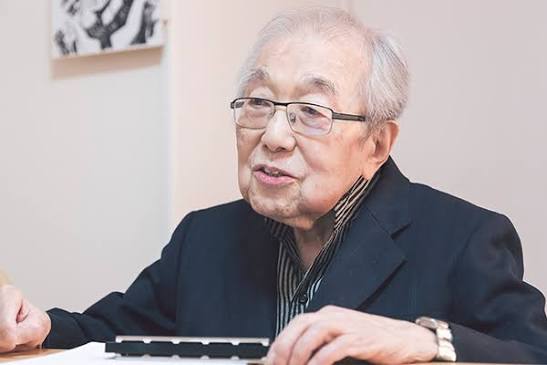
Is that where your relative pitch came from, that sense of the interval between one note and the next?
That's exactly where it came from, and it shaped the rest of my life, as we'll see later in this conversation.
Professor, you remember the past with astonishing precision. What you went to see, on what day, how things were back then. I'm amazed.
They say that's normal with age. What happened long ago stays engraved in every detail, and what happened yesterday is gone.
04My Father and the Piano
When did you decide you wanted to be a composer?
It was while I was studying the harmonica that the wish to compose appeared, and more specifically the wish to write music for films, because of the movies I'd gone to with my parents. Right around the time I started studying, a Deanna Durbin picture came out with an entire harmonica band in it, and the theme was sung with a whistled passage in the middle. That made a deep impression on me and gave me an enormous push to keep going.
One day I worked up the courage to tell my father I wanted to be a composer. He didn't discourage me, but he said that if I really wanted to compose, the harmonica wouldn't be enough, and I would have to study piano. I figured he was right and started learning to read the staff. In the old middle school there was still a music class through the second year, and it covered a bit of theory, which helped.
Since I already read numbers, the method I came up with was to transpose everything. I bought a songbook with a handful of tunes and decided to study one key per day: today F major, tomorrow D major, and so on, always choosing songs I didn't know so I couldn't lean on memory. I learned fast that way. After that, my family found a piano teacher who lived near our house, and I started going to her home once a week.
Your father was remarkably understanding for that era. Back then a father was more likely to ask what on earth his son thought he was doing, wanting to make a living from music.
He was, and I'm deeply grateful for it. My father ran an ironworks, hard work with no connection to the arts, and he still understood what I wanted. The one who complained at home was my mother, because I practiced too much and my schoolwork fell behind, and she went as far as ordering me to stop. My father stepped in and settled the argument by ruling that half an hour of piano a day was plenty. It was the opposite of what people imagine about those days.
So already in middle school you saw yourself as a composer. At that age I was still hiding from my parents to watch Kamen Rider.
Comics and animation existed in my day too, with Disney cartoons at the movies and magazines running Norakuro and Boken Dankichi, which everybody read. I don't know whether it was the craze it is now, but every boy read manga.
With the piano, my interest kept growing, and I understood that anyone who wants to compose has to study classical music, because in Japan at that time jazz and pop barely existed beyond popular songs, and there was no television. To me, "composer" could only mean film. The problem was that there was no composition teacher to go to, so the only option was to listen. Records were 78s, four minutes a side, and Beethoven's Third Symphony took up seven or eight discs, which meant flipping the record in the middle of a movement. That was normal at the time, and nobody could have imagined anything like a CD. Few records were released, so I combed the review magazines for what was worth buying.
It was a youth full of anxiety. I wanted to be a composer and had no idea whether I would make it, and whenever I read the biography of some famous composer I found out he'd been playing since he was 3. Biographies are always about geniuses, people who left their name in history and wrote the works everyone knows, and I kept asking myself what would become of me.
05The War
What happened to your studies as the war got worse?
When the war tightened its grip, I had to stop going to piano lessons. So I started taking secret singing lessons with the music teacher at my middle school, who was a good singer. The war with the United States had already begun and the dress code was very strict. We wore the kokumin-fuku, the government-standardized civilian uniform, a field cap, and puttees wrapped tightly around our legs whenever we went out.
At night, because of the blackout against air raids, the lamp in the room was covered with a black cloth so no light would leak outside. That's how I took a good part of my singing lessons, in that half-darkness.
Did people realize the war was going badly?
Things got worse without anyone telling us. The news reported nothing but victories, and you couldn't make sense of anything from the newspaper. People started to suspect when the air raids became more and more frequent. Nagoya had many munitions factories, which made it a target. Our house ended up burning down. We had moved to the outskirts precisely because Nagoya was dangerous, and that's where, in the suburbs, the bomb fell.
At the end of the war, classes were suspended across the country and students were mobilized for labor. Some of my classmates went to make weapon parts, and I was sent to a steel mill, where the work was brutal. There were students pulling still-hot iron bars, and I was on the cold end, swinging a sledgehammer on an anvil to shape the pieces. Cold iron does not take shape under a hammer, but that's what they had us doing. Nobody works that way anymore, except the smiths who forge swords.
Were you in Nagoya on the day the war ended?
I was. We were told there would be a message from the Emperor on the radio and that everyone should listen, so we gathered at noon. It really was his voice, but you couldn't make out what was being said. There may have been interference in the broadcast, I can't tell you. Some people heard an order to keep fighting, and most understood that we had lost the war. The whole place went silent.
After that broadcast, the entire country obeyed the American forces without much resistance. There were no attacks, nothing of the kind. That's how obedient the Japanese are.
06Psychology in Tokyo
When the war ended you went to Tokyo to study. Why psychology, and not music?
I decided to sit the entrance exam for the University of Tokyo because, to work in music, I needed to be in Tokyo one way or another. I chose psychology because I'd read in a book that there were areas where psychology and music overlapped, including the study of hearing, and that seemed useful.
As it turned out, psychology at the University of Tokyo was experimental psychology, which means sensation, perception and learning, and "learning" there meant rats running mazes. In practice I was in a hard-science program. Social psychology and the psychology of emotion were not taught at all. It was a materialist psychology, a psychology without a mind, in which even consciousness was treated as an intervening variable, a tool for reasoning. It was one extreme, and it still served me very well as a way of thinking.
The basement of the building had several laboratories, and some students bred rats for the experiments. The upperclassmen said everyone had to build at least one radio with their own hands, so I learned to use a soldering iron and built a vacuum-tube radio with parts bought in Akihabara. Even back then, Akihabara was the electronics district.
07Ikuma Dan
And composition, who did you study that with?
I went to study with Ikuma Dan, the composer whose name appears in the school music textbooks. A family acquaintance in Nagoya had graduated from the Tokyo Music School, today's Geidai, and had been Dan's classmate, and that was the person who introduced me. I learned a great deal from him.
Around then a phone call came from Nagoya saying my father was ill. It was an ulcer that had gotten worse, and surgery showed it was cancer. I waited outside the operating room, and by then it was too late for anything. I was in the first year of graduate school, so I finished that year, dropped out, and went back to Nagoya to care for him, continuing my composition studies through trips to Tokyo.
And there was no bullet train back then. How long did the trip take?
There really wasn't, but there was an express train, which took about four hours. Today, if you make the same trip on a regular train, it takes about seven.
08The Front Desk at CBC
How did you land your first job as a composer?
Before he died, my father's ironworks had failed and he had taken to managing a small wooden apartment building. I had no intention of taking that over, because what I wanted was to compose. Commercial broadcasting was just getting started in Japan, so I went to CBC, the Chubu-Nippon Broadcasting Company, which had only recently been founded.
I walked up to the front desk, where there was a receptionist, and asked her to introduce me to someone from the music department. The head of the music section came down and we talked right there in the lobby. I told him I wanted to compose and that I was studying for it, and he listened patiently and invited me to come back. He must have thought this young man might be useful for something. I went back several times, we even went out drinking, and one day he handed me a script and asked if I wanted to give it a try. It was "Atom Boy," a science fiction radio drama. I had no experience at all, and when I think about it today, it makes me cringe.
You just walked into a broadcaster and asked for work. That would be unthinkable today: a newcomer knocks on a TV station's door asking for someone in music, and reception won't even let him in.
It was a different time, and there were very few composers in Nagoya, which also helped. CBC had a music department and its own small orchestra, with one of each woodwind, flute, clarinet and bassoon, trumpet and trombone on a near-permanent basis, and a full string section with first violins, second violins, viola, cello and double bass, plus drums. You could make real music in there.
In the early days, television dramas went out live, with the music played at the very moment the actor delivered his line. That ended quickly, because it was too hard on everyone, and the music started being recorded separately. Even so, it was an enormous education. Since the house musicians were always the same people, they taught me everything, from how the oboe's low notes come out with difficulty to how the orchestra's pitch drops when the room is cold. And I was in the studio hearing the sound live, which teaches you far faster than any book.
09The Tape for Shintoho
How did the move to Tokyo and the entry into film come about?
After a while in radio I wanted to go to Tokyo. Ichiro Miyagawa, who later wrote the scripts for Mito Komon and who died recently, had been my classmate at the University of Tokyo, on the literature side, and by then he was working at the Shintoho studio as a producer's assistant. I went to talk to him. He had never heard a note of my work, and he still told me to come to Tokyo, because from Nagoya the conversation would go nowhere.
I copied the passages I thought were best from the radio dramas I'd scored onto a tape, put together a demo, and took it to Shintoho. They also called in a former head of the studio's music department to listen with me, and in the end they said it was good and that I should wait, because work would come.
Something else had happened before that. Rokuro Hara, the composer of "Omatsuri Mambo" for Hibari Misora, had visited Nagoya and told me to come to Tokyo and work as his assistant. I rented a room near his house and dropped by from time to time, and when he was swamped I recorded the background music for the Sazae-san radio drama.
10The First Film
Then came the call from Shintoho, with your first film.
It came. They phoned to say everything was settled and that I should come to the meeting. I moved to Tokyo immediately and looked for an apartment where I could play piano without bothering the neighbors, and I managed to find one. The film was "Ningyo Sashichi Torimonocho: Yoen Rokushi Bijin," a period detective picture starring Tomisaburo Wakayama.
The director had decided he wanted the entire score done with guitar alone. In those days a solo guitar brought to mind "Forbidden Games," and there was also "The Third Man," which is not guitar but another plucked string instrument. He must have seen those films and wanted something like them, and since I was a young composer, that's what they asked of me. The head of music was at that meeting and warned that guitar alone was risky, suggesting we add a timpani, and the director insisted on pure guitar. I was far too excited about my first film job, which was exactly what I wanted to do with my life, to object.
Today I would handle that with electric guitar, acoustic guitar, bass and drums. At the time I got carried away and hired six guitarists, divided into four parts, with no bass at all on the recording. When I listen to it today, it doesn't sound wrong. The film still turns up on video now and then, and even in theaters. I was 31.
11A Hundred Films
After that first film, did the work take off?
It worked, and the jobs came all at once. I was doing 10 to 12 films a year. Every studio was releasing two films a week back then, so the volume of production was very high. Even more requests came in from directors, and it was the department itself that held them back, because one person couldn't handle it all. In total I must have done about 100 films, and money stopped being a problem in my life.
Professor, a basic question: is a film score written afterward, looking at the finished picture?
Yes, afterward. In today's animation there is advance recording, where you record a large number of cues of this or that character before the picture even exists, and that's a matter of cost, because recording new music for every episode would be extremely expensive. In film, the work is done in front of the picture.
My method was to watch the final cut with the crew, go back to the studio, watch the film again in the screening room and take notes on everything. Every cue was timed, with the length written down in minutes and seconds. At the recording session someone would always turn up saying a piece of the film had been cut, and there were conductors who specialized in film, very skilled people, who would suggest on the spot where to drop a bar or repeat a passage to hit the exact length. It was one of those conductors who heard my music, introduced me to a television station and then to other studios. That's how my work spread.
12Gekko and Kikaider
Here's something I found out much later and that moved me: shortly before Kikaider you scored Ninja Butai Gekko, at Kokusai Hoei. I watched it as a kid and we sang that theme all day long.
That was a big hit and the series ran for a long time. I learned a lot on it, because it was more or less on that show that the musical phrases that work in children's action with special effects took shape. Come to think of it, the song was a bit odd, with a very low melody. Today I doubt anyone would accept a song like that.
And it was a song full of fight, like the Ninja Butai march. I hadn't even started school when I watched it. In high school the series was rerun on TV Kanagawa, we taped every episode, and that's when I saw your name in the credits and put two and two together.
At some point the work slowed down and I went to Toei to ask for a job, since I already had a relationship with them from my film days. Soon afterward they told me it was all set, and I assumed it would be an adult program. It was "Jinzo Ningen Kikaider."
That job became the turning point of my life as a composer. Without Kikaider, I wouldn't be who I am today. The 100 films I scored have no bearing whatsoever on the present, while the music from Kikaider is still performed and used everywhere. When I got the script, I asked whether it was children's stuff, and they told me on the spot that children's stuff is better, because it never goes away. They were right, and it was a foolish thing to ask. If I hadn't gone to ask for work that day, I would be completely forgotten now.
Forty years on, that music hasn't aged. An ordinary pop song doesn't hold up that long.
Almost nobody remembers anything from 40 years ago. On that count I got lucky.
13Hawaii and Brazil
I went to Hawaii with the show's crew, half work and half vacation, and I wandered into a karaoke bar. The catalog was on Toei laserdiscs and it was almost all enka, the traditional pop ballads. Then I spotted Kikaider on the list and had to try it. The disc was brand new, without a single crackle, because nobody ever requested that track, while the enka discs were worn out from use. The moment the intro started, the whole bar turned around and the hostesses started shouting Kikaider's name. That's when I understood that the story about his success overseas was true.
The same thing happens in Brazil. Akira Kushida has been going there for a few years now and it's an enormous success, with 20,000 or 30,000 people singing along in Japanese. Jaspion is a huge hit there. He told me that when he lands at the airport, the fans are already waiting and singing, and the singing follows him all the way into the terminal.
He also said a huge security guard came walking toward him, and he had no idea what was going on. The man leaned in and sang the theme song into his ear.
After hearing those stories, I picked up a travel book about Brazil at a bookstore, a paperback, and leafed through it. It had an entire chapter on tokusatsu, the Japanese live-action genre of superheroes and special effects, saying that a whole generation of Brazilians knows it better than the Japanese do. I was truly surprised. And there are people who learn Japanese just to be able to study animation and tokusatsu, at public universities no less. That's astonishing.
14Mazinger Z
And in the same year as Kikaider came Mazinger Z.
I thought it was a giant robot the likes of which had never existed, and that I would really have to push myself. Whenever you write an opening theme some problem comes up, and on that one there was an episode worth telling. There's a song everyone now knows as "Z no Theme," and it was recorded first, meant to be the show's opening. The crew walked out of the session with the tape in hand thinking it was great. We recorded it on a Saturday.
On Monday, Toei called to say they had played the song for the department head and he found it weak, with a mood far too sad for the show. They asked for something with more punch. The lyrics were still being written at that point, and they asked whether I could compose in one night. There was no alternative, so I wrote the first verse early that evening.
On Tuesday afternoon I played and sang the song for everyone in the rehearsal room at Columbia, because in those days you didn't use a tape for that kind of presentation. They approved it on the spot. On Wednesday I delivered the final version and on Thursday we recorded. That's how the Mazinger Z theme came to be.
So the classic was born in a single day.
It's a curious thing, but when the deadline bites, the music comes. Everyone had liked "Z no Theme," that first song, and the production chief made a point of using it anyway, leaving enough room for music inside the episodes so it could play. It must have aired many times.
The one who fussed over opening themes was Yoshinori Watanabe at Toei, and in this case he was right. Since in children's tokusatsu what matters most is the rights to the characters, they paid close attention to that detail. He used to say the opening theme is the cover of the product, and if the cover is bad, nothing works. That was exactly my concern, figuring out how to set off that rush of excitement in the very first bars.
In April we're doing Super Robot Spirits again, and at the end of last year there was a whole concert with nothing but Mazinger Z music. A show that stands on Mazinger alone, 40 years later, is something that normally never happens.
That show made me very happy. And I'll say without any embarrassment that the insert songs hold up just as well. Hearing all of it again, in Ichiro Mizuki's voice, with the same power as ever, is something to be grateful for.
When we hear those songs, we turn back into the elementary school kids who watched the show. That's where Super Robot Spirits came from. At the first one, with you in the audience, nobody believed you could stage an anime-song concert with the crowd on its feet like a rock show, and when the band came in with the trombone and the trumpet on the Mazinger Z intro, I cried. Years later, when Mizuki re-recorded the songs for an album tied to the Super Robot Wars video game, I was in the control room, and every producer and director in there, all men in their fifties, had a child's face as they watched him in the booth. That's when I understood that we don't hear this music with our ears, we hear it with our skin. I even wrote that in the liner notes of one of your albums.
Back then every boy watched those programs, which is why there are so many fans. It's something I'm grateful for. I always think it was worth doing.
Digital sound is another thing I learned from you. Denjiman already had a vocoder on it, and the processed voice is your own.
What's hard, when you spend a long time writing the same kind of music, is the musical phrase. In theory any phrase will do, but I have my habits, and unless it goes a certain way it doesn't turn into action music. The work lies in making varied things within that limit, and that's still true today.
15Listener Questions
The first email is from a listener named Daichi. He says his generation grew up on the "Chumei sound," that all it takes is an intro for him to start singing a song from decades ago, and he asks this: when you compose for animation and tokusatsu, what do you have in mind? And what has changed, and what hasn't, over all these years?
That's hard to put into words. What I'm after is that the thing has appeal. In a battle theme, for instance, it has to have punch, and beyond the punch it needs a musical phrase that pulls the listener along. In a song, I spend the most time on the opening.
That doesn't mean grinding away at the same passage for hours. The method is to let many ideas surface at once and then choose among them, without settling too soon on the first one that seems acceptable. The intro has to grab the listener, and a song that is merely well made is not enough. I still think that way.
The second email is from a listener who signs himself Chumei-sensei Love Mosakichi. He says he went to karaoke so often last year that he may be the Japanese man who sang more of your songs than anyone in 2012, and he wants to know which work left the deepest mark on your career.
On the spot that's hard to answer, because there are so many. If I have to choose, I would say the Space Sheriff series. That's where I renewed my resolve: I had been working hard before, and at that moment I decided to take one more step and write music that would outlast the show, background music included.
The thing is, at that time the record company was cutting back on soundtrack albums, because the company felt they were no longer worth it. I wanted to make the album anyway, so I went over budget and paid the difference out of my own pocket, hiring the studio and the musicians through the music office. I wanted a more attractive sound than the one I had been producing, and because of that the opening song itself changed.
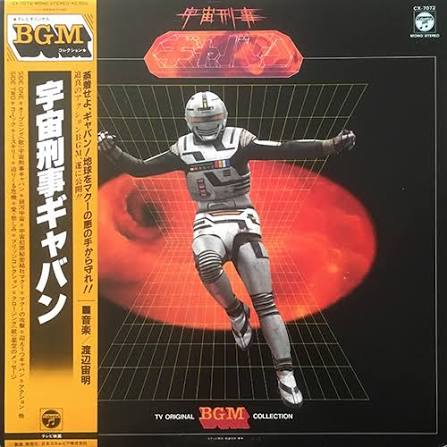
In Gavan the background music enters with each scene, and the scene becomes identified with it.
That's still important. There's no point in piling up cues that merely fit the picture. I'd rather have a few tracks with real appeal, each one standing on its own, and I work the same way with advance recording, when the music is written before the scene exists.
He also asks about lyricists. Is there one you have a special working rapport with?
There are no behind-the-scenes stories, and if there were I wouldn't tell them. Talking about rapport is a little unfair to the others, but I would still say Keisuke Yamakawa was the best lyricist for me. He wrote by hand, vertically, on manuscript paper, in large characters, and he built the song in blocks of four lines, four lines and two, with the composer's life in mind.
With a text like that, composing is easy, because the image arrives right away and the melody settles in on its own. An irregular text gets in the way. A structure of four bars followed by four more organizes the feeling of the person writing. The traditional Japanese meter of seven and five syllables is easy to set to music and has the drawback of becoming monotonous.
Where does the name Chumei come from? The first character is the one for "universe," isn't it?
It's my real name, those are exactly the characters. My parents intended it to be read Michiaki, but almost nobody can read it that way, so it became Chumei, as if it were a nickname. There's no origin story. In middle school a teacher asked me how it was read and remarked that the reading "Michi" doesn't appear in the dictionary for that character, and in the end he figured it out from the way the character is built.
The third email is from a listener named Marushin. He points out that on August 19 you turn 88 and sends his congratulations six months early. He also suggests a concert called Chumei Spirits, with Ichiro Mizuki, Mitsuko Horie and other singers, with the set list put together by you and Shocker OH!NO! and background music playing between the numbers.
If someone puts on a show like that, I'm in.
16Gavan, Goggle V and Gorenger
In the same period you did Gavan and Dai Sentai Goggle V, both at the same time.
They really did overlap, and inside Toei there was a debate about having the same composer on both shows. The colors are a little different: the Sentai team shows are aimed at a younger audience and the Space Sheriff series is more grown-up. I kept that in mind the whole time.
In Goggle V rhythmic gymnastics is a motif, and in Battle Fever J each character has the music of the country he represents, with a Spanish flavor, American disco and so on.
There was a request from the production along those lines. At first, the plan was for the characters to fight while dancing. In that outfit, dancing flamenco, the fight simply doesn't happen, so it became difficult and the dancing was dropped.
On the other side of that story is the masculine quality of Gavan. I have two sides: I like ballads and I'm good at them. The theme for the Tuesday rerun of Sazae-san is mine, and there's nothing of the team-hero shows in it. Lyrical melody was what I did originally, and for action I switch personas on the spot.
And Gorenger, with five heroes instead of one. Did the music change because of that?
I don't remember that part. The meetings started with Toei sending the script, I went to the head office, went over the material with them, and the conversation happened at the coffee shop that still exists near there. Gorenger has a story worth telling. That opening everyone knows was not something I wrote at first. The song went straight into the verse, with no introduction at all. I brought in the finished version, everyone approved it, and then the director at Columbia phoned to say it was good and to ask whether something couldn't go in front of it. I asked for a little time, hung up, and thought about it for around an hour, and that's when the scat came out, that wordless vocal line.
Which Nanbara, of the comedy duo Ucchan Nanchan, made popular all over again on Tamori's show, and today there are kids who know it without knowing it's from Gorenger. The series ran two years, and from there came the whole Super Sentai lineage, 37 shows with you at the origin of it all.
I wrote a lot of insert songs for that series too, and they sold well at the time. These days I listen to J-pop and find today's music cold for my taste, which may just be a difference of eras. I listen anyway, and I have my own way of listening.
17Farewell
You stay to the end of our events. The show ends, you go to the after-party with the crew, and then you still meet the fans waiting at the exit, talk with all of them and have tea with them. Reports of that show up on Twitter all the time, and there are people who become fans through the music and end up fans of you. There was even a funny comment at Metal Hero Spirits from someone who thought Chumei Watanabe was the name of a team of composers, because one person couldn't possibly have done all of that.
I don't usually listen to my own work. When I do, I end up thinking it still deserves to be heard.
Our time is up. A message for everyone listening to the show.
Thank you to everyone who listened this far, and thank you both for having me. I still intend to compose, and I have plenty of fight left. Because of my age, scoring an entire series' background music by myself has become quite a burden, and that's a pity. All the same, you can keep counting on me.