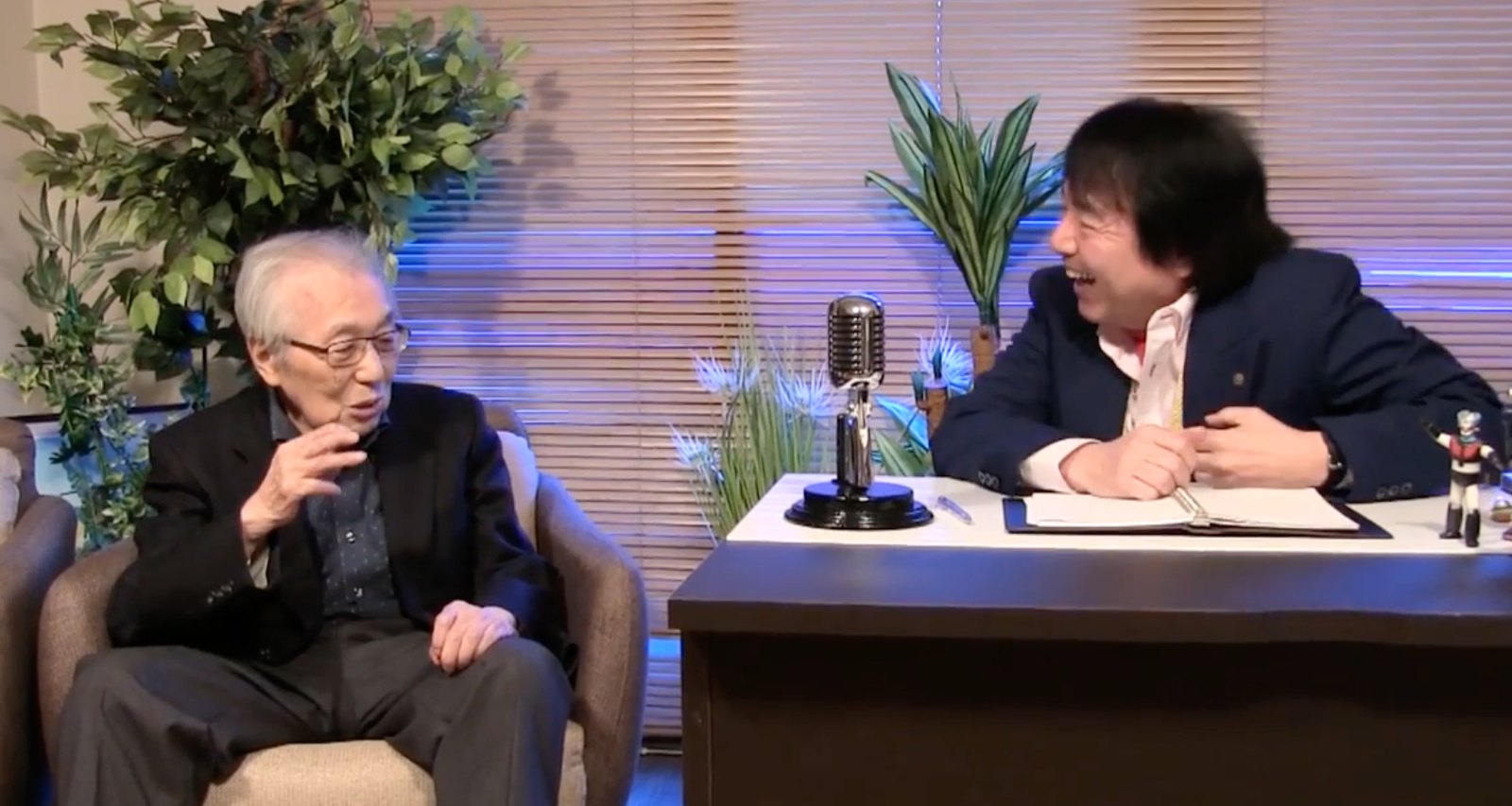
Chumei Watanabe gave this interview to The Marusan Show, a program on the Marusan TV channel hosted by Eiji Kaminaga, the sixth president of Marusan, the vinyl toy company that shaped the childhood of generations in Japan. The conversation was recorded in early 2016 and released in parts on YouTube. The occasion was the theme Watanabe had written for Tederos, Marusan's own series, which had just been included on the compilation Chumei Rare Treasures 1957-2015. At 90, with a new track in stores, the composer used the show to retrace his entire career, from the college degree that served as his safety net to the synthesizer he bought from a salesman and used on Mazinger Z.
01Tederos
Today's guest is the composer Chumei Watanabe, the man behind the music and the theme songs of a huge number of animated series and tokusatsu, the Japanese live-action genre of superheroes and special effects. Professor, welcome. Last year you wrote the theme for Tederos, a Marusan production, and that track has just come out on the compilation Chumei Rare Treasures. I never imagined the Tederos theme would be composed by you, and I was overjoyed when it happened. Today, besides promoting the album, I'd like to use your visit to walk through the history of your work.
I'm the composer Chumei Watanabe, pleased to be here. That project started with the Marusan people, in a conversation about something simple, built around the look of the toys. But music has to be done properly whatever the occasion, so I gave it the same attention as any other job. It was a tight-budget production, and a commission like that has an upside and a downside, because the composer gets far more freedom than on a big studio project.
02College as a Safety Net
When I read your résumé, the first thing that surprised me was your education. Since you're a musician, I assumed you had gone to a music school, and in fact you majored in psychology at the University of Tokyo, in a program that sits inside the Faculty of Letters. How did that come about?
To explain why I went to college at all, I have to go back a little. When I announced at home that I wanted to be a composer, my father didn't object, but he pointed out that nobody knew whether you could make a living from composing, and that it would be wiser to get an ordinary college degree first. So from the old-style preparatory school I went into psychology, which at that university is housed in the Faculty of Letters.
I chose psychology because I wanted to study something connected to sound, the side of it that deals with hearing, and I ended up writing my thesis in that area. So college, in my case, was a safety net in case I never made it as a composer. It's the reverse of what people usually do, and yet some people do it that way.
03The Classical Music Hour
How did you first encounter music? What made you want to compose?
Composers today have generally lived with music since they were small, and that has been true for a few generations now. My case was different, because I was born at the end of the Taisho era, and a boy of that time had almost no contact with Western music. On the radio, most of the programming was something else entirely. My father bought records and listened to the popular songs of the day, Taro Shoji and the singers of that period, and he called me over to listen with him. I sat next to him, quietly, and listened. That was all of elementary school.
And once the urge to compose appeared, how did you go looking for music?
After I decided I wanted to compose, I needed to hear real music, and in those days serious music meant classical. NHK had a music appreciation program on Radio 2 that aired every day, in the morning and again in the late afternoon, at 6, and I listened to it day after day. The trouble was that it was nothing but austere pieces, chamber music and the like, and showy orchestral music never came on. I found all of it dull and kept wondering whether the problem was me, that I didn't understand music.
Much later I saw that my instinct had been right, because that's how music is, and that experience ended up weighing on my work. That's where I learned that music needs to be a little showier, because nobody understands that kind of austere piece, and most people listen exactly the way I did back then.
04The Harmonica and the Theory Teacher
And your first instrument, how did it reach you?
My first contact with Western music came through the harmonica. I'm from Nagoya, but because of my father's work the family spent some time in Tokyo, and that's where I started middle school. A classmate of mine played the harmonica during recess. I found it impressive and immediately wanted to play too. I went to the instrument department at Mitsukoshi, the department store, bought a harmonica and the instruction book, and started teaching myself. That was my way into music, still in middle school.
And there was something else important about that school. The music teacher there wouldn't let the class sing at all. Instead of singing, he taught theory, the whole time. That's where I learned the fundamentals. Harmonica sheet music is written in numbers, with do as 1 and sol as 5, which is very useful, because the degree of the scale gets fixed in your head. After that I learned to read the staff through the construction of scales. In C major the scale goes like this, in D major the fourth degree changes to such-and-such a note, and the exercise was to read the sheet music as fast as possible, naming the notes, even without hitting the right pitch. It was an unusual method and at the same time a completely orthodox one, hardly taught anymore these days, and it served me for the rest of my life.
From then on I bought staff paper and practiced on my own. Today I'll master this key, tomorrow that one. Since the numbers 1, 2, 3, 4 and 5 correspond to do, re, mi, fa and sol, the interval between notes comes out naturally. That's how I came to read the full staff before I had ever touched a piano.
05Piano at 15
How old were you when you started piano?
Around 15. One day I told my father I wanted to be a composer, and he replied that, for that, the harmonica wouldn't do, it had to be piano. My sister was already taking lessons, so there was a piano in the house, and I went to learn from a teacher in the neighborhood.
And as soon as you started piano, were you writing your own music?
Not at all. I had never written a piece in my life and had no idea how composing was done. I had no clue whether I would ever become a composer. The only thing I had was the desire, and confidence I had none.
06Ikuma Dan
So at the university you were studying psychology and, at the same time, studying composition outside it.
That's right. At the University of Tokyo the humanities programs demand less than the sciences, but I studied properly. And the psychology there was experimental, which turned out to be very useful for the way I think, because everything is done with data, measuring every detail. It was no use for composing, but when it came to talking with a sound engineer it helped enormously, because I had studied acoustics and knew what he was talking about.
Composition I went to study with Ikuma Dan. I entered graduate school and stayed in Tokyo precisely so I could keep studying with him. When I finished my first year, my father fell ill, it was cancer, and I rushed back to Nagoya to care for him. I dropped out of graduate school after that first year, made Nagoya my home base, and started traveling to Tokyo about once a week, just for the composition lessons.
07The Front Desk at CBC
After graduating and going back to Nagoya, you started working in radio. How did that happen?
After a while of studying I wanted to start working, because I had to earn a living. I figured there might be work in radio. The Chubu-Nippon Broadcasting Company, CBC, had just been founded, so I went over, walked up to the front desk and asked the young woman there to call someone from the music department. There was a music section, and its head came down. We talked in the lobby, I told him I was studying composition and wanted to write for radio, and he listened very patiently and told me to come back. I went back several times, and one day he handed me a script and said: try this one.
Was it a radio drama?
It was, and science fiction at that. It was called Atom Boy and came from Osamu Tezuka's manga, adapted for radio. At that point my range of compositional tools was very narrow, I didn't really know how to go about it, and so I can't call the result a great success.
08The Tape for Shintoho
And from radio in Nagoya you moved to film in Tokyo. How did that transition come about?
That head of music at the station was originally from Tokyo. Around then Rokuro Hara, a composer of popular songs, passed through Nagoya and told me to come to Tokyo, even suggesting I work as his assistant. But what I really wanted was film. So I took the tape with the background music I'd written for the radio dramas and went to the Shintoho studio. Ichiro Miyagawa worked there, a man who later became a screenwriter and died recently, and who at that time was a producer's assistant at the studio.
I went to ask his advice. He had never heard a note of my music, but he said that from Nagoya the conversation wouldn't go anywhere and that I should come to Tokyo. He must have trusted me on the strength of the conversation alone. I brought the tape, there were people at the studio who understood music, they listened and said it was good, that I just had to wait for a phone call because things would be settled soon. I moved to Tokyo and waited about six months.
09Six Guitars
And then came the first film, with music for Shintoho.
Word came that it was set, and the first job was a film by director Nobuo Nakagawa, from the Ningyo Sashichi detective series, with the request that the score be done with guitar alone. I was taken aback. The crew thought it was risky too, and someone suggested adding a timpani, and I said I would do it with guitar only.
Since the guitar's sound is short, I needed something to sustain the chords, and I used microphones for that. I ended up hiring six guitarists, which may have been too many. But each of them played a different part, and the result sounded almost orchestral. I think a way of working came out of that.
10Super Giant
That's how you came to write film music, and soon after came your first hero, Super Giant, in 1957, one of the forerunners of the Japanese superhero.
That was by chance. It wasn't a planned series, the project appeared out of nowhere, and it grew out of my working relationship with director Teruo Ishii. I admit it gave me trouble. Until then I'd been doing contemporary dramas, plenty of period films and action films, and a children's superhero was a different thing, because the character flies, like Superman. The brawl scenes gave me the most trouble.
11Television and Gekko
And after film, your work started reaching television.
There was a conductor who specialized in film music, a very helpful man, and I asked him for help. He must have thought I was up to it, because without my asking again he introduced me to a television network. It started with Nippon TV, with television dramas, and from there I began working in television as well.
Among those television jobs was Ninja Butai Gekko, which I loved as a kid. To give you an idea, I went around dressed as Gekko, and we all sang that theme, which was hard, though everybody nailed the ending, the "Gekko, Gekko" part.
Every boy dressed like that back then. It was the era of Onmitsu Kenshi and Gekko Kamen, and all of those series were big hits with a lot of buzz. Shintoho, rather than making films, had moved into producing television programs, and the producers and directors of that time called on me quite a lot for their projects.
12Kikaider
From Ninja Butai Gekko we reach the 1970s and the henshin boom, the craze for transforming heroes, with Kikaider.
Even after moving into television, I was basically doing adult programming, serious drama, with a method completely different from today's. At some point the work slowed down, and I went to Toei to ask for a job, since I already had a relationship with them from my film days. Soon they called to say it was settled. When I read the script, it was a children's show, and I'd been expecting an adult drama. I was surprised and even said something rude: oh, it's for kids? The people there shot back that kids' shows are better, that those are the ones that last. I thought maybe that was true, and today I can see that was the turning point of my life as a composer. If I'm still working today, it's because of that.
On Kikaider, in a 30-minute program, there was an enormous number of songs: the opening, the ending, the insert songs, the enemy army's song, Jiro's theme before he transforms, Gill's song. The opening was sung by Hide Yuki, the insert songs included work by Masato Shimon, who would later record the opening and ending of Kikaider 01, and the DARK song was sung by Ichiro Mizuki. Several singers on a single show. Looking back, it was lavish.
On Kikaider it was already in the original concept that Jiro would play the guitar, which was an interesting idea, and that's why the insert songs were written so that each character's personality came through clearly. There was Saburo's theme, and so on. As for the singers, at that time Columbia had few artists under contract, so they mobilized everyone they had available.
13Mazinger Z and the Moog
Kikaider was well received, and right after it came the giant-robot anime boom with Mazinger Z. Kikaider was tokusatsu, with live actors, and Mazinger Z was animation. Was that your first animated work?
It was the first. Until then I had done theatrical films, action films, hero films, and this was animation, with a giant robot, something that didn't exist until that moment. What excited me was the difference from what I'd been doing: in an action film the dramatic weight is lighter, and on Mazinger Z the weight was something else. I thought it would be a lot of work, and I threw myself into it.
Was Denjiman the first work where you used a synthesizer?
It was Mazinger Z. The instrument was called a Moog, which is the name of the man who invented it. A salesman from a music store came by offering the synthesizer, I found it fun and bought it on the spot. I used it for the scenes in the enemy's lair, bringing the instrument into the studio. Back then practically no composer owned a synthesizer, and only some time later did the models that could play chords appear.
14Inazuman and Sazae-san
After Kikaider came Inazuman, with the same lead actor, Daisuke Ban. What do you remember about Inazuman?
When I listen to it today, I recognize a mannerism of mine in the way I build a melody, and it shows too much. After that, under its influence, other similar things followed. The vocal recording, on the other hand, was very good and fresh. I was still seen as a newcomer, Toei had put me forward, and even so everything was approved without much difficulty. Today I think it was well done.
Shortly after that came Sazae-san. The series has been on the air since 1969, on Sunday evenings at 6:30, and still is. In 1975, about six years after its debut, a Tuesday rerun began at 7 p.m., in prime time, and even though it was a rerun it got a brand-new opening theme, composed by you.
That request came through the record company, from the animation studio, which wanted its own theme for the Tuesday Sazae-san. It's the genre farthest from me there is. Family comedy is hard precisely because it has to be light and charming at the same time, and that's not easy to pull off.
The Sunday Sazae-san was already a national institution, with its opening and closing themes in everyone's head. When you wrote the Tuesday theme, were you concerned about setting it apart from the Sunday one?
I can't say I had never heard the Sunday theme, but I didn't have it in my head either. The request was for me to write something separate, independent of it, and that's what I did.
15Gorenger and the Ten Minutes
After Sazae-san we come to Gorenger, whose opening is the most famous example of what fans call the "Chumei sound."
The show was a hit and the song was a hit too. I wrote the song starting straight in on the verse, with no intro, took it to the record company, and it was approved on the first pass, in one go. Later, once I was home, the phone rang, and it was the director in charge saying it was fine as it was, but asking whether some interesting phrase couldn't go in before the start. I asked for a moment, hung up, and spent about ten minutes thinking. Since there were no lyrics for that part, it had to be scat, a vocal line without words. I called back, sang what had come to me, and it was decided right there, over the phone. It turned out to be a big success.
That scat is a signature of yours. When we commissioned the Tederos theme, one of the things I asked for was precisely a scat, and you put one in, and that's what makes people recognize the sound instantly. Goggle V has one too.
Maybe it really is necessary, in a sense. On Goggle V there were no lyrics for that section, and the song needed to be appealing no matter what, so I decided to carry the melody with the voice itself, in scat, without words. I think it worked.
And the shouts that turn up in a lot of the songs, like the ones in Kikaider 01? Are they written into the composition?
The shouts come up in the studio, during recording, on the spur of the moment. Some director asks to try a shout at a certain point and we record it. They're not in the score and not in the lyrics. It's something born right there, in the moment.
16Denjiman and the Chorus
From Gorenger you went on to JAKQ, Battle Fever J, Denjiman, Sun Vulcan and Goggle V, from the late 1970s into the early 1980s. Of that run of team shows, which stayed with you most?
Denjiman. I wanted a chorus on the music, and I joined the chorus myself. That's a point of pride for me. As for the synthesizer, in those days few composers owned one, and there were people who made a living programming the instrument for others. We'd call one of them in, hand over the score, and they'd program everything from there.
17Kushida and Mizuki
On Sun Vulcan the theme was sung by Akira Kushida. Do you remember how he came aboard?
I do, and it's a story for the whole of Japan, so to speak. Toei had passed along to Columbia a complaint that it was always the same group of singers and that it was time for someone new to appear. Columbia took that seriously. Right around then a demo LP arrived at the label, and it was the soundtrack album of the Australian film Mad Max, with Kushida's name on the cover, singing in English. The director in charge called me in and said: a singer showed up with this demo, listen and tell me what you think. I listened, thought it was great, and said on the spot: let's go with this guy, I recommend this singer.
But the director wanted the department head's approval and took the record up to him. The head hesitated and said he hadn't quite understood what was there. I got irritated and said: what do you mean, you didn't understand? He's obviously good. And that decided it. From then on Kushida became the label's go-to singer, and the ones who opened that door were me and that director.
And Ichiro Mizuki, the singer of Mazinger Z? How was it with him?
Mazinger Z was my first job of that kind, and at that point I barely knew any singers. It was the record company people who said there was a singer named Ichiro Mizuki, brought him in to record, and since it turned out well the choice was settled that way. Mazinger Z in his voice became a worldwide hit, and that deserves to be noted.
18The Insert Songs
This is a hard question, I know. You've composed an enormous number of songs. If you had to choose, what would be your three best?
That's nearly impossible to answer, because to me they're all good. And it isn't just about the opening themes. Among the insert songs there are several I would very much like people to hear, but at concerts only the opening theme gets sung, and the insert songs are left out. That's why I can't pick three. If I had to recommend something, I'd ask people to listen to the ballad-style ending songs, the slower ones.
The truth is that the masterpieces are in the insert songs. The opening theme has to sell the show, it has to make its presence felt, and all the attention goes that way. It's not that the themes are bad, they're all good, but an insert song hardly depends on the picture, and a good insert song works even without the scene it was written for.
And among so many jobs, was there one that gave you more trouble, a song that took a long time to come?
There's always a bit of trouble, because you can't do the same thing every time. With every new commission the combination of words and rhythm is different, and that's where the difficulty lies.
19The Internet Rumor
You've always been out in front, with what people call cutting-edge music, and you still keep up with what's being made today. So much so that a rumor went around online that you had written a song for AKB48.
A lot of what gets called cutting-edge is doubtful when it comes to still being sung at karaoke ten or forty years later. What lasts is music you understand on first hearing, and I think that's what matters most. As for the rumor, it wasn't AKB, it was a group from the same family, SKE. I was looking for something else online and saw a song credited "composition: Chumei Watanabe," and I wondered what that was about, because a mistake like that doesn't happen by accident. It turned out the page was run by the distributor, not the production company, and they said they would fix it, which took a while. It's still strange, and only Yasushi Akimoto could explain it. It may have been done to create buzz, or someone mentioned my name somewhere.
20At 90
You're 90 and still working, and I'm looking forward to the next new song. There are still the concerts in March and May, and a few tickets are still available online. The Chumei Rare Treasures compilation, with the Tederos theme, has been in stores and on Amazon since December 2015. For me, hearing the "Chumei sound" I've known since childhood in a brand-new song, written now, was a thrill. Thank you so much for today.
Thank you.