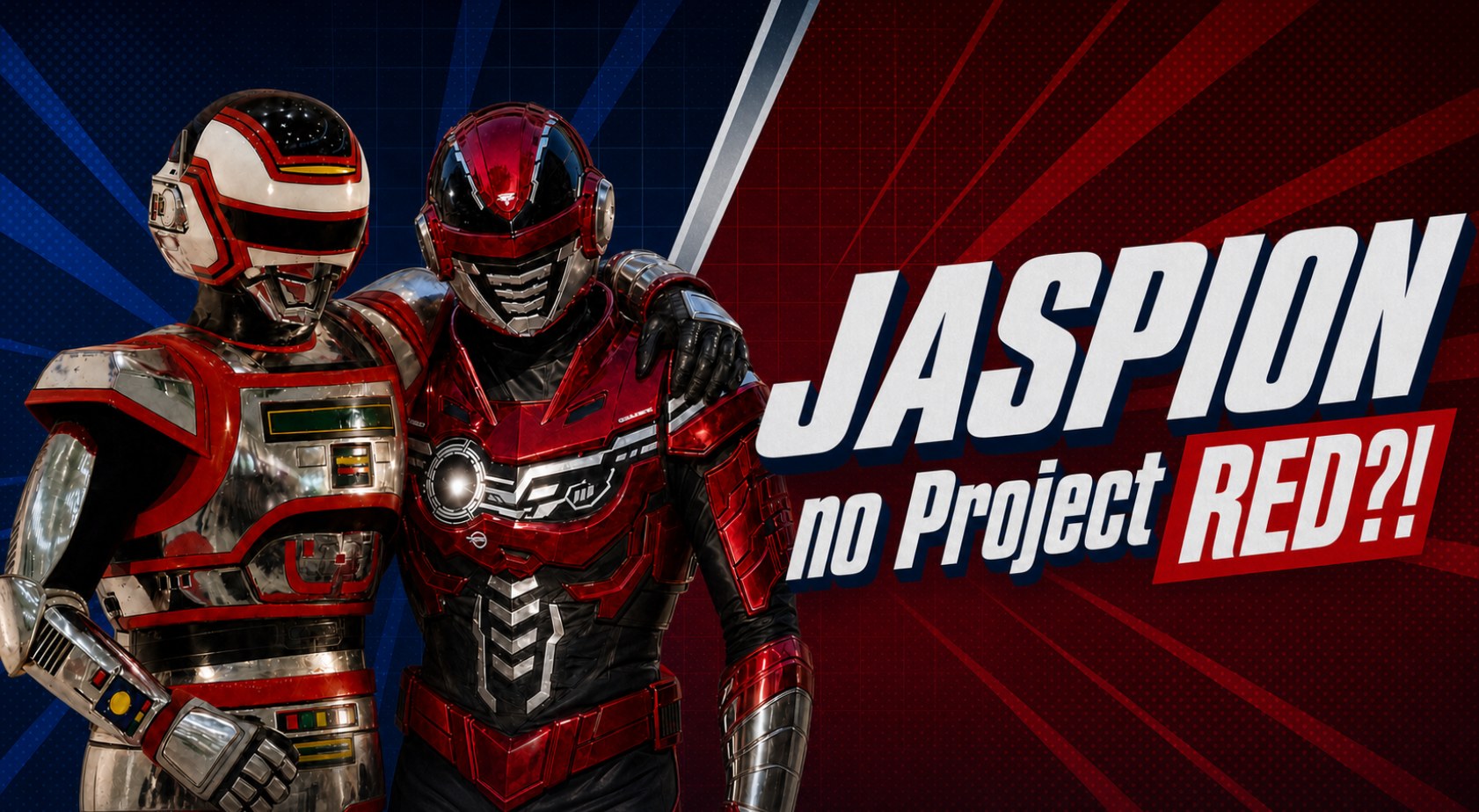
One of the most influential names in modern tokusatsu talks to Kyoudai Express about the end of Super Sentai's annual cycle, the new PROJECT R.E.D. brand and the Brazilian film adaptation of O Fantástico Jaspion.
Few people have shaped modern tokusatsu as much as Shinichiro Shirakura. The producer behind Kamen Rider Agito, Kamen Rider Ryuki, Kamen Rider 555, Kamen Rider Den-O, Kamen Rider Decade, Choukou Senshi Changerion, Gosei Sentai Dairanger, Kikai Sentai Zenkaiger and Avataro Sentai Donbrothers is now a senior executive at Toei, where he runs the company's character strategy and serves as head producer of its film and television output.
Shirakura recently returned to the center of the debate about the future of tokusatsu with an interview to the Japanese newspaper Asahi Shimbun, in which he laid out the reasons why Toei is bringing the annual Super Sentai cycle to a halt after half a century on the air.
The end of No. 1 Sentai Gozyuger closes out a structure that had run almost without interruption since 1975. As Shirakura makes clear, though, that does not necessarily mean the franchise is dead. For Toei, this is a chance to rethink a model that worked for decades but struggled to grow as a long-term brand.
That is the context in which we at Kyoudai Express approached Toei and invited Shirakura for an exclusive interview. We took the opportunity to talk directly with one of the people who set the company's strategy about the future of Super Sentai, the way audiences have changed, the challenges facing hero shows and Toei's ambitions abroad.
One of the main subjects of the interview is PROJECT R.E.D., the new tokusatsu brand created to fill the space Super Sentai leaves behind. According to Shirakura, the goal is not simply to replace Sentai with another annual series, but to break with a system in which characters and worlds are reset from scratch every year.
The project intends to try out different formats, create new heroes and build a universe of its own, different even from the model used by the Marvel Cinematic Universe. The official PROJECT R.E.D. site presents the brand as a line of shows led by red heroes whose worlds can cross over through different dimensions.
Shirakura also spoke about the long-awaited Brazilian film adaptation of O Fantástico Jaspion. He confirmed that he traveled to Brazil at the start of the project and took part in meetings with the team at Sato Company. He now follows the production from a distance, but said he plans to return to the country once it moves forward, and he joked about a possible tie-in with PROJECT R.E.D., even though Jaspion is not red.
He also sees real room for collaboration between Brazilian and Japanese creators. For him, a co-production that brings together the talent of both countries and surprises audiences around the world would be a source of enormous satisfaction.
A producer's method
"When we pitched the idea of "13 Kamen Riders fighting and killing each other" for Kamen Rider Ryuki (2002), not a single person agreed with it."
Shinichiro ShirakuraOver the course of your career you have worked on countless hero productions. When you start planning a new one, what is the first thing you think about: what kind of hero to create, what kind of story to tell, or who the show is for? Has that way of thinking changed since you were young?
The first thing I do is draw up a list of the conditions that particular project demands. Of the options you mention, "who the show is for" is the closest to it.
After that, I work out the image of the hero and the story that fit those conditions.
The way I develop a project has not changed since I was young. Back then, though, the conditions were simpler. I do not know whether it is because I have gained experience or because I have lost some of the drive I had when I was younger, but the conditions have grown steadily more complex, and the work has become harder.
Among the shows you have worked on, was there an idea that ran into strong resistance inside the company or among the people involved, but ended up becoming a turning point for the franchise?
When we pitched the idea of "13 Kamen Riders fighting and killing each other" for Kamen Rider Ryuki (2002), not a single person agreed with it.
Beyond being a commercial success, the show had a very strong impact on society. I believe it ended up setting, in a number of ways, the direction the Kamen Rider franchise would follow afterwards.
The audience that no longer waits for the hero to struggle
"What children and viewers are looking for seems to be an "appealing, fascinating person", regardless of whether that person stands for good or evil."
Shinichiro ShirakuraThe places where younger generations come into contact with content are far more fragmented today: television, streaming services, YouTube, short-form video on social media, games. In your view, how has the way children and young people watch hero shows changed?
This is not limited to hero shows. In any genre, the audience needs a certain familiarity with the conventions of that genre, and an understanding of them.
For someone to feel the catharsis of a story in which "the hero struggles and then wins", for instance, the viewer has to already know the basic narrative structure: a powerful enemy appears, the hero struggles, the hero wins.
That kind of familiarity has been shrinking year after year. My impression is that a growing number of viewers see "the part where the hero struggles" as a waste of time.
I found it striking that you say more and more viewers see the scenes where the hero struggles as a waste of time. Faced with that audience, should shows change the grammar and the structure of their stories? Or should they find a new way to convey the appeal and the catharsis of overcoming hardship and winning?
The way shows and stories are built has to change with the times and with what the audience wants. Going further than that, the ideal is to get ahead of the audience, to invent ways of creating that did not exist before and to lead your own era.
Is there anything about today's children and young viewers that you think the television industry, or adults in general, get wrong? If any real audience reaction has gone against your expectations, could you tell us about it?
This is not something that only happens now. The television industry and adults have always tended to believe that a "righteous, upstanding person" will win the audience over.
When you look at how people actually react, though, what children and viewers are looking for seems to be an "appealing, fascinating person", regardless of whether that person stands for good or evil: someone strong, someone interesting, someone good-looking or full of energy and drive.
A different show for each audience
Among children and their families, longtime fans, young people who are not familiar with tokusatsu and viewers abroad, which of these audiences does Toei especially want to reach with its future tokusatsu productions? What kinds of touchpoints do you plan to expand in order to get there?
We intend to separate "children and their families", "longtime fans" and "young people who are not familiar with tokusatsu and viewers abroad", and to offer different work to each of them.
For "young people who are not familiar with tokusatsu and viewers abroad" in particular, we intend to offer films above all.
Toei's tokusatsu output has always had television series at its core. Watching a single film and understanding from it what makes a show interesting, however, is a lower barrier to entry than watching the 50 episodes produced over a full year.
The end of the annual Super Sentai cycle
"I think that comeback will take a different shape from the traditional Super Sentai."
Shinichiro Shirakura, on the return of Super SentaiWith No. 1 Sentai Gozyuger, the annual Super Sentai television series has come to a stop. Why did that decision become necessary now? Among "an ending", "a pause" and "a period to be reborn in a new form", which is the most accurate way to understand where Super Sentai stands? Could you also explain what conditions would have to be in place for the franchise to come back with a new production in the future?
The Super Sentai business model has one specific trait: "only the new show is strong". In that respect it is different from the Kamen Rider franchise, whose past shows and characters stay popular for a long time.
Because the business inevitably ends up confined to a passing phenomenon, limited to a single year, there is no way to lay out a medium or long-term development plan spanning several years. As a result, there are limits to how far the franchise can grow as a brand.
Once we have built up knowledge through the attempts and the experiments of PROJECT R.E.D. and found ways around those limits, I believe the conditions for Super Sentai to return will be in place.
I think that comeback will take a different shape from the traditional Super Sentai, though. In that sense, I believe it is fair to say that this is a period for Super Sentai to be reborn in a new form.
PROJECT R.E.D., the universe Toei wants to build
"We want to create a new hero universe, one that is also different from the MCU."
Shinichiro Shirakura, on PROJECT R.E.D.What challenges was PROJECT R.E.D. created to take on, and what forms of expression does it want to try that would be difficult within the traditional Super Sentai and Kamen Rider models?
First of all, we want to create a wider variety of hero intellectual properties.
Toei takes pride in its experience and its skill in making hero shows. In practice, though, we essentially produce only two franchises: Super Sentai and Kamen Rider. Hero shows have far broader possibilities, and we intend to explore them.
Second, we want to break with the traditional production system Toei has kept in place for several decades: the one-year cycle, at the end of which both the world of the show and its characters are completely reset.
We want to create a new hero universe, one that is also different from the MCU.
Within PROJECT R.E.D., is there a possibility that the format changes radically from one show to the next, taking in single heroes, teams of heroes, giant robots and even genres other than the Space Sheriffs? And on the other hand, what would be the core element shared by all of these productions?
The mission PROJECT R.E.D. has been given is precisely to change the format radically from one show to the next.
If everything is too different, though, the shows may end up too fragmented and lose the unity a single brand needs.
That is why we set as a common element something inherited from Super Sentai: a red character in the central position, even though R.E.D. does not actually stand for the color red.
Does the new hero universe PROJECT R.E.D. wants to build assume that the shows will connect at the level of the story, with characters from different productions turning up and crossing paths? Or is it about developing independent works, each on its own, brought together under a shared way of thinking and a shared brand?
It is about crossovers, with characters from different shows meeting each other, but that does not necessarily mean they are connected at the level of the story, the way they are in the MCU. That is exactly where we are looking for a new form.
What kind of result or audience response would you have to see in order to conclude that PROJECT R.E.D. is heading in the right direction, and that the conditions for reviving Super Sentai in a new form are in place?
At the very least, the essential condition is reaching a point where we ourselves feel that we are managing to create genuinely new hero shows, ones that did not exist before, and that we have built a production structure capable of delivering images that exist nowhere else in the world.
Jaspion, Brazil and a co-production
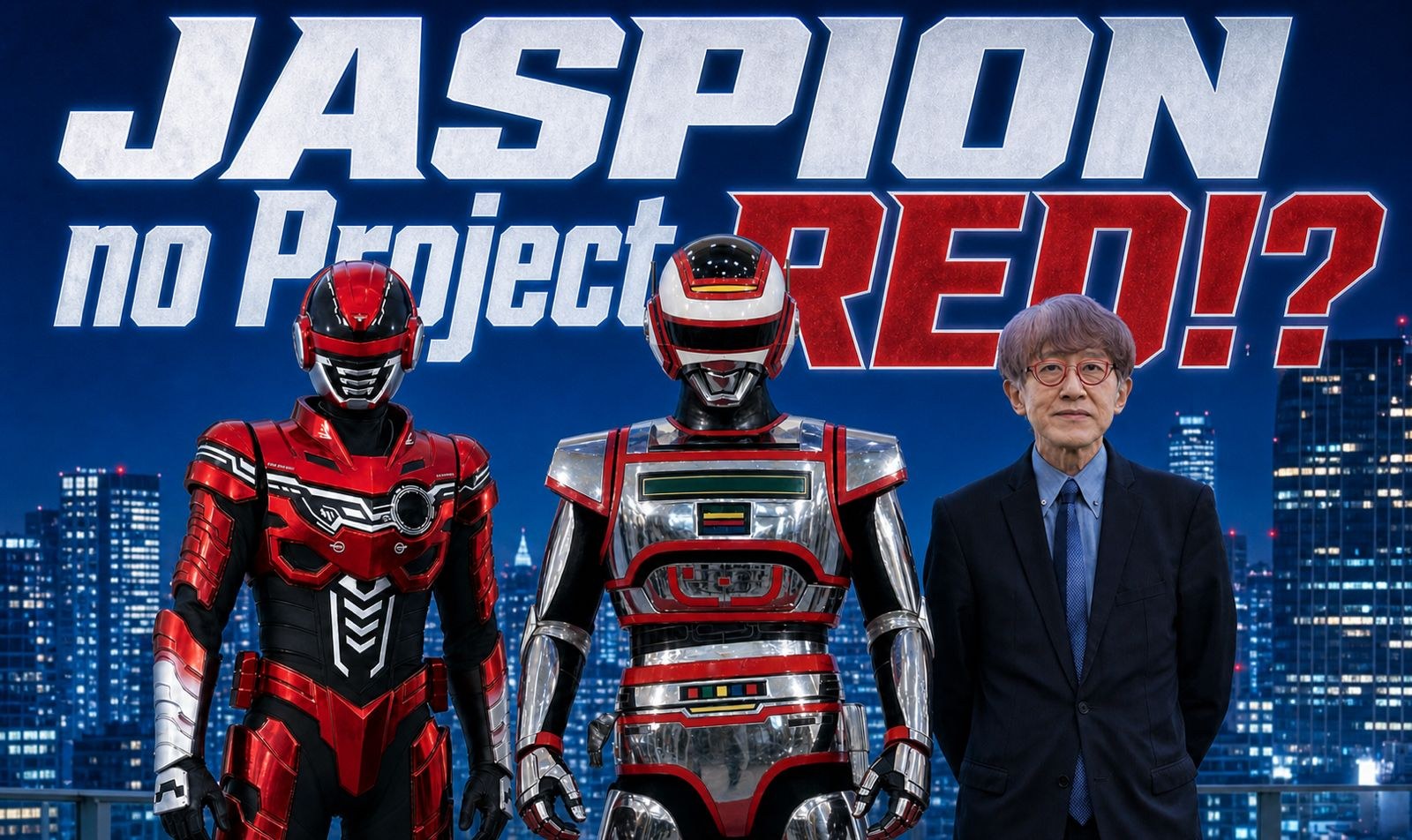
"If Brazil and Japan can join forces in a co-production and create something that surprises the whole world, there could be no greater joy for us."
Shinichiro ShirakuraIt has been reported that Sato Company, in Brazil, is planning and developing a film based on O Fantástico Jaspion, and that it is in talks with Toei about the script. How are you involved in that project?
When the project started, I visited Brazil and had in-depth discussions with the team at Sato Company.
At the moment I only receive reports on how it is progressing, so my involvement is indirect. Once the project moves forward significantly, though, I would like to visit Brazil again.
It would be interesting if it could be tied to PROJECT R.E.D. as well... even though Jaspion is not red.
In the case of a Brazilian film adaptation of O Fantástico Jaspion, what would you say are the essential elements or principles that absolutely have to be preserved for the work to still be Jaspion?
I think the ideal is precisely not to feel bound to the original Jaspion, and to create freely.
After all, the original itself came out of eagerly absorbing whatever was considered interesting at the time. It took the Space Sheriff series that came before it as its base, but it also drew on Star Wars, on Ultraman, on kung fu movies and on the JAC boom of the day (the Japan Action Club, which really did exist back then).
In Brazil, several Toei tokusatsu productions are already distributed and made available officially through Sato Company and other companies. Is there a possibility of expanding those partnerships, allowing releases closer to the Japanese schedule, a steady flow of new productions, subtitles and dubbing for the local audience, and even future co-productions?
We will keep working so that new Japanese productions can be watched regularly in Brazil.
The goal is to grow the scale of the business, but we do that so we can make richer and more ambitious work.
Through the Jaspion project, we have started to see that Brazil also has a great many extremely talented creators.
If Brazil and Japan can join forces in a co-production and create something that surprises the whole world, there could be no greater joy for us.