There are careers that track the history of Japanese tokusatsu so closely that the two are hard to tell apart, and Hiroshi Butsuda has one of them. Tokusatsu is the Japanese tradition of live-action fantasy built on costumed heroes, miniature sets and effects created in front of the camera. Butsuda is the president of the Tokusatsu Research Institute (Tokusatsu Kenkyujo), a company that has been producing effects for film, television and advertising since 1965. His own career rests above all on the Super Sentai and Kamen Rider series, with stretches of work on large feature productions alongside them.
He studied engineering at Kyushu University and joined the Tokusatsu Research Institute as an art assistant, training under the veteran special effects director Nobuo Yajima. In 1990 he ran an effects unit of his own for the first time, on Chikyuu Sentai Fiveman. Since then he has helped set the look of one generation of giant robots after another, along with their transformations, their combinations and their battles on a monumental scale.
His career runs straight through a deep change in the way Japanese productions are made. It began in an era ruled by miniature work, wires, optical compositing and explosions shot in camera, and it now sits in a landscape where CGI and digital compositing touch almost every stage of the job. Rather than treat the two approaches as rivals, Butsuda looks for ways to combine them, keeping the energy and the unpredictability of physical work while he explores what the newer tools can do.
In this interview with Kyoudai Express, Hiroshi Butsuda talks about the start of his career, the challenge of putting giant robots on screen, his attachment to GoGoFive, the changes computer graphics brought with them and the directions Japanese tokusatsu may take as artificial intelligence arrives.
01From engineering to tokusatsu
How did you move from the engineering school at Kyushu University to the Tokusatsu Research Institute? Was there a decisive moment that pushed you toward this line of work? And how did the art assistant jobs and the storyboards you drew early on shape the way you direct effects today?
I came to Tokyo with my friend Miike. We worked temporary jobs and spent our free time calling companies to set up meetings. Nothing in particular decided it for me. I had loved Thunderbirds since I was small. Later on I understood that art and storyboards were the simplest, clearest way to get my intentions across to the effects crew.
02The directing debut on Fiveman
When you made your debut as special effects director on Chikyuu Sentai Fiveman, what was the hardest part of the job? Is there a memory from the set that has stayed with you?
I tried to bring an animation sensibility into live-action footage. What stayed with me was learning how hard it is to make everything come out exactly the way the storyboard says it should.
03How the Tokusatsu Research Institute's role has changed
Comparing the old Tokusatsu Research Institute with the company today, how has its role on set changed, and what kind of work do other companies ask you for now?
Instead of being asked to do everything with miniatures shot live, we get more and more requests to produce images in computer graphics.
04Dividing the work on Super Sentai
On a Super Sentai production, how do the main Toei crew and the special effects unit at the Tokusatsu Research Institute split their duties and agree on the visual direction of the show?
The main crew shoots the actors' performances and the action at full scale. The effects crew shoots the giant battles with the robot suits. Before filming starts we hold meetings around the storyboards so that everyone shares the direction we are going to follow.
05When a change of plan improves the result
Over so many years of shooting, was there a case where the method you had planned did not work and an idea found on the set produced even stronger images? Could you tell us what happened behind the scenes?
At first we intended to build GaoLion as the Land Lion, using a miniature. We made the bold call to switch to computer graphics instead, and that let us create dynamic shots of a kind nobody had seen at the time.
06A combination that stands out
Of all the robots and all the transformation and combination sequences you have worked on, if you had to pick one you feel a special affection for, which show and which scene would you choose? Why?
I would pick the first episode of Kyuukyuu Sentai GoGoFive, where each of the Victory Machines takes part in the rescue operation as they move toward the combination. The reason is that the scene reminds me of Thunderbirds, and it is very cool.
07How to avoid repeating yourself
Over many years you have directed the transformations and combinations of countless Super Sentai robots. When you shoot a new one, what do you draw on to avoid repeating the ways you have staged them in the past?
I try not to lock myself into miniatures alone, and I experiment with computer graphics in a bold way. At the same time, a combination sequence built entirely in computer graphics can end up looking flat. When that happens, we try cutting in shots of the robot suit, for example.
08Scale and the feeling of weight
What matters most in the shooting and the directing when you want to convey the scale and the weight of giant robots and monsters?
The camera speed, meaning how many times faster than normal it is running, the focal length of the lens, and the low angle looking up at the subject.
09The toy and the image on screen
How do you reconcile the transformation and combination mechanisms of the toys, and the design limits that come with them, with the need to make everything look spectacular on screen?
I respect the basic mechanisms of the toy, but in the parts I find interesting I exaggerate or stylize what is happening while I direct.
10What digital brought, and what it took away
In the move from the era of miniatures and optical compositing to the era of computer graphics and digital compositing, what did tokusatsu gain and what did it lose?
What we gained was how easy it became to erase the wires that run the mechanisms. What we lost was the tension of having to get everything right in a single take on the set.
11Miniature or computer graphics?
On today's productions, what decides whether a scene is shot with miniatures or created in computer graphics? And what does it take to blend the two techniques so that the seam never shows?
There is no fixed rule for it. To combine them so that the result looks natural, you have to know the characteristics of both very well.
12The challenges of GoGoFive
Kyuukyuu Sentai GoGoFive often comes up as one of the defining works of your career. Among the effects scenes involving disasters and rescue operations, which one was especially hard to film? Could you tell us how it was done?
In the first episode, the close shots of each part of the vehicles during the rescue work were the hardest. To get them we added working mechanisms to miniatures built specifically for close-ups, at the base of the fire truck's ladder and in the thrusters of the hover vehicle, for example.
13Japanese tokusatsu today
After so many years around production, how do you see Japanese tokusatsu now? What part of its appeal has stayed the same, and what has changed the most?
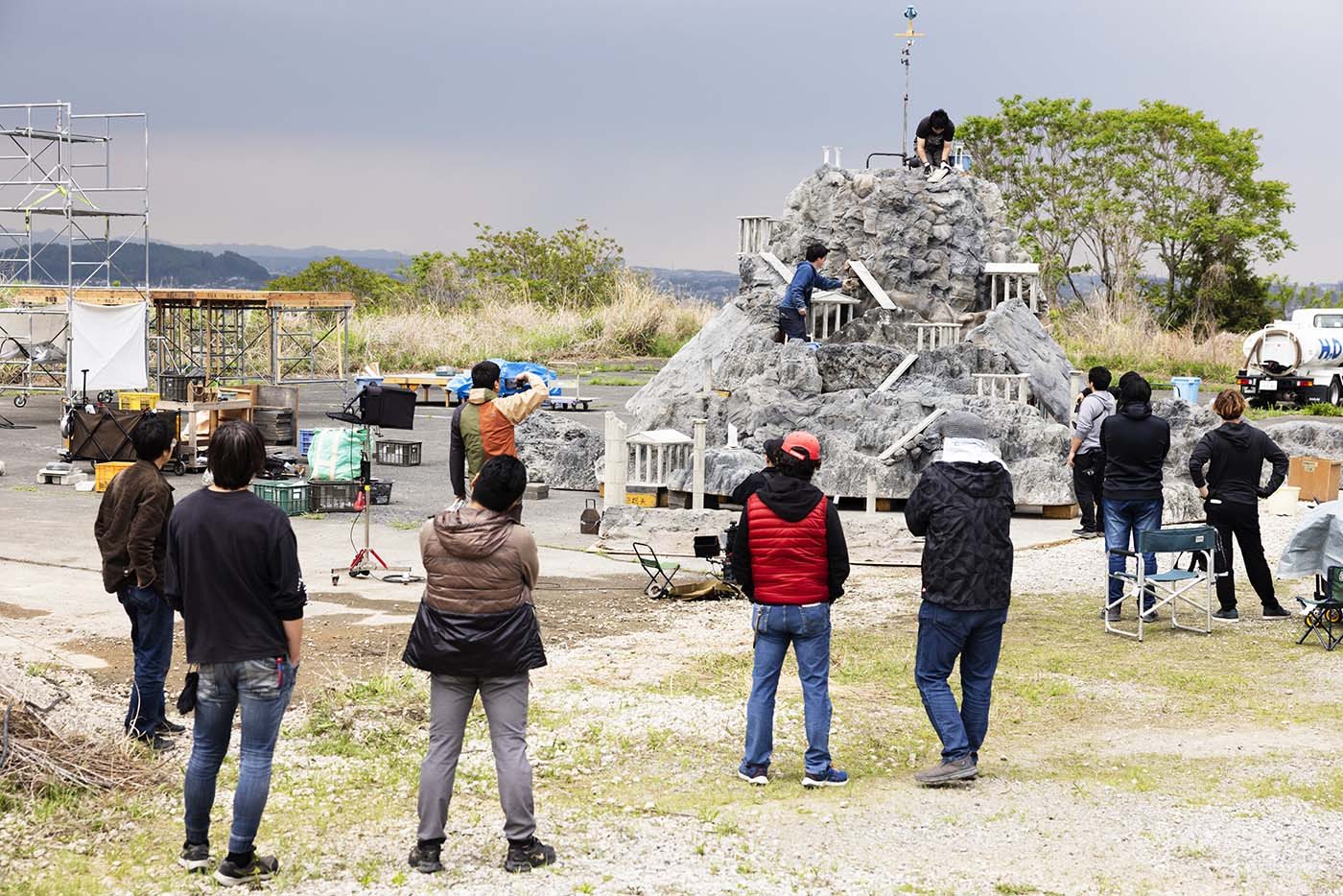
It is a shame that miniature shooting keeps shrinking little by little. Even now, though, on the sets where miniatures are used, the crew works with real enthusiasm and has fun while shooting.
One important change is that we spend far less time hiding the rigging in a scene, because we can erase it afterward in digital processing.
14Different generations and cultures
The shows are made mainly for children, and yet they also have to meet the expectations of longtime fans, of adults and of viewers in other countries. How do you think about a visual language able to reach different generations and different cultures at the same time?
Basically, I shoot in the belief that whatever strikes me as fun when I put myself in a child's frame of mind will also reach adults and people in other countries.
15The future of tokusatsu
Audiences today are not only watching television. They have streaming services, social media, games, short videos and an enormous amount of other content, and tokusatsu has to compete for their attention with big international productions and shows made for the streaming platforms. In that setting, what makes it hard to get people interested in tokusatsu and keep them watching? What are the particular strengths of Japanese tokusatsu, what has to evolve and what should be preserved?
To get people interested in tokusatsu, I would like them to be able to watch more behind-the-scenes videos and other material about how the work is made. On the other hand, some people say that would ruin the dream for children, which makes it a hard question to settle.
The strength of Japanese tokusatsu lies in the miniature shooting techniques developed and refined over many years. I believe that if we bring computer graphics, artificial intelligence and other technologies into them boldly, entirely new work can come out of it.