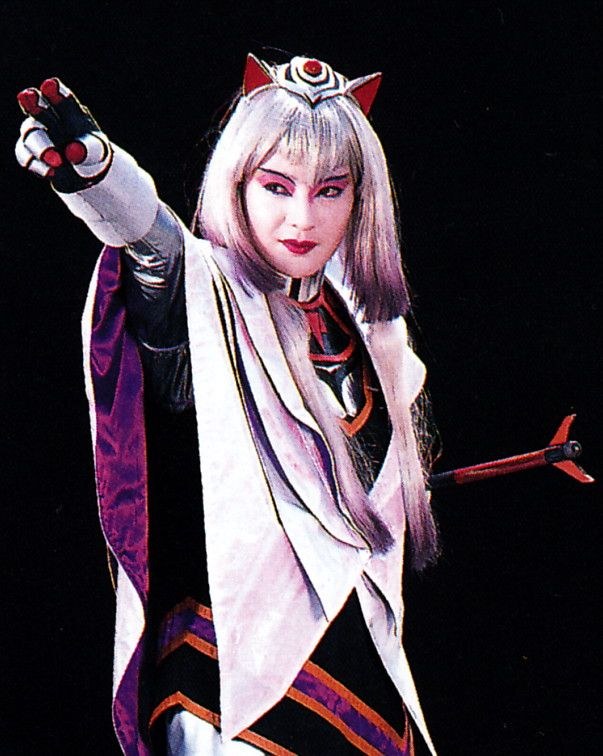
Fukumi Kuroda, who played Queen Ahames in Dengeki Sentai Changeman, gave this interview to Toei Hero Max magazine in 2009, as Toei Video released the series on DVD in Japan for the first time, 24 years after its TV Asahi premiere. Kyoudai Express has translated the conversation in full.
Changeman aired on TV Asahi from February 2, 1985, to February 22, 1986, over 55 episodes, and reached Brazil in 1988 on Rede Manchete, the network that brought Japanese hero shows to a generation of Brazilian kids. Ahames, queen of the planet Amazo, joins the story in episode 17 as an ally of the Gozma empire and dies in episode 53 after blowing up the Changemen's base. The DVD collection came out in five volumes over the course of 2009, and this conversation was recorded on June 25 of that year at Toei Video.
Kuroda was born in Tokyo in 1956 and made her television debut in 1977. In 1985, the year of Changeman, she also played the geisha Tsurumatsu in Haru no Hato (Spring Waves), NHK's historical drama of the year, and joined the cast of Juzo Itami's film Tampopo. She later became an essayist and one of the Japanese entertainers most closely associated with South Korea, the subject of books such as Seoul My Heart.
In the interview, she explains that she designed the character's makeup with the show's makeup artist, with pink eye shadow and blue eyebrows, and that she chose to play the queen with the intensity of Greek tragedy so she could carry the weight of the costume. Kuroda remembers scenes shot on the edges of rooftops and cliffs with no safety line, and the backstage talks with Hiroko Nishimoto, Mai Oishi and Kana Fujieda, who played Shiima.
The conversation also covers the episode 33 scene in which Ahames receives the Rigel Aura, one of the most talked-about moments of the series. Kuroda says she made it sensual on purpose, at a time when she was asking herself whether she had a future as an actress.
01The costume
Do you remember when you were offered the part in "Changeman"?
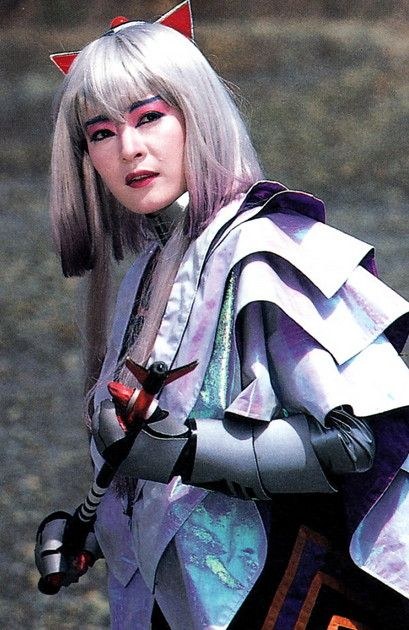
I don't know exactly how the offer came about, but a lot of it was different from the work I had done until then, and that stayed with me. For example, they first showed me the concept drawings of the character and then took my measurements to make the costume. That process alone felt out of the ordinary (laughs). Once the costume was ready, there was still the wig and the cat ears. The V-cut bangs were also chosen to match the look of the costume. It was the same with the makeup. The costume was so beautiful that I didn't want the heavy, poisonous makeup of the villainesses who came before. I wanted to show a seductive kind of beauty. The pink eye shadow, the eyeliner and the blue eyebrows were all things I came up with myself, talking it over with the makeup artist. Later, people told me many times that "Ahames was mysterious," and hearing that made me very happy.
02Nagasaki
Your first appearance was in episode 17, shot on location at the Dutch village in Nagasaki.
At first she hides that she's an alien and shows up dressed as a tulip girl, right? If I remember correctly, right away I had a fight scene with Okamoto (Yoshinori Okamoto), who played Buba (laughs). I remember we talked through how to use the weapon Ahames carries in her hand, a sort of staff, or scepter. Okamoto is a true professional, and I learned a great deal from him. I was given a still from those days and I still have it. Every now and then I look at it and the memories come back.
Since you joined in the middle of the series, did you feel a little out of place?
That never happened. Quite the opposite. What I mostly felt was curiosity about how I was going to play that part. Back then, the trend in TV dramas was a naturalistic, low-key style of acting. I think the idea was that it looked more realistic that way. Ahames, though, wore those outfits, and she was a queen besides, so I decided to play her like Greek tragedy, with all the intensity I could muster. If you underplay it, you can't hold your own against the costume. It's like kabuki. For an actor, getting to do the kind of performance that other sets would forbid is a lot of fun. I think I was completely carried away when I played her.
03On location
After that first appearance, Ahames kept heading to the front lines.
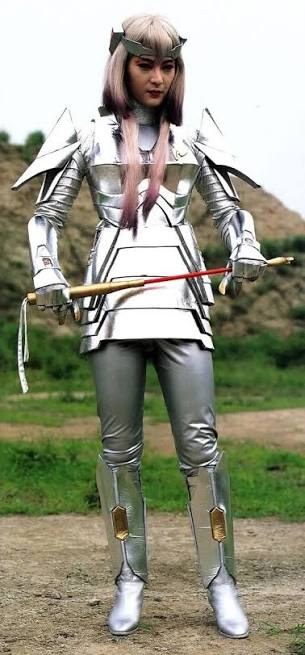
We shot on location a lot. We often went out toward Yorii, for instance. And Ahames always appears out of nowhere in high places, right? On top of a cliff, on the roof of a building. On the rooftops, so that my whole body would be in the shot, I had to climb over the railing and stand on the outside of the parapet. That would be unthinkable today (laughs). Once we shot at the fountain of the Hikarigaoka housing complex in Nerima, and that was a very high spot too. They asked me to "stand on the concrete ledge." In that costume I couldn't see my own feet at all, so it was frightening. On the clifftops there was no safety line either. If I had fallen, that would have been the end of me (nervous laughter). Looking back, I think I was pretty brave. In the second half she started riding the Jangeran, and we did a bit more work in the studio. The composite effects went in afterward to finish the scene, and the instructions from the action director, Yamaoka (Junji Yamaoka), were always very precise. He explained each situation in a way that was easy to follow, and I never had to wonder where to look. The shoots moved along at a very good pace.
04The cast
What were your impressions of the rest of the cast and the crew?
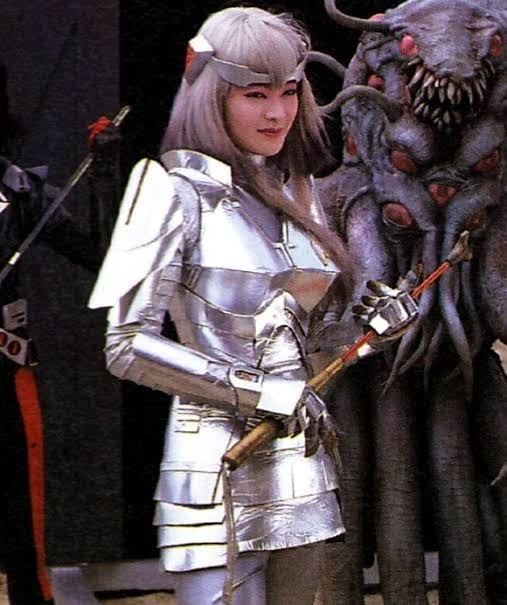
Everyone treated one another as equals, in a good way. There was a real team spirit and a very friendly atmosphere. Every so often the women would chat among ourselves. Hiroko (Hiroko Nishimoto) told us she had started going to a beauty salon, and Mai (Mai Oishi) that she had started using hair mousse. That's normal today, but back then it was just catching on, and there weren't even cell phones (laughs). We mostly talked about fashion and beauty. Kana (Kana Fujieda), who played Shiima, had a gorgeous figure, remember? Whenever the subject came up, someone would say, "I hear long shapewear really works" (laughs). Another thing I remember is that we often went out to eat on location still dressed as Ahames. When we walked into a restaurant, everyone would freeze for a second, and then they'd go back to eating as if they hadn't seen a thing. That stuck with me (laughs). In the second half the costume changed and I managed, somehow, to get in and out of it on my own, but the material that kind of outfit is made of doesn't absorb sweat, which was really hard. I still watch the shows now and then, but because I know what goes on behind the scenes, my eyes always go to the villains' costumes and the monster suits (laughs). I think about how hard the people at JAC (the Japan Action Club, now JAE) work, and I wonder, "Is it any easier for them now than it was back then?"
05Episode 33
In episode 33, the scene where Ahames is bathed in the Rigel Aura and wears a look of ecstasy has become legendary.
To be honest, I knew exactly what I was doing there (laughs). Villain or not, I wanted to play Ahames as a sensual woman. And the director didn't stop me either (laughs). At that point I was at a crossroads as an actress. I wasn't sure whether I was someone who could keep going in this business. So I made up my mind that in every role I got, I would pour in everything I felt and try things. Ahames is one of the best examples of that. Whether it was a children's show or anything else didn't matter in the least. I had an adventurous urge to show how far I could go as an actress. If I did nothing, I would be an actress who simply faded away, so I had nothing to lose. I wanted to do everything I could so I wouldn't have regrets. Coming across the role of Ahames at a time like that was a stroke of great luck.
06The villains
In the final stretch, the plot was driven by the moves of the characters on the side of evil, such as Gaata's family, Shiima, Buba, Ahames and Giluke.
The villains' pasts were portrayed with care, and on top of that they were given a dignified exit before they died. As an actress, that made me very happy. Shohei Yamamoto, who played Giluke, was already saying back then, "Evil has to be played with beauty." He was an elegant man himself, and Giluke had that side to him too, didn't he? The villains of "Changeman" were never petty. When I saw the footage of Buba's last battle (episode 52) at the voice recording session, I was stunned, because it was absolutely beautiful. Ahames blows up the Changemen's base and dies laughing. I still treasure my script for episode 53. I hear there are actors who don't like to talk about having done this kind of work when they were young, but I don't feel that way at all. "Changeman" is a show I love, and Ahames is a character I love. These shows are more highly regarded today than they were back then, and having been in one has become a kind of badge of honor, hasn't it? As one of the alumni, I'm glad to see it.
07Tampopo
The same year as "Changeman," you also appeared in director Juzo Itami's film "Tampopo." Your scene with Koji Yakusho is striking, and I believe it was the work that drew a lot of attention to you.
I was playing a geisha named Tsurumatsu in NHK's historical drama "Haru no Hato" (1985) when Itami, who played Hirobumi Ito, invited me to be in the film. Since I was also a regular as Ahames, I asked Toei to work around my schedule, and somehow I managed to take part. I'm not in many scenes, but it seems people who know films liked them (laughs). That work also reflects what I was feeling at the time. In a sense, I went into the film with "nothing to lose." Looking back, I can see that a number of turning points in my life piled up in that period. It was shortly before that, as it happens, that I began studying Korean in earnest.
08The DVD
How do you feel now that "Changeman" is coming out on DVD, 24 years after it aired?
It's very moving. It will soon be a quarter of a century. It's a series that people really do tell me, again and again, "I used to watch it." I don't often get the chance to work with the people from those days again, but when I hear from others that one of them is doing well, it makes me happy. I've never properly watched the series again, so I'd like to sit down and take my time with it on DVD.
Tell us how you feel about the Super Sentai series, which is still going today.
The series had been around for a long time before "Changeman," the one I was in. I think it's a great part of the culture Japan has built, and I want to express my respect for those who came before us and also thank the fans who have always supported us. I believe everyone who has been part of a Sentai feels the same way. As long as that time slot keeps going, it will never become "the past." Seeing the school I graduated from still so full of life makes me want to work hard too, and to the people on the current series I want to say, from the bottom of my heart, "Go for it!"
And if you were offered a new part?
I'd love to come back as Ahames. I love Ahames. Next time, I'm thinking of bringing a lot more subjects with me (laughs).