Sonny Chiba left it in writing, in memoirs dictated shortly before his death and published by the newspaper Nikkan Gendai in 2021, that the person to whom he had thought of entrusting the future of the Japan Action Club was Etsuko Shihomi. His choice was the first woman admitted to the stunt school he founded in 1970 and the first actress in Japanese cinema to do her own action. She starred in the Onna Hissatsu Ken series, known in the West as Sister Street Fighter. Shihomi left the JAC in 1985 and stopped acting two years later, at 31, and Chiba died without telling her what he had intended.
The career he wanted to prolong lasted 13 years and ran entirely inside the machine the JAC built for Toei. Shihomi trained in the gym that produced the stunt performers of Kamen Rider and made her television debut as the robot Bijinder in Kikaider 01. She shared sets with the men who would wear the suits of Super Sentai and Metal Hero and became the model for the actresses the school began training in the 1980s. What she left to tokusatsu lies in those suits, in those actresses and in the proof that a woman could carry an action film without a double.
Okayama
Etsuko Shiomi was born on October 29, 1955, in Saidaiji, a district of Okayama known for the Hadaka Matsuri, the naked-men festival of Saidaiji Kannon-in temple. Her father had studied at the Nakano School, the Imperial Army's training center for intelligence officers, fought in the war and then worked at the Finance Ministry's printing bureau. Her grandparents were teachers. "I grew up in a house where people hardly ever told jokes or laughed out loud," she told Challenge+, the Tenmaya group's magazine, in September 2023. "I was such a serious child that I was class president, and what I wanted to be was a teacher."
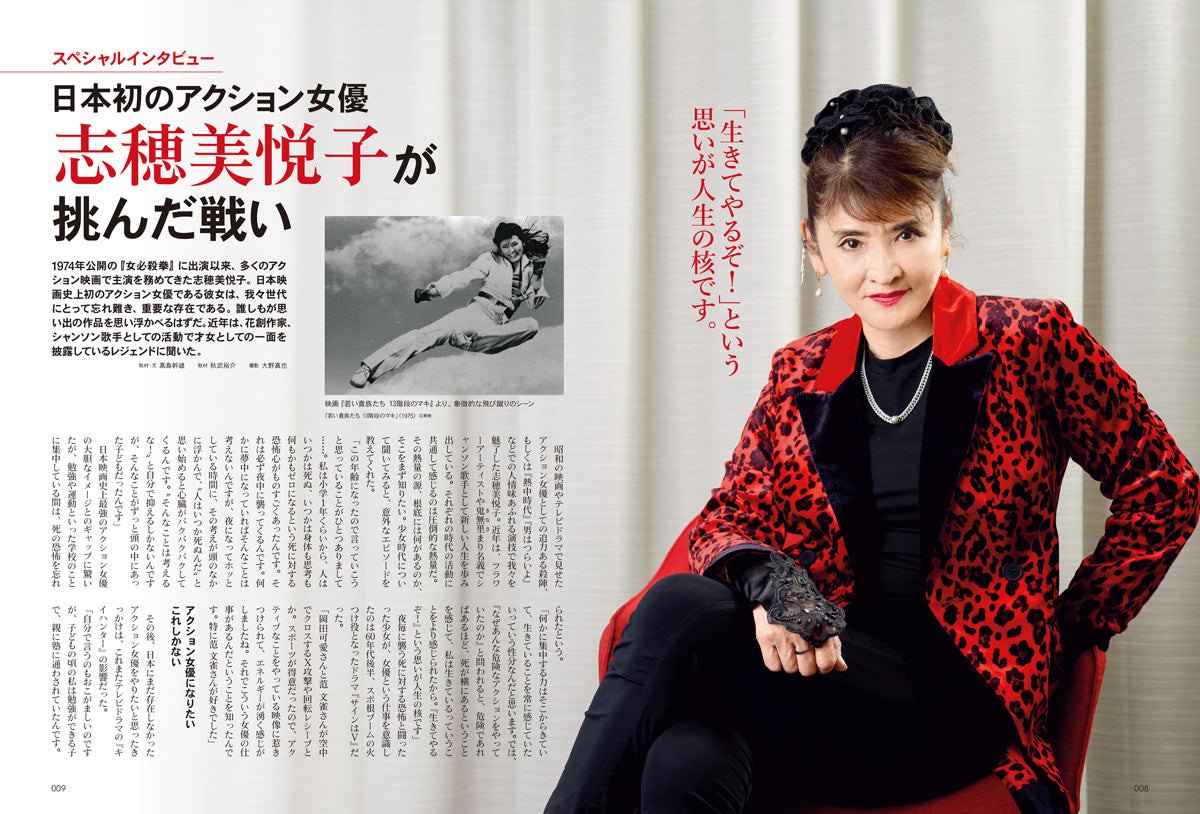
In a cover interview with the magazine Showa 40-nen Otoko, conducted by the journalist Mikio Takashima, Shihomi described a fear that has stayed with her since childhood and that she spoke about publicly only after turning 70. "From about first grade I had a terrible fear of death, of the day when my body and my mind would both go to zero. That fear always came in the middle of the night. While I was absorbed in something I didn't think about it, but at night, in the hours when you relax, the thought would surface, and my heart would start pounding." Schoolwork and sports kept the thought at bay, and she traces to this both her powers of concentration and the choice she would make years later. "If people ask why I did such dangerous stunts, I answer that the greater the danger, the more I could feel death right beside me. The will to say 'I'm going to live!' is the core of my life."
The greater the danger, the more I could feel death right beside me. The will to say 'I'm going to live!' is the core of my life.
Etsuko Shihomi · Showa 40-nen OtokoShe won the school races from elementary school on, ran track in junior high and high school and clocked 13.4 seconds in the 80-meter hurdles, the second-fastest time in the prefecture's history. The idea of becoming an actress came from television, with Sign wa V, the TBS volleyball series that opened the sports-drama boom at the end of the 1960s. "I was good at sports, so the images of Kaori Okada and Fan Bunjaku crossing in midair for the X attack drew me in and gave me energy. That's how I learned this job called actress existed," she told Showa 40-nen Otoko. The trade she chose, stunt work, came from another series, Key Hunter, which Sonny Chiba starred in on the same network from 1968 to 1973.
Chiba had founded the Japan Action Club in 1970, a school and agency to train actors who could do their own action. Shihomi found the address in a magazine and mailed a postcard without telling her family, and the reply came to the house with an invitation to an audition. Her father, a former soldier, held out for two days and then set the condition she has repeated for 50 years: "I won't nip your wish to be an actress who does action in the bud. If you're serious, I'll let you take the exam. But you finish high school."
A JAC
The exam, in the summer of 1972, came down to a forward roll and a backward roll, and the examiners said that was enough. Chiba received her at home, next to his wife, the actress Yoko Nogiwa, and set a year of training. In October she moved to Tokyo and transferred to Nakanobu Gakuen high school, to keep the promise she had made her father.
The school she entered was at that moment supplying the stunt performers and trampoline artists for Kamen Rider and Barom-1. From Robot Keiji, in 1973, it took sole charge of the action on Toei's hero series. Training took place at night, in a rented gym, from 6 p.m. on, with gymnastics, trampoline, stage fighting and period swordplay. "There was pool day too," Shihomi told the website Bunshun in March 2022. "Except it wasn't about swimming. It was swimming with your hands and feet tied, or taking a punch and falling into the water." The school's first students were Junichi Haruta, Osamu Kaneda and Tsutomu Sakai, future names in Super Sentai action, and Shihomi was the only woman in the class. "I wanted to be the very first actress who could do action, something that didn't exist in Japan," she said in the same interview.
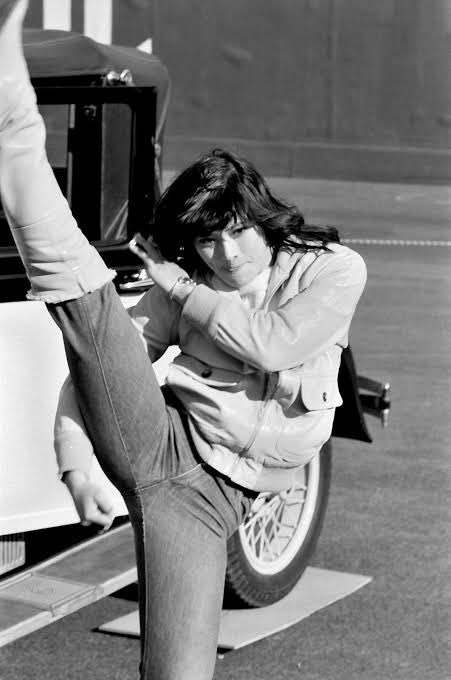
The stage name was chosen by Chiba's wife, the actress Yoko Nogiwa, who kept the Shiomi reading because she held that nobody builds a career by destroying their real name. The middle character, "ho," meaning ear of grain, came from Chiba's legal name, Sadaho Maeda. Inside the agency the student became the founder's kid sister, picked up the nickname Ecchan and would play his character's sister in four films. On Chiba's method, she told Challenge+: "Any JAC member who trained under him, when they heard 'you can do it,' got into a state of mind where they really could do anything. He didn't want to be called a master or a teacher."
Bijinder
Her first regular role came through the same channel that linked the JAC to the hero series. At the end of 1973, Kikaider 01, the Shotaro Ishinomori series Toei produced for NET, lost its actor Daisuke Ban, called away to star in Inazuman. The production created a robot to accompany the hero, Bijinder, whose human form was a young woman named Mari. Chiba recommended his student to Toei, and the 18-year-old schoolgirl entered in episode 30, broadcast on December 8, 1973, and stayed through episode 46, the last.
Chiba personally staged her fight choreography in the debut episode. The series' action coordinator was Kazuo Mishima, of the Mishima Kengikai group, and the JAC supplied the stunt performers. One of them was 18-year-old Kenji Takahashi, who would take the name Kenji Ohba and wear the suits of Battle Kenya, Denji Blue and Gavan. Inside Bijinder's silver costume was the suit actor Kimihisa Utsunomiya, the performer who wears the suit and does the action, and the fight scenes with Mari's face showing were Shihomi's. Eight of the final 17 episodes carry the robot's name in the title, and the producer Susumu Yoshikawa later acknowledged that Bijinder had become the de facto lead.
Koryu
The next step came from Toei's film division. The studio's president, Shigeru Okada, was watching his line of girl-gang films, the sukeban pictures, decline, and he wanted to ride the Bruce Lee wave after Lee's death in July 1973. He ordered up a "female Sonny Chiba," a karate sukeban, and since no Japanese actress could do it he went looking for his star in Hong Kong, in Angela Mao, who had played Bruce Lee's sister in Enter the Dragon. On February 26, 1974, he asked the screenwriter Noribumi Suzuki for a karate version of Hibotan Bakuto, the female yakuza series the two had made in Kyoto. Suzuki named the heroine Koryu, red dragon. The account is in Suzuki's memoir, Toei Guerilla Senki, from 2013.
Shihomi got into the project after Chiba stopped Suzuki in the courtyard of the Tokyo studio, offered him his student and showed him 16mm footage of her on the trampoline and the gymnastics apparatus. Suzuki asked whether that was really a girl and promised her a substantial part. Angela Mao dropped out without the reason being explained, and the supporting player took the lead. "It fell out of the sky," Shihomi told the newspaper Nikkan Sports in June 2026. "From that day on, the training got even harder."
Shooting began on July 12, 1974, at the Oizumi studio, under the direction of Kazuhiko Yamaguchi, and lasted a month and a half. Chiba took a supporting role and the actor Hiroshi Miyauchi, who had been Kamen Rider V3, played Koryu's missing brother. Among the henchmen was Kenji Ohba, still uncredited, who takes an elbow from her in one scene. The lead's fee was 250,000 yen. The film opened on August 31, 1974, an end-of-vacation date the studio considered weak, and grossed 190 million yen. The theaters filled with women and teenagers, an audience Toei had not expected for a karate film, and the studio's survey recorded that there were almost no men among her fans.
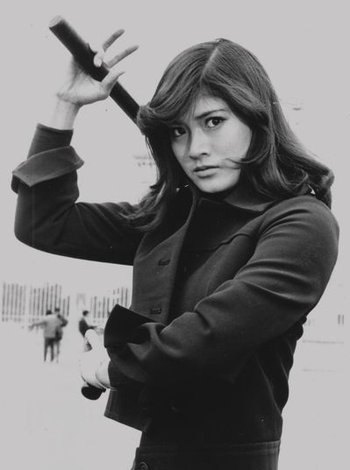
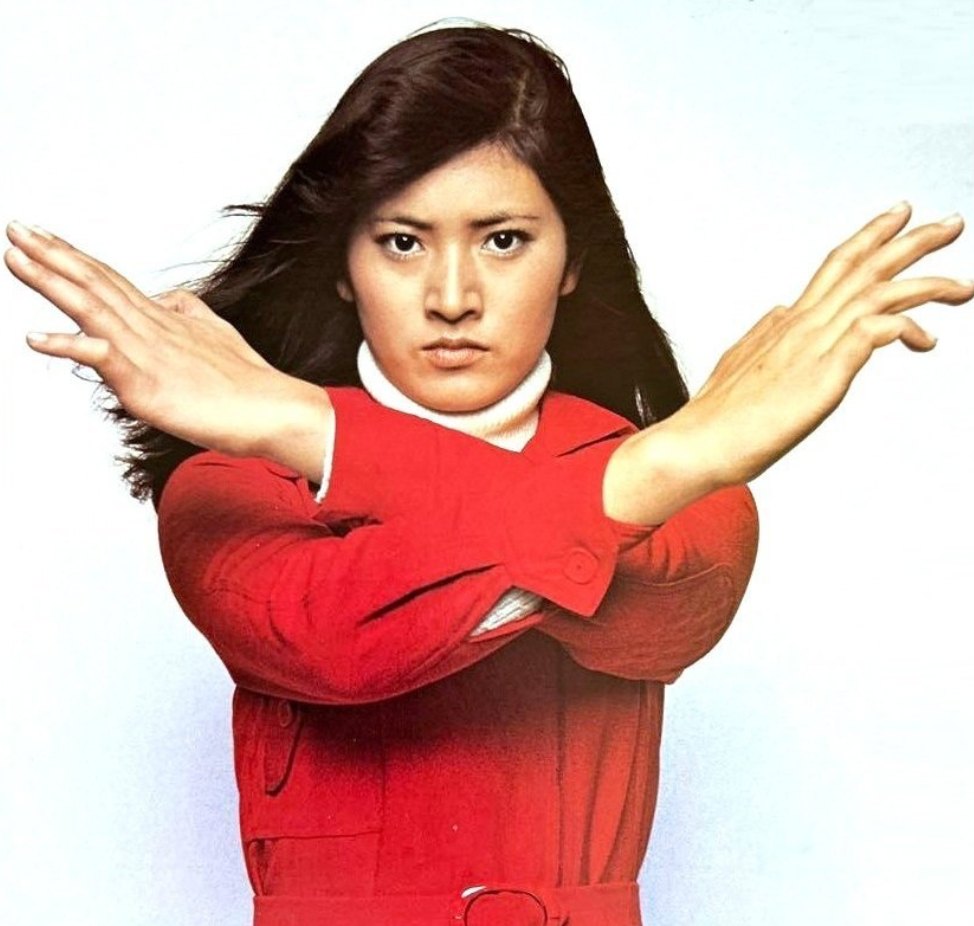
The scholars Inuhiko Yomota and Hana Washitani, in the 2009 book Tatakau Onnatachi, wrote that Shihomi never traded on sex appeal and that audiences were captivated by the extension of her leg in her jumping spin kicks. The two set her apart from the lineage of Komako Hara, Yoko Matsuyama, Junko Fuji and Meiko Kaji. The critic Sadao Yamane, quoted in the same book, defined Koryu as a heroine Japanese cinema had never had, one who could fight men on equal terms. Yamane called the series the country's first purely action-driven women's film.
Two sequels followed in December 1974 and August 1975, with Yamaguchi directing, and the fourth and final film, from 1976, was shot in Kyoto by Shigehiro Ozawa with a different character. In 1975 Shihomi's bromides, the star photos sold in the shops of Asakusa, reached third place nationally, a mark Toei had not seen with an actress since Junko Fuji. That same year she received the Elan d'Or award for best new actress. By 1977 her bromides were the best-selling in Japan.
Jacarta
The series reached further abroad than at home. In June 1975, at the Asian Film Festival in Jakarta, Shihomi and Okada were given an escort of 10 motorcycles and crossed the city without stopping at a single traffic light. In Indonesia alone the series earned about one million dollars, and the Indonesian foreign minister, Adam Malik, received her at the palace. In May 1976 she gave a karate demonstration at the Tashkent Film Festival, in the Soviet Union, with Toei's president as her sparring partner, at the series' first screening in the Communist bloc. In August of that year the film opened in New York under the title Sister Street Fighter, cut by six minutes to escape an X rating.
In testimony collected in Tatakau Onnatachi, the actress said she would have preferred a different kind of film. "I didn't want to make karate movies. I had watched Key Hunter and I wanted to do suspense action." On Koryu: "She isn't a woman, or rather, she doesn't make you feel she's a woman. She's completely neutral." Her reference for the fights was Bruce Lee in Enter the Dragon. "His face when he kills someone is a face of sadness. I always wanted all my fight scenes to have that sad face." Her favorite among her own films is Karei naru Tsuiseki, from 1975, in which she plays a racing driver and secret agent with seven disguises. She tore a ligament in her right knee a week before shooting and filmed anyway. In September 1977 she left her exclusive contract with Toei.
Fukasaku
Leaving the contract coincided with doubts about staying in action. At 25, as she told Challenge+, Shihomi was thinking of giving up the genre, and the one who talked her out of it was the director Kinji Fukasaku. "What are you talking about? There is no actress in Japan who can do action, so you are a rare thing. Your body in motion is beautiful. Don't waver." Fukasaku cast her in three films over the next five years.
There is no actress in Japan who can do action, so you are a rare thing. Your body in motion is beautiful. Don't waver.
Kinji Fukasaku a Etsuko Shihomi, segundo ela · Challenge+, 2023The first was Yagyu Ichizoku no Inbo, from 1978, a period film that grossed more than 3 billion yen. She is Akane, the youngest daughter of the Yagyu clan, a swordswoman who lives dressed as a man and sister to Chiba's Jubei. Shihomi carried the character into the television series that same year and into two series after it. Also in 1978 she joined Uchu kara no Message, Toei's answer to Star Wars, with effects by Nobuo Yajima. The production built a 40-meter spaceship at full scale next to Byodo-in temple, in Uji. She played Emeralida, granddaughter of the chief of the planet Jillucia, sent into space with the warrior Urocco to find the eight heroes of the Liabe seeds. The launch press conference, in February 1978 at the Hotel Okura, brought together Okada, Fukasaku, Shotaro Ishinomori, Vic Morrow, Chiba and Hiroyuki Sanada, then 17.
In Satomi Hakkenden, from December 1983, Shihomi is Keno, the only woman among the eight dog warriors, an assassin who dances with a snake at Hamaji's wedding feast and beheads the magistrate. Fukasaku wanted only Sanada from the action roster and ended up casting four of the eight warriors from Chiba's school, among them Kenji Ohba, fresh off Gavan, as Genpachi. The action credit reads JAC Command, and the film was Japan's top-grossing picture of 1984.
O-Ren
Between the Fukasaku films, the series that showed the JAC in bulk was Kage no Gundan, the Hattori Hanzo ninja saga Chiba starred in on Kansai TV from 1980. The agency's stunt performers were on screen every episode. Shihomi went through every season in different roles, as a guest ninja in the first, the head of an enemy clan in the second and a thief who ran an izakaya in the third. In the fourth, in 1985, she became the group's second-in-command, the character O-Ren, who goes about dressed as a shamisen player and carries a blade hidden in the instrument and a revolver in her obi. When Quentin Tarantino wrote Kill Bill, he named the boss of the Tokyo yakuza O-Ren Ishii. The first name comes from Shihomi's character, according to the film reference guide published by the website Eiga.com.
In July 1981 the agency staged a version of Makai Tensho at the Shinjuku Koma theater in which Amakusa Shiro was a woman, and the part was hers. To promote the run, Shihomi jumped from the theater's roof onto a stunt mat set up on the sidewalk.
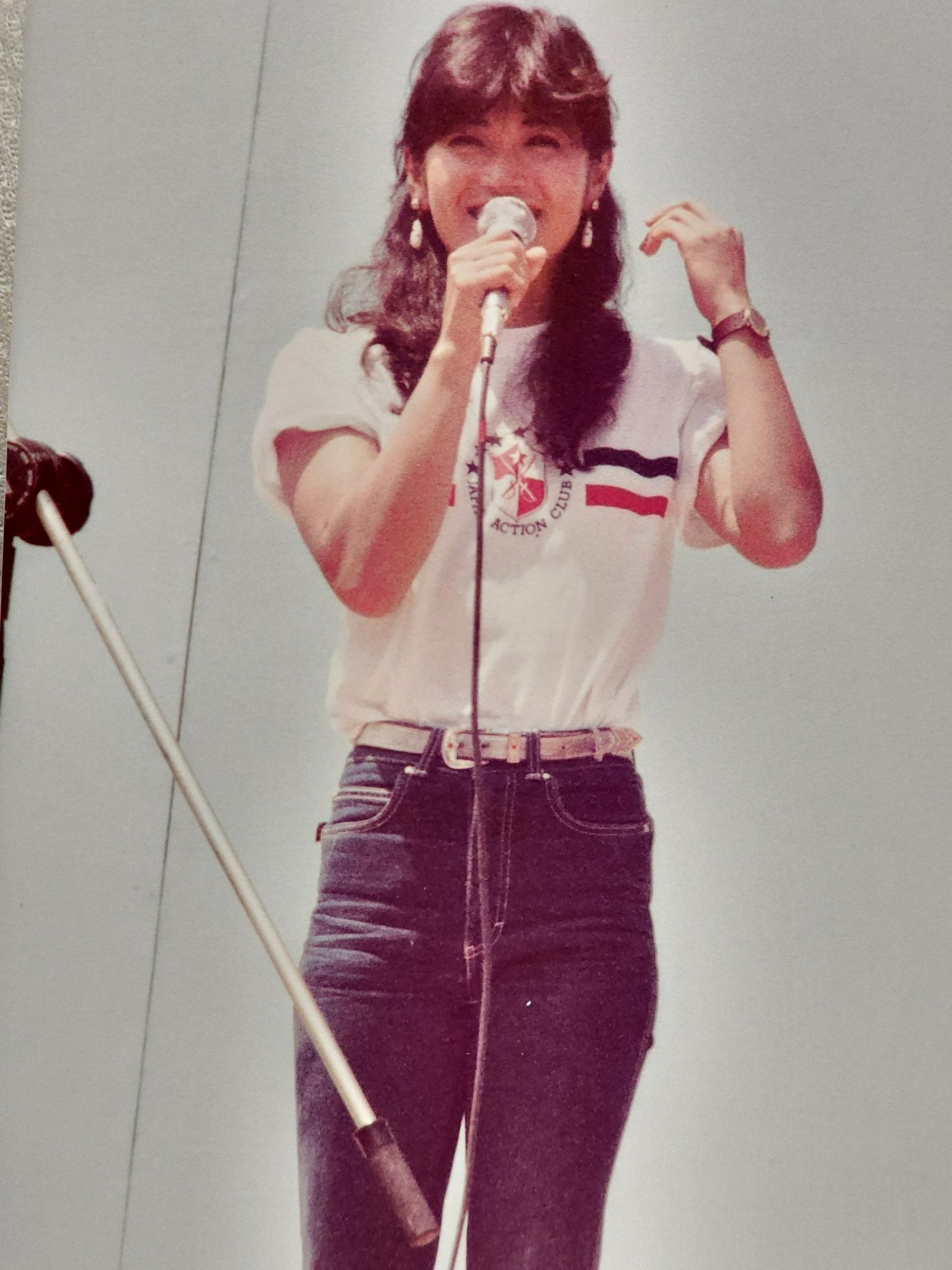
Hiroyuki Sanada, raised by Chiba from boyhood, became a national idol from 1978 on, and Toei and Kadokawa began building films around him. Shihomi was moved into supporting parts, such as the Chinese fighter who helps Sanada in Ninja Bugeicho Momochi Sandayu, from 1980, and his blind sister in Hoero Tekken, from 1981. To Nikkan Sports she judged the period from her mentor's side. "When Hiroyuki got popular, I thought it was incredible that Chiba could step aside. He wanted to be the lead too, of course. To accept that the era had turned and to raise Hiroyuki all the way up, that's extraordinary."
The exit
In 1985 Shihomi left the JAC and Sunny Chiba Enterprise and opened her own agency, named Hundred, a nod to the "sen," thousand, in Chiba's name. To Challenge+ she explained the decision in one sentence. "I got tired of being inside an organization. The JAC had a very strong color of action equals a man's world, and I think that's why the wish to leave grew in me." The weekly magazine Shincho wrote in 2019 that she and Sanada held the same grievance against the agency, that fees did not rise when an artist broke through.
Chiba's memoirs show what the exit cut short. "The one I secretly thought of making my successor, entrusting her with the future of the JAC, was Etsuko Shihomi," he wrote. "Her obedient nature, her effort, her spontaneity. And the exceptional athletic ability to carry out dangerous action." In the same pages he acknowledged the methods of the era. Early in her career, feeling his student lacked femininity, he ordered her to film without underwear, so that modesty would show in the way she moved. "Today it would be harassment," he wrote. And he concluded: "If she hadn't retired, she would have been an actress able to compete on the world stage."
The one I secretly thought of making my successor, entrusting her with the future of the JAC, was Etsuko Shihomi.
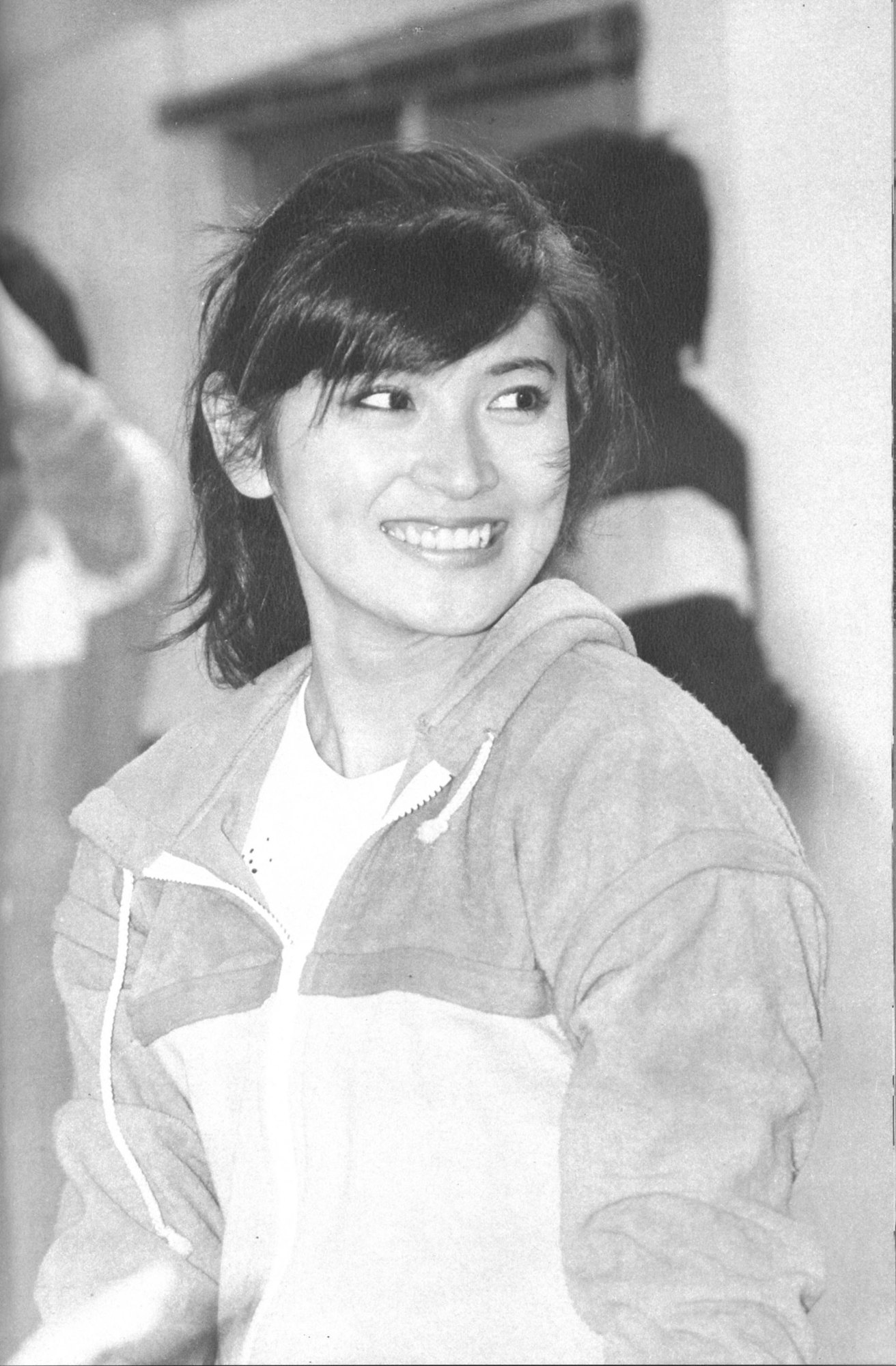
Sonny Chiba · Nikkan Gendai, 2021The independent period had one high point, Nidaime wa Christian, from 1985, an action comedy the playwright Kohei Tsuka wrote for her, in which she plays a nun who inherits a yakuza family. It was her first starring role in nine years and brought in 1.25 billion yen in distribution rentals. In June 1986, while shooting the TBS drama Oyako Game, she fractured the base of her left little finger, and the one who took her to the hospital was the lead, the singer Tsuyoshi Nagabuchi. In December the two made the New Year's installment of the Otoko wa Tsurai yo series, her last film. The marriage was registered in August 1987 and celebrated in September at a shrine in the mountains of Nara.
Shihomi was 31 and never announced a retirement to the public. "I always said I wouldn't marry anyone who made me give up acting," she told Nikkan Sports. "But I ended up with someone from another field, who said a house doesn't need two stars." In the same interview she described leaving as her own choice. "Thinking about it now, an actress is, in the end, an illusory image. I stopped being satisfied living only with other people's scripts, other people's direction. Enriching real life seemed more fun." Her three children, born one after another, made the pause permanent.
After the movies
Her return to public life came in 2010, through flower arrangement, as a student of disciples of the Belgian florist Daniel Ost. After the 2011 earthquake she drove a four-ton truck of supplies to Iwate prefecture and published a photo book with the proceeds going to the victims. She spent four years giving flower workshops in temporary housing. In 2014 she decorated the Toindo, a pavilion designated a national treasure at Yakushiji temple, in Nara. To Bunshun she connected the new trade to the old one. "Creating on a stage fit with the experience of showing fighting and movement from when I was an action actress."
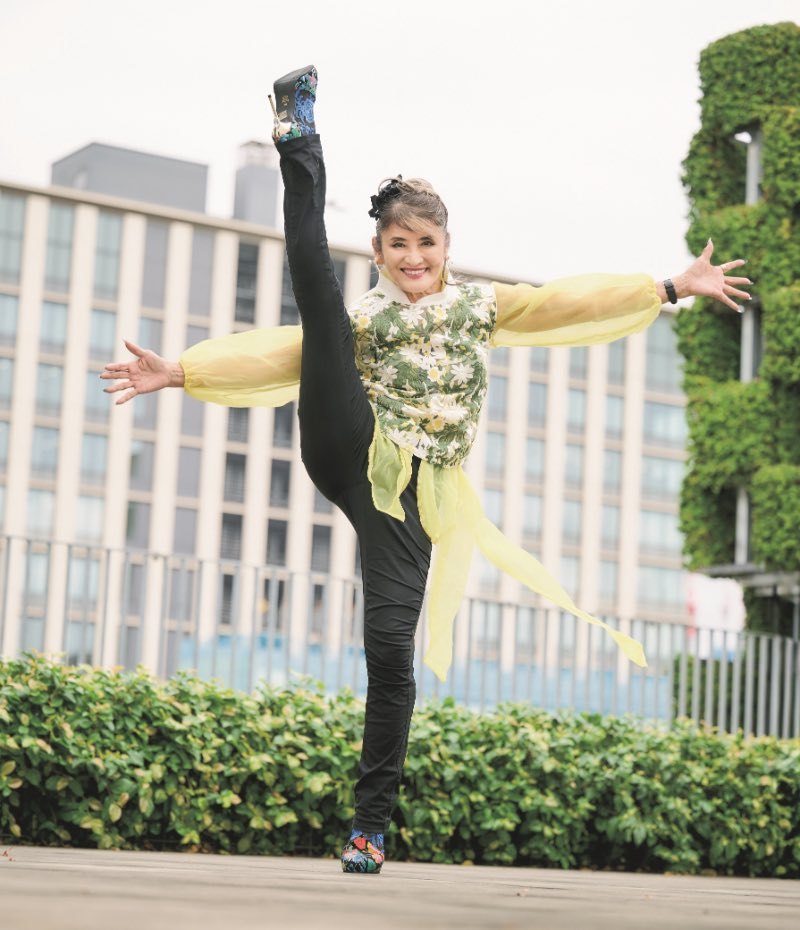
Her bond with the JAC ran through the decades away from film. When Chiba died, on August 19, 2021, she posted four lines on her blog: "It was too sudden, there are no words. But the JAC spirit lives on. It lives on in each of its places. Hands pressed together." In May 2024, at 68, she announced a career as a chanson singer under the name Mari Kinasa, taken from Bijinder Mari, and in May 2025 she won the 12th Tokyo Chanson Competition. On June 14, 2026, at the reunion of about 270 former members that the JAC billed as the first and the last, she sang five songs and said in tears: "The JAC was my youth, my pride." In July 2026 the Meguro Cinema, in Tokyo, devoted a week to her, and Shihomi watched one of her own films in a theater for the first time in 40 years.
The legacy
Shihomi made few appearances in tokusatsu series, only in Kikaider 01 and in one episode of JAKQ Dengekitai, in 1977, but her legacy to the genre went far beyond the screen. The men who wore the suits of Super Sentai and Metal Hero between 1975 and 1990 trained in the gym where she trained. Kenji Ohba, who doubled on Kikaider 01 and took a beating from her in Onna Hissatsu Ken, is the best-known example. The list of Chiba's earliest stunt performers also includes Junichi Haruta, the black ranger of Goggle V and Dynaman, and Osamu Kaneda, who would go on to direct the action on dozens of series and now runs the agency.
The second inheritance is the actresses the school went on to train. The JAC only took in women in significant numbers at the end of the 1970s, when the popularity of Sanada and Shihomi drew thousands of applicants per class. Magazines called the tokusatsu heroines who came out of it "post-Etsuko Shihomi." The label stuck to Yuki Yajima, the first Yellow Four of Choudenshi Bioman, and to Naomi Morinaga, Annie in Shaider. Yajima wrote in the agency newsletter that the veteran was strict at work and a presence like an older sister, and that Shihomi lent her all of her own costumes when she had nothing to wear for a show. Makoto Sumikawa, Diana in Jikuu Senshi Spielban, told Kyoudai Express that she entered the JAC school admiring the house's leading lady. She wanted to do real fighting, in the style of Shihomi's kung fu films. Sayoko Hagiwara, Dyna Pink, told the magazine No Guarantee in 2016 that she took Dynaman because she admired the JAC, and the magazine attributes the agency's 1980s boom to the pair of Sanada and Shihomi.
In 2014 the director Shusuke Kaneko, the same one behind the 1990s Gamera trilogy, assembled in Shojo wa Isekai de Tatakatta actresses he described as carrying Shihomi's genes. One of them is Rina Takeda, a karate black belt who has been making action films without a double since 2009. In 2013 the Laputa cinema in Asagaya mounted an eight-film retrospective of her work. In 2019 the British distributor Arrow released the four Onna Hissatsu Ken films on Blu-ray, with new interviews with Chiba and the director Yamaguchi.
Shihomi does not speak of successors and told Challenge+ that she had no model either. "There was no earlier Japanese actress to serve as an example. If I had to force it, the reference was the hero's sister in Enter the Dragon, played by Angela Mao." What she was after, according to the same interview, was first place. "From then on I believed that in any field it only made sense to be a pioneer. Second or third is already too late."
What remains is a short career that changed two things in the industry. Toei learned from Onna Hissatsu Ken that an actress could carry an action film on her own and that the audience for that film would be female. The JAC learned that it could train women for the same trade it sold to men. The heroines of Bioman, Shaider and Spielban passed through the school she entered as its only female student, and the name of a supporting character from Kage no Gundan reached Hollywood. Chiba wanted to hand her the entire agency. She left first, and what she built in the 13 years she stayed is still inside the suits.
Sources: Challenge+ (September 2023), Bunshun Online (March 2022), Nikkan Sports (June 2026), News Post Seven (December 2023), Nikkan Gendai (2021), the magazine Showa 40-nen Otoko (interview by Mikio Takashima), Magmix (2023), Eiga.com, Toei Video, Josei Jishin (June 2026), Daily Shincho (2019), Chunichi Sports (August 2021), No Guarantee (2016), Tatakau Onnatachi (Inuhiko Yomota and Hana Washitani, Sakuhinsha, 2009), Toei Guerilla Senki (Noribumi Suzuki, 2013) and the Kyoudai Express interview with Makoto Sumikawa.