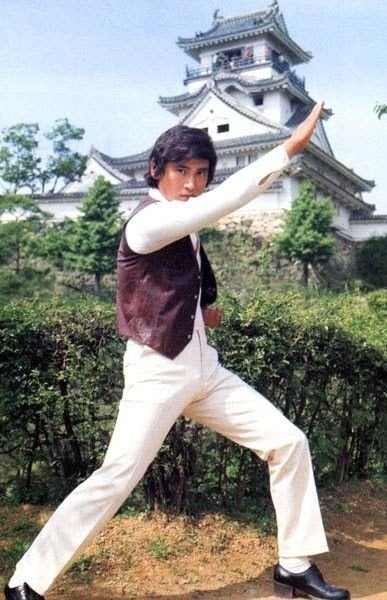
Hiroshi Miyauchi was 25 when he debuted as Shiro Kazami, the hero of Kamen Rider V3, in February 1973, and he has never really let the character go. Speaking to the publisher Futabasha for its interview series THE CHANGE in 2024, he put it simply: "For me, the turning point was Kamen Rider V3."
Born on June 14, 1947, Miyauchi went on to play Shiro Kazami in Kamen Rider V3 (1973-74), Akira Shinmei, the blue hero Aoranger, in Himitsu Sentai Gorenger (1975-77), and the private eye Ken Hayakawa in Kaiketsu Zubat (1977). After that came Sokichi Banba, better known as Big One, in J.A.K.Q. Dengekitai (1977), and Commander Shunsuke Masaki in Special Rescue Police Winspector and its sequel Solbrain (1990-92). He also kept coming back to Kazami as a guest in Kamen Rider X, Kamen Rider Stronger, the 1979 Kamen Rider known as Skyrider, and the 1976 movie that gathered all seven Riders, which makes him the actor with the most appearances in the Showa-era Kamen Rider shows. The Japanese press calls him Mister Hero.
From 2001 to 2003 he wrote a monthly column for the website Toei Hero Net, where he signed in as "member No. 4410." The column was called Hitorigoto, or "Talking to Myself," and in it Miyauchi went through Kamen Rider V3 one monster at a time and all 32 episodes of Kaiketsu Zubat, rewatching each one on laserdisc before he wrote.
Tanba and Chiba
As a teenager, fresh out of junior high, Miyauchi went to see the actor Tetsuro Tanba, an acquaintance of his father's. He told Futabasha he had felt cut out for acting since he was a boy. Tanba told him there was a step to take first and sent him back to finish high school.
In 1968 Miyauchi passed Toei's New Face audition, the studio's talent search, as part of its 12th class, and signed with Tanba Production, his mentor's agency. His first jobs were in the studio's gang pictures, such as Nagasaki Blues and Organized Violence: Brothers' Oath, both from 1969, and in the Furyo Bancho (1970-71) and Onna Bancho (1972-73) series. His first television role came in 1969, in the samurai drama Aa Chushingura on Kansai TV.
In 1971 the Teichiku label released a single with his voice, "Yogiri no Sekai." It barely sold. Miyauchi later said the only copies that moved, a few hundred of them, went at promotional events where he showed up in person.
His action training came on Key Hunter, a TBS spy series that ran from 1968 to 1973, where Miyauchi played agent Shunsuke Dan alongside Tanba and Shinichi "Sonny" Chiba. Chiba gave the newcomer a piece of advice that Miyauchi repeated to the website Mynavi in 2023:
If you're going to watch, watch from behind the lens, from where the cameraman is standing.
Sonny Chiba to Hiroshi Miyauchi, on the set of Key HunterMiyauchi called it "a treasure I still keep." It taught him that two actors standing a meter apart, moving in sync, look on screen as though they are trading real blows.
On Key Hunter, Dan usually took a beating until Chiba's character, Kazama, came to the rescue, and Miyauchi carried the formula over to V3. In his Toei Hero Net column he called it "the art of taking a beating": a hero only matters, he argued, when he steps in after the villain has the upper hand. "If the monster shows up and we shout 'Henshin!' right away, that never happens."
V3
Miyauchi got Kamen Rider V3 without an audition. He was shooting Key Hunter in Urabandai, in Fukushima, when he was told to report to the Tokyo office of the broadcaster MBS. He sat waiting without realizing it was an interview and was asked whether he could do action and ride a motorcycle. He arrived with a third-degree black belt in karate, a first-degree black belt in judo and the fight scenes of Key Hunter behind him. He went back to Fukushima, and the next day he learned he would be the next Kamen Rider. He told Mynavi about his second visit to the station: "From way down the hall I heard producer Seiji Abe shouting, 'He's here!'"
Tanba, his mentor, assumed his protégé would spend the whole show inside a costume and told him, "Don't do it." When Miyauchi explained that he would play the man without the mask, before the transformation, Tanba changed his mind. "Well, then, go ahead."
Miyauchi had no idea what Kamen Rider was, so he bought videotapes to watch Hiroshi Fujioka as the first Rider. After his training with Chiba, he figured he could give the unmasked hero more action, and he asked the crew for more scenes before the transformation. To get ready, he practiced riding the bike with one hand and then with no hands at all, he told Futabasha. Over the course of the series the balance of screen time flipped. Early on, the unmasked Shiro Kazami appeared in about 40 percent of the scenes and V3 in costume in 60 percent. By the end, Kazami had 70 percent. In the first weeks he wore a wig, because his hair was still short from an Onna Bancho movie. The rumor that "Miyauchi wears a wig" spread so far that a wig maker offered him a commercial. He turned it down.
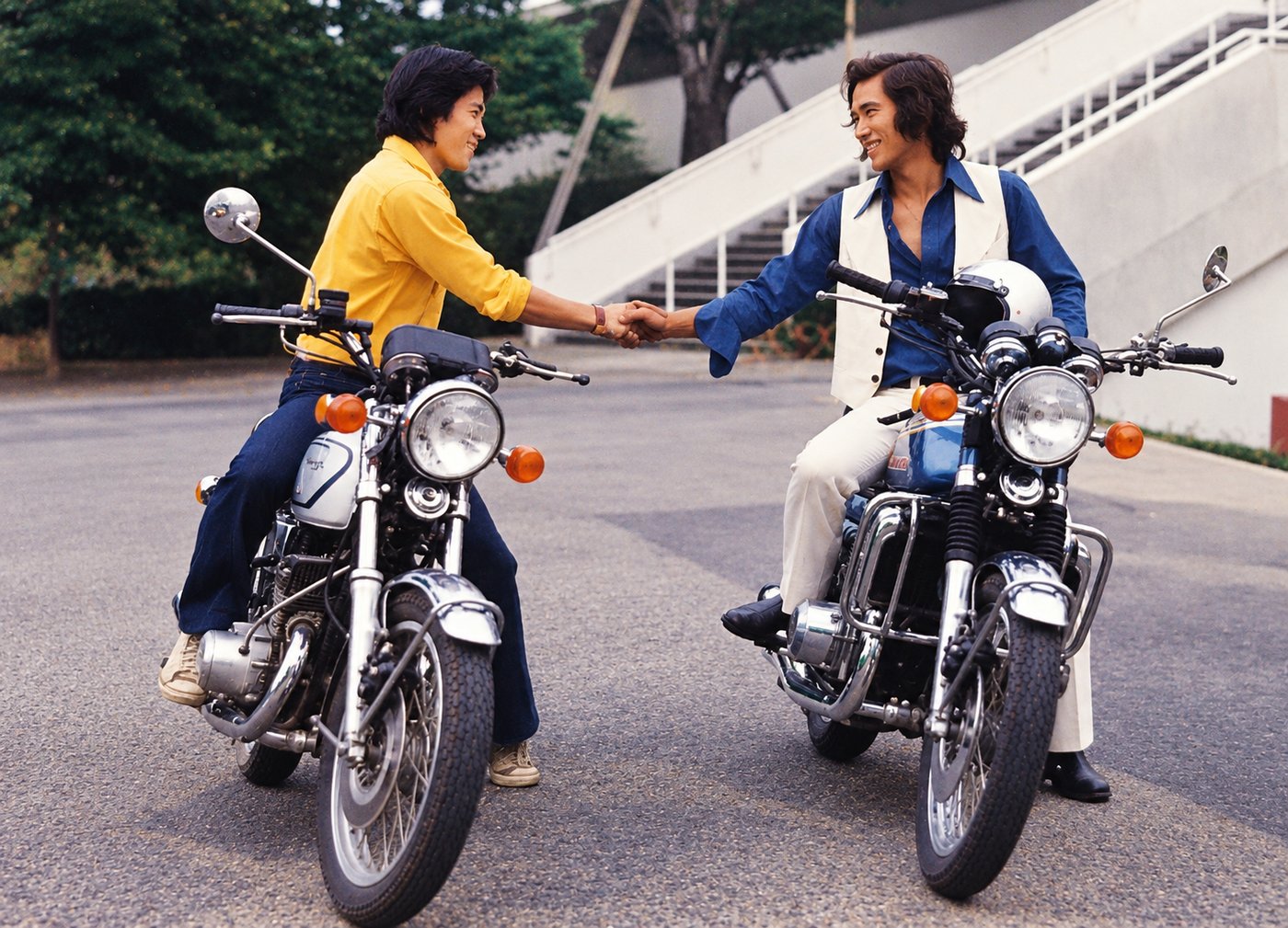
Miyauchi changed the transformation cry from "Buisuri," the Japanese pronunciation of V3, to "Buisuryaa," because, he said, the "a" sound echoes better. Between locations he drove the show's motorcycle himself instead of letting it ride in the production truck, and he asked the effects crew for more explosives than the script called for. Ryo Hayami, the star of the next series, Kamen Rider X, was afraid of pyrotechnics and said of his colleague: "He really is something else."
The most dangerous scene in the series, by Miyauchi's own account, came in episode 22, when he had to pass under a curtain of fire and the wind shifted in the middle of the take. "I kept going and going, and the flames never ended," he told Mynavi in 2017. The actor Akiji Kobayashi, who played Tobei Tachibana, the Riders' "Oyassan," was the one who scolded and advised the young lead, on set and off.
V3's success had Miyauchi spending Sundays, holidays and school breaks performing on department store rooftops across Japan. Some shows were billed simply as "Shiro Kazami is coming," with no costumed hero at all, and on some days, he said, there were shows in about 100 places around the country at once. The character was on bicycles, soft drinks and curry. Years later, whenever someone on the street greeted him with "Look, it's Kamen Rider," he would still answer like a kid: "I always make a point of saying, 'Kamen Rider V3!'"
Miyauchi sang the opening theme himself, "Tatakae! Kamen Rider V3." The composer Shunsuke Kikuchi started the session with no rehearsal, and the singer Ichiro Mizuki, who had recorded the demo, took him out into the hallway and taught him the melody line by line. The two later had a real fight during a break at an event and came out of it friends for life. After Mizuki's death in 2022, Miyauchi told Mynavi that the anime and tokusatsu of that era are still loved "thanks to Ichiro Mizuki, who spent his whole life singing those songs."
Gorenger
In 1975 Toei offered Miyauchi the role of Akaranger, the leader of Himitsu Sentai Gorenger, the first Super Sentai team, and he said no. According to the website Magmix, the idea of taking orders inside a team bothered him. Then came the offer to play Aoranger, and the person who talked him into it was the show's creator, Shotaro Ishinomori, meeting him for the first time. Ishinomori compared the pair to the most famous rivals in Japanese swordsmanship:
Akaranger is Musashi Miyamoto, and Aoranger is Kojiro Sasaki.
Shotaro Ishinomori, persuading Miyauchi to join GorengerMiyauchi had three other shows going and could give Gorenger only about one day a week. The production solved the problem by putting Akira Shinmei at the controls of the team's flying fortress, the Varibune, in scenes shot in the studio, and in about ten episodes the actor only recorded his lines. He told Magmix he watched his posture constantly: "When I played Shinmei, I paid attention to the way I stood."
Miyauchi gave each hero a different body. Shiro Kazami faced monsters from a low stance, Akira Shinmei met the enemy eye to eye, and Ken Hayakawa and Sokichi Banba talked down to their opponents with the ease of men who already knew how the fight would end. Hayakawa's signature shrug came from Hawaii, where V3 also aired. At an autograph session organized by the local station KIKU-TV around the time of Gorenger, Miyauchi saw a local boy make the gesture and kept it for later.
Zubat
Kaiketsu Zubat premiered on February 2, 1977, on Tokyo 12 Channel, today's TV Tokyo, on Wednesdays at 7:30 p.m. Ken Hayakawa is a private detective who roams Japan hunting the man who killed his best friend, the scientist Goro Asuka, and who wears the suit Asuka invented, which holds up for only five minutes. The show borrowed its spirit from the Wataridori westerns that Nikkatsu made with Akira Kobayashi, and 30 of its 32 scripts were written by Shukei Nagasaka. In his column, Miyauchi recalled a line from the writer: "I wrote these scripts so that even college students would enjoy them."
Miyauchi wanted to play the whole series as Hayakawa, without transforming. He already had three regular jobs and, before saying yes, asked to read the script, which wasn't finished. By his account, producer Toru Hirayama may have taken the request as a no, and the part ended up his anyway.
In every episode the sound of a guitar announced Hayakawa's arrival, with the detective perched somewhere high or standing in silhouette, and every episode ended in a duel with the villain's hired bodyguard, usually fought with the bodyguard's own weapon. During those duels Hayakawa liked to tell his rival he was only the second best in Japan.
Miyauchi worked out the duels by playing with props in his spare time, together with fight choreographer Kazutoshi Takahashi, who came from samurai movies and, Miyauchi said, played with props even more than he did. In the column he explained the method: "What helps you pull off things like that is the habit of playing with props every day." One of those games produced the smoke ring he would slip over the barrel of a revolver.
In episode 2 the opponent was a bodyguard played by Hideyo Amamoto, a master of iaijutsu, the art of drawing a sword and striking in one motion. Miyauchi drew with the blade reversed and slid the sword back into its scabbard in a single take. In episode 26, facing a killer armed with scalpels, he turned the blades back on him and trimmed the man's beard into a little mustache on each side. In episode 27 he fired an arrow using a guitar string and then used the arrow as a toothpick, and in episode 28, on a beach, he scraped out the sand with his foot and planted the guitar upright, two touches improvised on set.
The show had a lot of outdoor scenes, and the crew lived with one eye on the weather. Episode 3 was shot in late December at an equipment yard in Murayama, on the outskirts of Tokyo, and snow started to fall just before noon, in the final minute of the suit's time limit. Everyone in the cast and crew who wasn't busy swept the ground in frame so they could finish the climactic fight.
In episode 4 there were so many explosions around the Zubacker, the hero's car, that in several takes Miyauchi couldn't see anything ahead of him. In episode 30, the only one in which Hayakawa rides a motorcycle, he drove standing up with someone on the back, and the villain's bomb spears were filmed with napalm, a bright flash charge, take after take, because the actor loved working with pyrotechnics. The white summer outfit Hayakawa wears from episode 24 on was his idea too.
For the bodyguard in episode 29, Miyauchi brought in Baku Hatakeyama, Kiranger in Gorenger, his neighbor and a friend since that show. Hatakeyama died in 1978. In the column, Miyauchi wrote only this: "A lot happened, and I can't write about it."
Ratings reached 15.5 percent with episode 6, but the toys made by sponsor Takatoku didn't sell. The company asked for more fight scenes, Nagasaka refused to change his scripts, and the show ended on September 28, 1977, at episode 32 of a planned 52. In the last episode Hayakawa finds Asuka's real killer, Supreme Leader D, head of the crime syndicate Dakker, and rides off alone in the black leather outfit from the opening credits. Decades later, Miyauchi signed every copy of the final volume of the laserdisc collection.
Big One
In J.A.K.Q. Dengekitai, the next Super Sentai series, Miyauchi joined midway through its 1977 run as Sokichi Banba, Big One, the franchise's first extra hero. He was told he would play the team's "captain" and expected a few days of shooting, mostly giving orders. Only later did he find out the character transformed and fought. Banba's arrival shifted the show's focus, and Miyauchi said he felt he owed an apology to Yoshitaka Tanba, his mentor's son and the original lead of J.A.K.Q.
Banba's costume was built from Miyauchi's suggestions, with a red lining so it would flash during fight scenes. He also gave the character a set of comic disguises, with different makeup and a different voice each time. In 2001, for the direct-to-video movie Hyakujuu Sentai Gaoranger vs. Super Sentai, he put on Banba's white suit again, made from scratch because nobody knew whether the original still existed.
Winspector and Solbrain
After Zubat and J.A.K.Q., Miyauchi went more than a decade without a regular role in a hero show. He made guest appearances, such as the space cop Alan in Space Sheriff Gavan in 1982, and did a great deal of stage work in period plays. His return came in 1990 with Special Rescue Police Winspector, which aired on TV Asahi on Sunday mornings at 8 from February 4, 1990, to January 13, 1991.
Winspector opened Toei's Rescue Police trilogy. Its team handled high-tech crimes and disasters, saving lives came first, and there was no monster empire to fight week after week. Miyauchi played Shunsuke Masaki, the 41-year-old commander who had founded the unit, holding one of the highest ranks in the Japanese police.
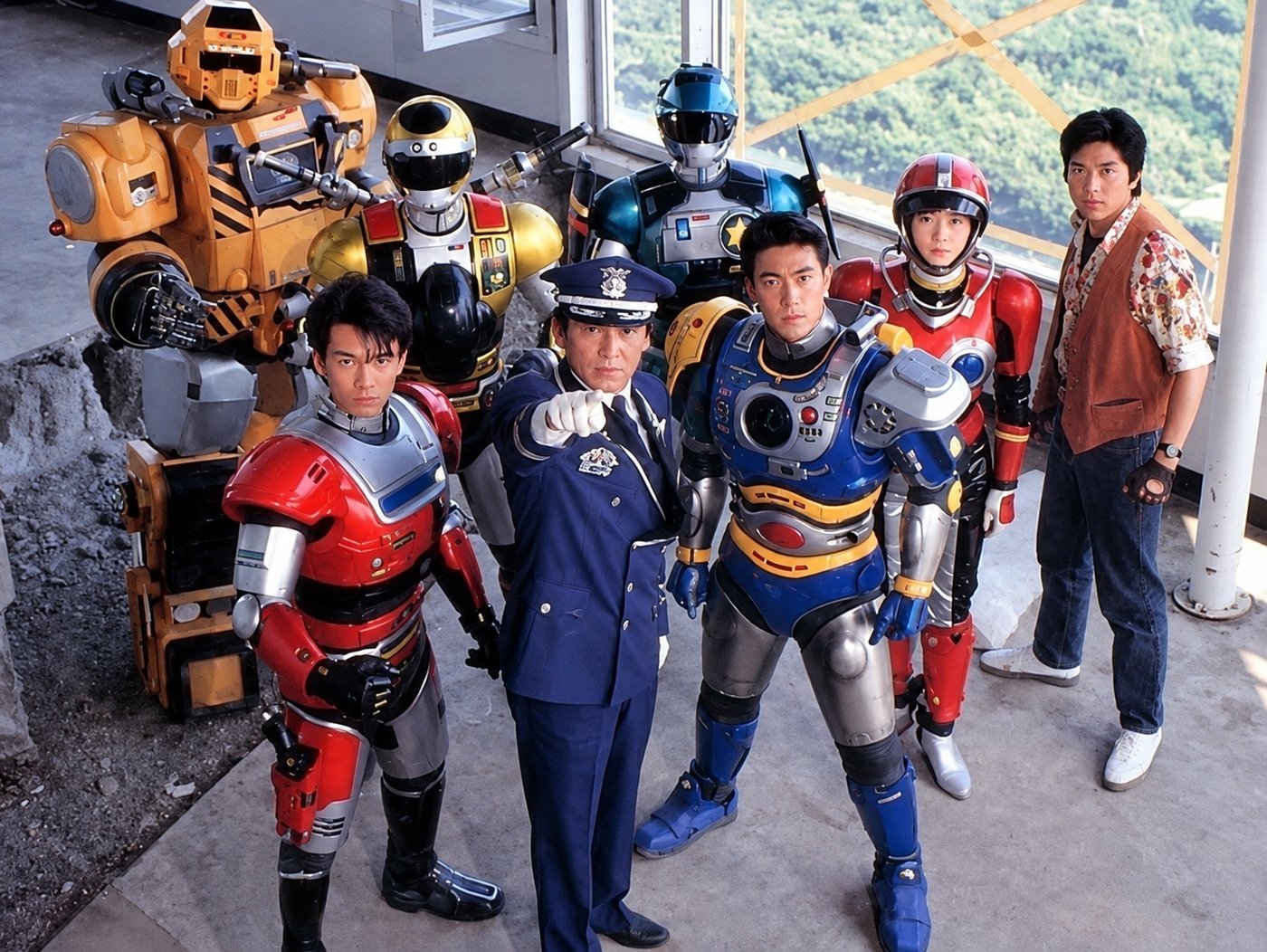
For the part, Miyauchi drew on the bosses Tanba used to play in Key Hunter and G-Men '75. His one condition was that Masaki would not transform, because he wanted to show a new side of himself as an actor. He still asked for action scenes and pitched ideas for the costume. Masaki went into the field, made arrests and fought alongside his officers, and in episode 13 he test-drove the team's Winscord vehicle himself despite the risk of getting hurt. Miyauchi also recorded "Moyase! Hitomi o," the character's song, released on the show's music album in 1990.
In Special Rescue Command Solbrain, which aired from January 20, 1991, to January 26, 1992, Masaki rebuilt the unit with a new team whose motto was to save the criminals' hearts as well as their victims. He was the link between the two shows. Through Masaki, members of Winspector came back as guests, and Ryoma Kagawa, the previous lead, returned for several episodes. Back then Miyauchi kept hearing the same question: why would an actor with four transforming heroes behind him keep taking kids' shows like Solbrain? He gave his answer in Masaki Kyomoto's HERO Kosho-gaku, a 1992 book from Bandai in which the actor and hero researcher Masaki Kyomoto collected accounts from the people who made the hero shows:
What is a "kids' show"? The content may be made so children can understand it, but calling a work that film professionals poured their hearts into a kids' show is an insult.
Hiroshi Miyauchi, in Masaki Kyomoto's HERO Kosho-gaku (1992)Masaki made one last appearance at the end of Exceedraft, the third show in the line, in episodes 47 to 49. The producers asked for Miyauchi to tie the three series together, and he wore his Solbrain-era uniform with a different cap. In the story, Masaki is on a plane full of senior police officials bound for a conference in Paris when the villain traps it in another dimension, and he only returns after the villain is defeated.
The Wardrobe
Miyauchi set himself a rule that a hero never changes clothes. In J.A.K.Q., Winspector, Solbrain and Choriki Sentai Ohranger (1995) he wore a single outfit for the entire run, and he explained why: "If the transformed hero never changes, why would the man before the transformation?" Another rule was never to eat on camera, one he broke himself in Zubat and joked about later: "What an appetite this time, huh?"
Actress Tamao Sato, from the Ohranger cast, remembered being puzzled to see her colleague in socks at an inn in the middle of summer. Miyauchi told her: "If a kid saw me looking like that, he'd think it was uncool. A hero always has to look sharp." His trademark white gloves came from an idea of Chiba's, to protect his hands during action scenes.
The line Miyauchi repeated most over his career is "a hero show is an educational program." He explained what he meant to Mynavi in 2023: "It's not about preaching. I kept playing heroes believing that a hero's strong influence holds something that can work miracles." In the first episode of Zubat, Hayakawa takes off his hat and gloves before his dead friend's altar, a gesture Miyauchi held up in his column as something parents should teach their children. He answered children's fan letters in hiragana, the first Japanese script kids learn.
Hakuba
In November 2001, while shooting a TV Tokyo mystery movie in Hakuba, in Nagano, the crew bus skidded on ice on the way up the mountain. Stepping off, Miyauchi slipped, twisted his body the way he would in a rehearsed fall and felt something pop in his lower back. He spent the rest of the shoot climbing a 2,000-meter mountain every day in a brace and bandages, and wrote in his column: "If it had happened during a scene, while acting, I could live with it."
In 2002 he was performing at Tokyo's Meijiza theater in a company led by the singer Hiroshi Itsuki, writing his column in the dressing room with the stage monitor on. He said the posture and gestures he learned on Zubat helped him on stage. In 2005, in the movie Kamen Rider The First, he played Tobei Tachibana, Akiji Kobayashi's old role, in a single scene, and said he was happy to play "Tobei, a part I'd admired since back then."
In 2008 Miyauchi underwent an eight-hour operation to implant artificial blood vessels. He only talked about it in public in 2012, at an event with Naoya Makoto, Gorenger's Akaranger, and later joked on television: "I guess I've become an artificial human." In 2019 he appeared in the final episode of NHK's Tokusatsu GaGaGa as a bookstore owner.
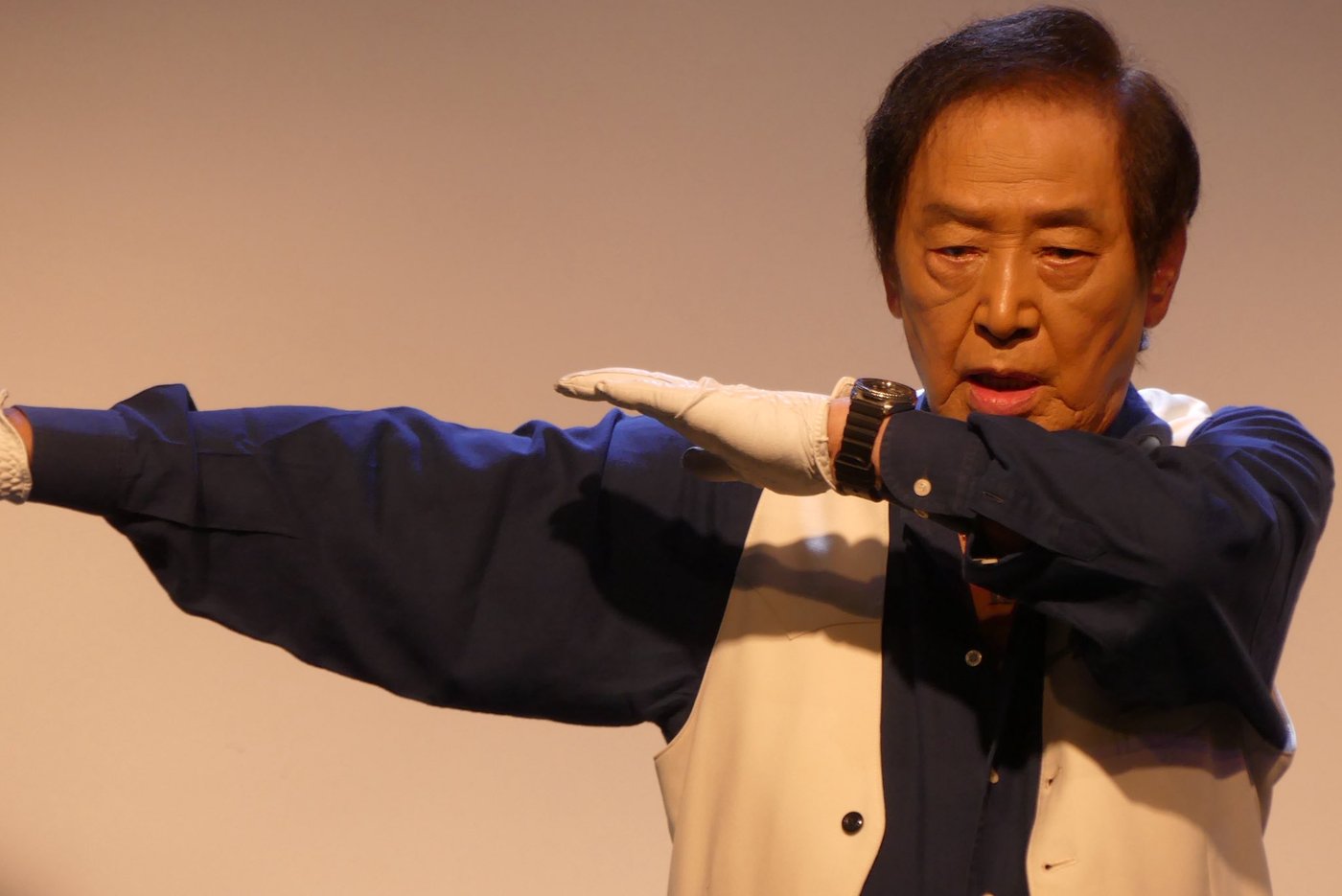
On April 29, 2024, at 76, Miyauchi opened the Kamen Rider 50th anniversary exhibition in Tokorozawa, in Saitama, with V3's Double Typhoon belt around his waist. Before striking the pose he told the crowd: "Justice is immortal. I'll show you Shiro Kazami's transformation." In his 2023 Mynavi interview, looking back on 50 years of V3, he summed up his bond with the character: "Looking back, I realized that the man I am today is the same as Shiro Kazami. I can transform anytime."
Sources: Toei Hero Net, Mynavi (2023), Mynavi (2017), Magmix, Oricon, Cinema Today, Futabasha THE CHANGE, Nakanocchi and Japanese Wikipedia.