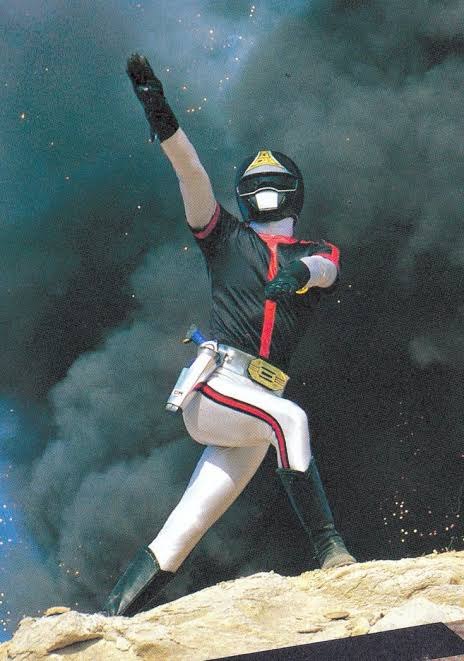
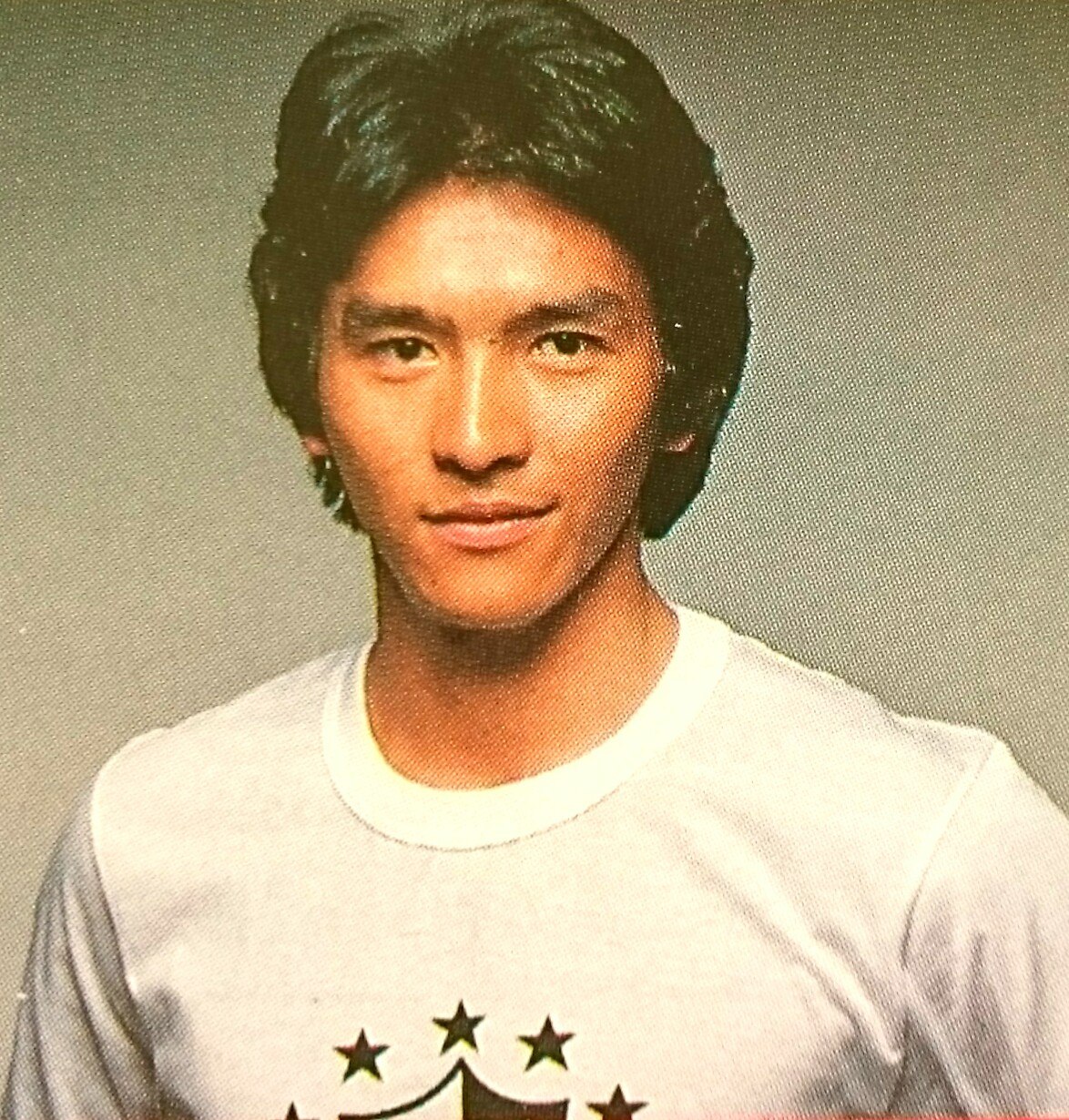
Actor and stuntman Junichi Haruta, Goggle Black in Dai Sentai Goggle V and Dyna Black in Kagaku Sentai Dynaman, gave this interview to journalist Mishio Suzuki for the book Suit Actor no Kyouji (The Pride of a Suit Actor), released in Japan in 2023. Kyoudai Express has translated the conversation in full.
Haruta was born in 1955 in Fukuoka Prefecture and moved to Tokyo at 15 to join the Japan Action Club, or JAC, the action troupe founded by Shinichi "Sonny" Chiba. In 1975, doubling for Tetsuya Watari in Kinji Fukasaku's Jingi no Hakaba (Graveyard of Honor), he jumped from about 15 meters with no air bag. In 1982's Goggle V he became the first hero in black in Super Sentai history and played the character both with and without the mask, as he would again the following year as Dyna Black in Dynaman. In Super Sentai, the suit actor, the performer inside the costume who does the fighting, is usually a different person from the actor who plays the hero unmasked.
In his conversation with Suzuki, Haruta describes the fall from the Fuji-Q Highland roller coaster that kept him out of work for a year and the trampoline days on the original Kamen Rider in 1971. He credits action director Junji Yamaoka for the level of the action in that era and talks about Karasu no Hane wo Nuu Onna, a feature film about a suit actor that he directed, wrote and starred in.
Suzuki's book collects 18 interviews with performers, directors and action choreographers and has not yet been published in Portuguese or English.
01JAC
How did you join JAC?
I watched Shinichi Chiba in "Key Hunter" and in the series "Judo Ichokusen," and I thought it was beautiful, the way those guys flew and leaped through the air. I went to Tokyo at 15 to join JAC. My dream was to be a stuntman and work away from the cameras, without being seen.
Without being seen?
A lot of people are surprised, but I wasn't the only one. When a henchman's part had lines, nobody wanted it, and whoever lost at rock-paper-scissors had to speak.
Back then you jumped from a height of 15 meters.
There were no air bags yet, so we stacked up thick mattresses and cardboard. It was as Tetsuya Watari's double in "Jingi no Hakaba" (1975), directed by Kinji Fukasaku. It's scary, and if you land wrong, it hurts. But when they shout "Action!", you find the courage.
02The roller coaster
And the jump from the roller coaster?
It was for a TV special about stuntmen, and I had to jump from the roller coaster at Fuji-Q Highland. I had done the calculations, but the car was moving fast and the drop was about 7 meters. When I jumped, my body was carried along and overshot the mattress. An iron pole came straight at me, and on instinct I twisted away from it in midair. I avoided it by a hair, but I landed with both feet on the dirt and bounced. They say my feet sank about 10 centimeters into the ground. I dislocated my second lumbar vertebra and had multiple fractures in my left leg. The local hospital couldn't treat me, so I was taken to Tokyo, a two-hour trip, with no anesthetic. It took me about a year to come back.
Weren't you afraid to go back?
Even a jump of 3 meters or so scared me. The doctor had told me, "You won't be able to do this anymore." But I was sure I would be doing it again soon, because I was young.
03Kamen Rider
What was your first job in tokusatsu, Japan's live-action special effects genre?
The trampoline scenes for "Kamen Rider" (1971). The chin of the mask and the top of the helmet were separate pieces, and when I jumped the mask would come loose, which made everything harder. The eyes were made of mesh, so you could barely see, and the suit was leather and hard to move in. Every two episodes there was a "trampoline day." Two guys from JAC would go, one as the Rider and one as the monster, and we shot trampoline takes nonstop. For the Rider Kick, the monster stood on the mattress and the Rider jumped off the trampoline to hit him.
04Goggle V
In "Dai Sentai Goggle V" (1982), you began playing the hero both before and after the transformation.
I had no reservations about acting or about wearing the mask, but the schedule was brutal. Several times a day I'd put on the suit and then go back to shooting with my face showing. I didn't even wear makeup, and I never worried about my hair or how I looked on camera. I did it all barefaced.
What were you going for when you acted in the mask?
I didn't want to do that exaggerated "hero acting." I felt that if I acted with real emotion inside, something would come through the mask. A Noh mask seems to change expression depending on who wears it, and the same thing happens with the suit. If the person inside is happy or sad, it has to show. A suit actor also has to be capable of genuine inner acting. Rattling off the lines any old way and moving around isn't enough.
What's the advantage of having the same person also play the transformed hero?
When it's time to dub, you know exactly the timing of every line. And since the movements are your own, you're satisfied with the result. When someone else does it, you always end up thinking it would have been better to move some other way.
You played the Black ranger in two series in a row.
I think the one who recommended me was Yama-chan, Junji Yamaoka. Maybe he figured he'd put me in there to move around a lot. In the episodes centered on Black, I was chased, beaten, knocked down and on the run before I even transformed. It was grueling.
05The cliff
People say that on Goggle V a cliff descent on a rope was hard to shoot.
It was a rappelling scene. When I pushed off the rock face for the first time, the rope slipped off the pulley and I went straight to the ground from about 16 meters up. I landed on my feet, hard, but the ground was dirt and I fell backward the instant my feet touched down, so it ended up being just a sprain. I wrapped it up and kept shooting. Nobody thinks of going to the hospital for a sprain.
You did many other difficult scenes.
On Goggle V I also did, in a single take, a sequence where I hit a mini-trampoline, did a front flip, landed on my feet on top of a metal drum, did another front flip, came down on the concrete and kept fighting. It sounds like a circus act, doesn't it?
You could have shown that with cuts, without actually doing it.
Yama-chan wanted to show JAC doing it for real, action with no tricks. I think that's exactly why the audience found it so amazing. The hero shows of that era had more action than any other drama on television.
06A stuntman's pride
There was no hazard pay, was there?
There wasn't. It was all included in the fee. If they had paid extra for everything, it would have been a fortune (laughs).
What drove you?
A stuntman's pride. I never said "I can't." The sense of accomplishment after you nail a scene is priceless, and there's also that little feeling of superiority in knowing you're capable of doing it. Above all, we worked toward a single goal, which was getting the world to recognize JAC, Japan's first stunt team.
07Yamaoka
The action of that era really was impressive.
Without Yama-chan we would never have done action at that level, and the hero shows wouldn't have gotten where they did. The credit goes to him, for building the action with so much passion and fighting with producers and directors.
You went all the way, with no compromises.
The times helped too. Today, an unreasonable demand is treated as workplace bullying. Back then, in the Showa era, we did crazy things if it meant making a good show. I think that passion is why these series are still alive today. Children's shows were called "jari-ban," shows for brats, and there was a feeling that not even the cast was recognized as real actors. Maybe that's exactly why, with a "we'll show you" attitude, we did things nobody else would do.
08Kyoryuger
In 2013 you made a guest appearance on "Zyuden Sentai Kyoryuger."
In the old days we shot action all day long, and now it all goes so fast you want to ask, "Is that it?" (laughs) I feel the fight choreography lacks commitment, that nobody insists on redoing a scene. They don't do wide shots with depth anymore, either. It reminded me once again that the old series only existed because of Yama-chan's extraordinary passion as an action director. Everything is more lukewarm now, don't you think? Doesn't anyone want more movement in the action anymore, more action before the transformation?
09The film
I hear you recently shot a feature film.
I did. I directed and wrote the story for "Karasu no Hane wo Nuu Onna" (The Woman Who Sews Crow Feathers), which tells the story of a suit actor. I do incredible stunts in a single take, with no one standing in for me. I want to release the film in Japan as well.
Do you have any reservations about the term "suit actor"?
None. I think "suit actor" is the term that best fits our work, because on top of the stunts we do things a stuntman doesn't do, like the heroes' poses and roll-call introductions. Darth Vader in "Star Wars," for example, I don't think he could pull off a roll-call pose. The ones who can do those stylish moves are Japan's suit actors.