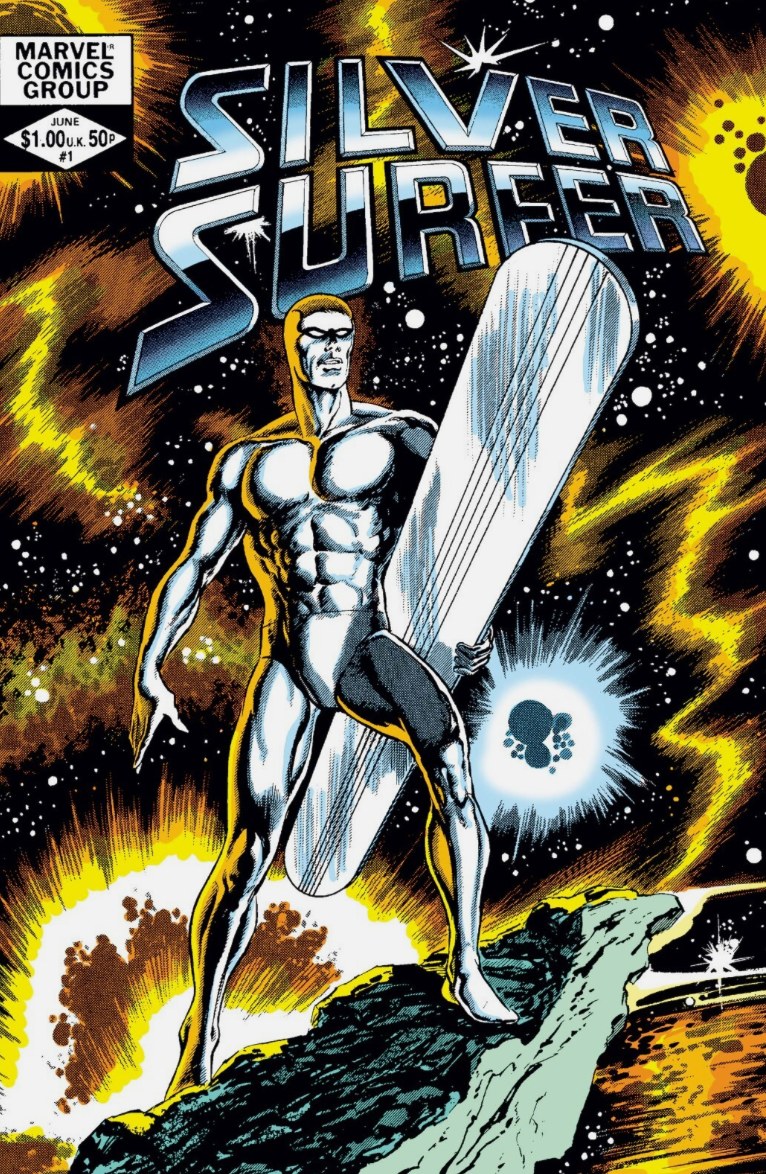
On the night of August 31, 2026, a livestream by Resistência Tokusatsu, a Brazilian YouTube channel devoted to Japanese superhero shows, paid tribute to the late designer Katsushi Murakami and brought up a little-known chapter of Marvel's years on Japanese television.
The panel brought together hosts Bone Lopes and Maurício Guarche, Fábio Ribeiro of the Coleção em Ação Show, and Ricardo Cruz and Giuzão Chagas of Tokusatsu.com.br, all of them longtime voices of the Brazilian fan community. When the conversation reached Murakami's design work on Space Sheriff Gavan, Cruz pointed to signs that the space cop might carry traces of an earlier Toei project: an action series starring the Silver Surfer, conceived in the final years of the partnership between the Japanese studio and Marvel. It would have been a tokusatsu show, the Japanese genre of live-action series built on costumed heroes and practical effects.
The Series Toei Imagined
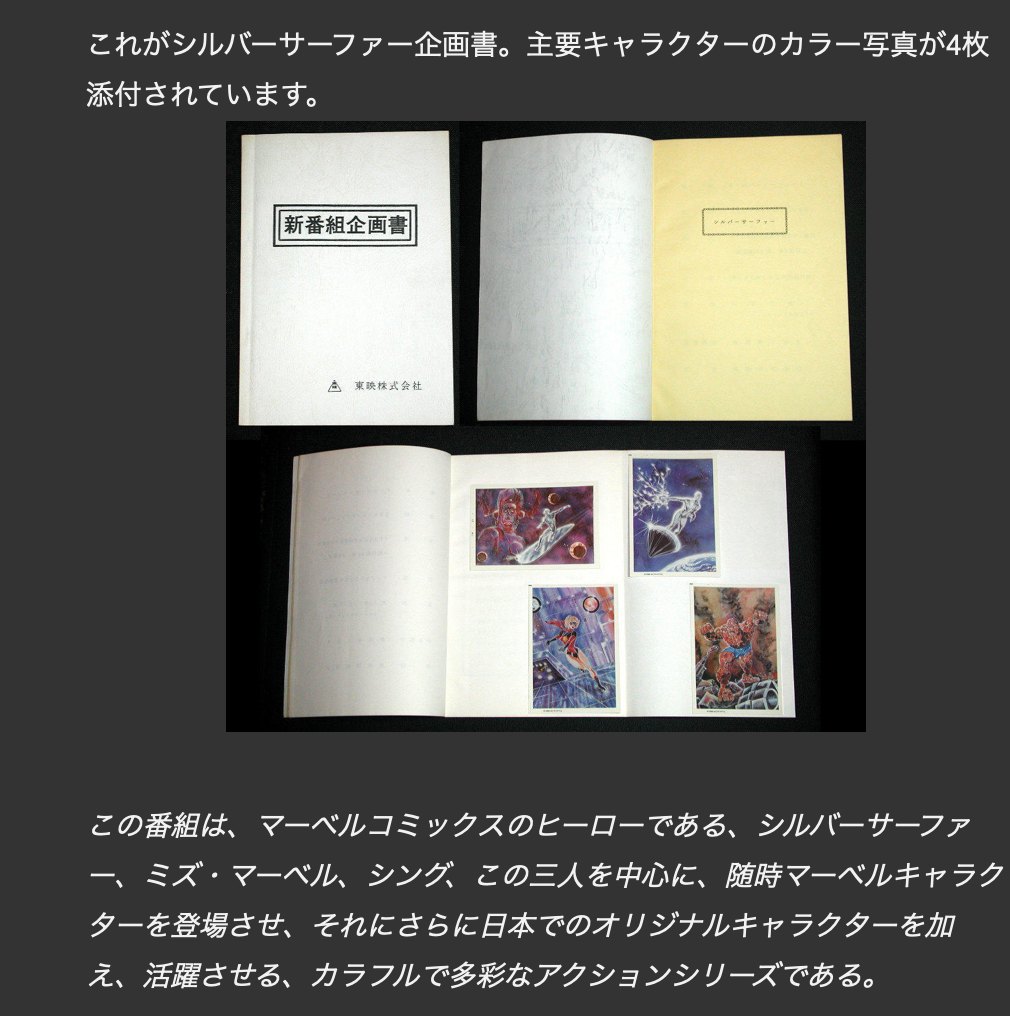
That remark set off the research behind this article. In old Japanese blogs, several of them now locked behind a curt 403 Forbidden, and in posts written by collectors, we found photographs of a production proposal, story summaries, character profiles and details about the television format Toei had in mind. We also found references to a 148-page booklet, packaged with the Japanese DVD box set of Toei's Spider-Man, that documented the project. Taken together, the sources make it possible to reconstruct a series that was never shot and to weigh, with some caution, how it might relate to the birth of Gavan.
The documentary trail starts with a home video release from Toei Video in December 2005. Catalogued as DSTD02367, the box collected the episodes of the Japanese Spider-Man and came with a special publication whose title translates roughly as “The Great Spider-Man Investigation.” Across 148 pages, the booklet revisited the making of the 1978 series, its behind-the-scenes stories and the circumstances of the deal between Toei and Marvel.
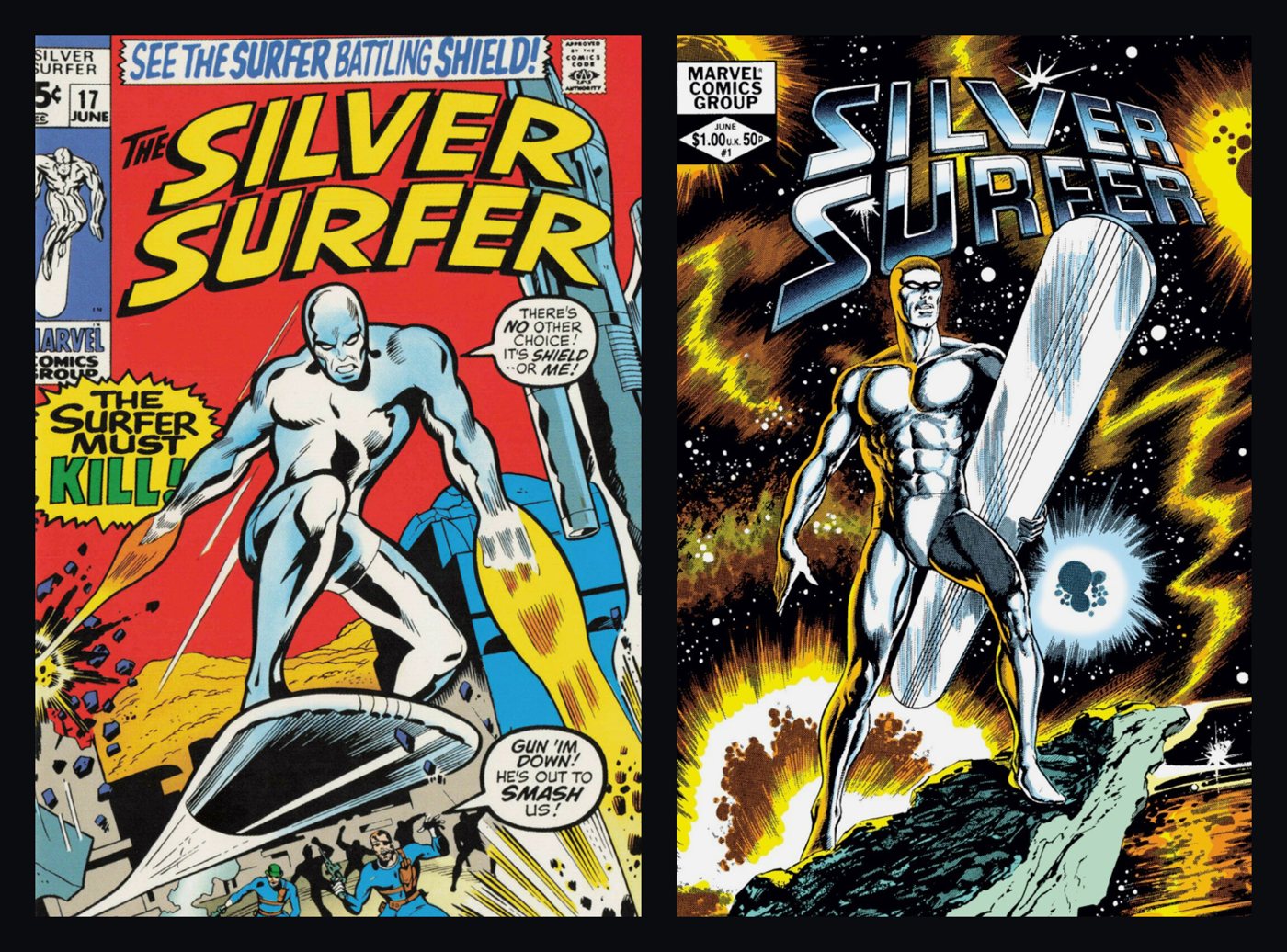
The booklet went well beyond an episode guide. It covered the ideas floated during the partnership, including shows that never left the planning stage. A Japanese blog from 2005, reviewing the box set, noted that the section on the origins of Toei's Spider-Man even included an illustration of the Silver Surfer. Another Japanese blog about the collaboration between the two companies said the booklet detailed three adaptations that never got made: 3-D Man, Moon Knight and the Silver Surfer.
Finding those characters in a Spider-Man publication makes sense given what the booklet was. The 1978 series had been the first major television result of the Marvel and Toei association. The Japanese version kept the American character's name, mask and basic powers while giving him a new identity, an alien origin, vehicles of his own and a giant robot called Leopardon. Its success helped establish a visual grammar that would shape tokusatsu production for years.
The deal also covered Battle Fever J, which premiered in 1979 and is often described as a Japanese answer to Captain America. Denziman and Sun Vulcan followed, both still produced under the collaboration. As the partnership wound down in 1981, the two companies had apparently been looking at new ways to bring Marvel characters to Japanese television.
3-D Man would have been one of those options. Created in the comics by Roy Thomas and Jim Craig, the character wore a red and green costume with a design that could easily be turned into a masked Japanese hero. Collectors have speculated that his resemblance to Kikaider, Toei's android hero from 1972, may have caught the studio's eye. The adaptation never moved forward. Moon Knight is also said to have drawn the studio's attention: his hooded look recalled Japanese heroes such as Gekko Kamen, the masked crime fighter who ruled the country's television in the late 1950s. Moon Knight did get a manga version in Japan, but the idea of turning him into an action series stayed on paper.
The third project was far more ambitious. The Silver Surfer would headline a cosmic adventure alongside Ms. Marvel and the Thing. The proposal called for a weekly science fiction action series with self-contained episodes of about 30 minutes. Production would start with at least 26 installments and could be extended if the audience responded.
The document credited production to Toei and involved Planning Company 104, a firm long associated with planning and visual design for the studio's series. Creation was credited to Saburo Yatsude, the collective pen name Toei uses on many of its productions. The series was pitched as entertainment for young viewers and families, combining space adventure, heroic action and electronic video compositing techniques.
“This program is a colorful, varied action series built around three Marvel Comics heroes, the Silver Surfer, Ms. Marvel and the Thing, joined by original Japanese characters.”
シルバーサーファー proposal · Toei, 1981 (translated from the document)That last detail deserves a closer look. The mention of VTR compositing shows the studio was thinking about visual effects capable of depicting space travel, energy blasts and the protagonist's cosmic powers. For Japanese television in the early 1980s, that would have been a technically demanding project. Miniatures, sets, pyrotechnics and optical effects would all have to work together, week after week, to reproduce a universe that on the comics page had no physical or budgetary limits.
The story reworked the mythology created by Stan Lee and Jack Kirby from the ground up. Toei's Galactus ruled as an emperor of the universe, at the head of an expansionist organization that conquered worlds, captured their inhabitants and remade them into soldiers. The planet-devouring cosmic force of the comics had turned into the boss of an invading army.
The Surfer would be one of those prisoners. Captured by Galactus's forces, he would undergo a process of bodily modification and be pressed into service. At some point, though, he would discover his ties to Earth. His father came from the planet Zenn-La; his mother was a woman from Earth. The revelation would drive him to break with Galactus and flee to his mother's planet.
On Earth, the character would go by the name Koji Shibuki. Away from the fighting, he would live as a young man devoted to surfing and ocean sports. That civilian identity brought the hero closer to Japanese viewers and gave an everyday purpose to the image that had made him famous in the comics. He would be an actual surfer whenever he was not fighting invaders, and the board that carried him across space would carry him across waves too.
「スカイボードという名のサーフボードをあやつり、光速で宇宙を駆ける全身銀色の宇宙人。ゼン・ラ星の住人であったが、侵略軍団がゼン・ラ星を滅ぼした時に捕らえられ、超能力戦略開発セクションにおいて、宇宙戦闘用兵士に改造される。」
“A silver-skinned alien who rides a surfboard called the Sky Board and races across space at the speed of light. Once a resident of the planet Zenn-La, he was captured when the invading army destroyed it and remade into a soldier for space combat in the Psychic Powers Strategic Development Section.”
Character sheet: シルバーサーファー (Koji Shibuki) · Toei proposalHis board would be called the Sky Board. It would serve as both a flying vehicle and a weapon, preserving the character's classic silhouette while adapting it to tokusatsu conventions. The strategy echoed what Toei had done with Spider-Man: keep whatever makes the hero instantly recognizable, and rebuild his biography and his world around the needs of a weekly Japanese series.
The Surfer's powers were also codified. One attack would be the Cosmic Blast, fired from a fingertip. Another, the Cosmic Burst, used both hands and produced a stronger discharge. The most powerful technique would be the Cosmic Attack, a full-body strike that concentrated his energy into a single decisive charge. It came at a price: after using it, the Surfer would be left weakened for about an hour. That limitation handed the writers a dramatic tool, since the hero could not reach for his greatest power without risking helplessness. It is a very television-friendly solution, in a medium where even near-invincible characters need to face some kind of danger by the end of each episode.
Ms. Marvel would be Masumi Suzuka, a college student from a wealthy family who worked at a café. Gifted with clairvoyance, she would know about threats ahead of time and would likely serve as the link between everyday events and the cosmic war. Her origin differed considerably from the American comics, but the project preserved the idea of a heroine with extraordinary abilities and a role of her own. The Thing would become Gen Ishihara, a truck driver transformed after being hit by an explosion or some form of alien energy, in place of the pilot and scientist of the comics. Giving him an ordinary job followed a tradition of popular Japanese television: hand the fantastic character a life the viewer can grasp at once.
The three heroes would work with an Earth defense organization. Translations of the sources mention an independent operations room, a structure set up to coordinate the resistance against Galactus. That kind of base was familiar territory in tokusatsu, where protagonists routinely got support from scientific teams, military bodies or units specializing in unknown threats. The result would be an ensemble series, even with the Surfer's top billing in the title and the pitch: Ms. Marvel and the Thing would let the show rotate powers, personalities and storylines, and the three together made a striking visual combination, a hero entirely in silver, a young woman with psychic abilities and a rock creature of enormous strength.
The surviving images help picture that intention. In 2008, the author of a blog devoted to Toei's Spider-Man posted photographs of what he identified as the Silver Surfer proposal. He wrote that the document came with four color images of the main characters.
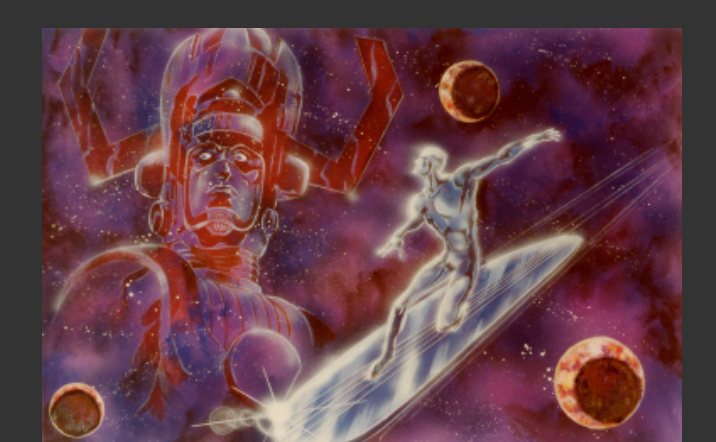
One showed the Surfer facing Galactus. Another had the protagonist using his cosmic powers. The remaining two presented the Japanese versions of Ms. Marvel and the Thing. Everything about the material suggests concept art made for a project presentation. That distinction matters: the images prove that visual development took place, and they say nothing about actors being cast, costumes being built or footage being shot. To date, no cast list, screen test or studio photograph has surfaced to show the program ever entered pre-production. Toei's Surfer appears to have stayed at the proposal stage.
Even so, the level of detail is striking. The document defined the target audience, episode length, the initial episode count, the visual effects methods, the organization in charge of defending Earth, the civilian identities, the protagonists' origins and even the names and limits of their attacks. Someone had put real work into turning a Marvel character into a viable Japanese television production, far beyond a note jotted down in a meeting.
The Birth of Gavan
The date attached to the project is what makes it so intriguing. The document is placed in the Japanese spring of 1981. Space Sheriff Gavan premiered on March 5, 1982. Roughly a year separates the two, a period when Toei was searching for a new solo hero to fill the gap left by Kamen Rider's temporary absence from television. At the time, the studio's flagship hero show was Sun Vulcan. The Super Sentai format had already cemented color-coded teams, vehicles, ships and giant robots. Toei producer Susumu Yoshikawa believed the company needed a different path for a lone protagonist, one who would feel as grand as an entire team.
Official testimonies later collected in the book on the history of the Space Sheriff series offer a detailed account of Gavan's creation. Yoshikawa said the starting point was the search for a reinforced combat suit with a new look. The concept of a galactic police force and a detective dispatched from space is said to have drawn on E. E. Smith's Lensman novels. Development went through many drafts. One proposal imagined a protagonist tasked with capturing monsters and delivering them to a kind of space zoo. Yoshikawa talked through possibilities with writers and producers including Shozo Uehara, Susumu Takaku and Yoshiaki Kobayashi, while toy maker Bandai weighed in with suggestions about design and the show's commercial potential.
Murakami's decisive contribution is said to have been an illustration. Yoshikawa described it as a mechanical warrior wielding a sword, standing in something like an alien swamp surrounded by strange creatures. The drawing broke away from the usual look of a man in fabric and protective pieces. The hero's body seemed built like a machine. Murakami also pushed for an intensely silver finish: the effect was fairly easy to reproduce on small toys and far harder on a full-size filming suit. The metallic surface had to catch the light without betraying the limits of the materials. That technical difficulty ended up becoming part of Gavan's identity.
The transformation took its name from a metal plating process. In the series, the armor was beamed onto the hero's body in five hundredths of a second. Since the change happened too fast to be seen, each episode replayed it in slow motion with the narrator's explanation. The solution turned a storytelling constraint into one of the most memorable rituals in tokusatsu. The official sources on Gavan document the roles of Yoshikawa, Murakami, the writers and Bandai. None of them, so far, names the Silver Surfer as an inspiration: the literary influence Yoshikawa cites is Lensman, and the visual origin is credited to the mechanical design Murakami presented.
The Surfer hypothesis comes from how close the two projects were in time and from the similarities in their descriptions. The protagonist of the Marvel pitch would have had a silver appearance, a cosmic origin and an Earth mother. Gavan is also the son of an alien and a woman from Earth. Both reach the planet caught up in a war against an organization from space.
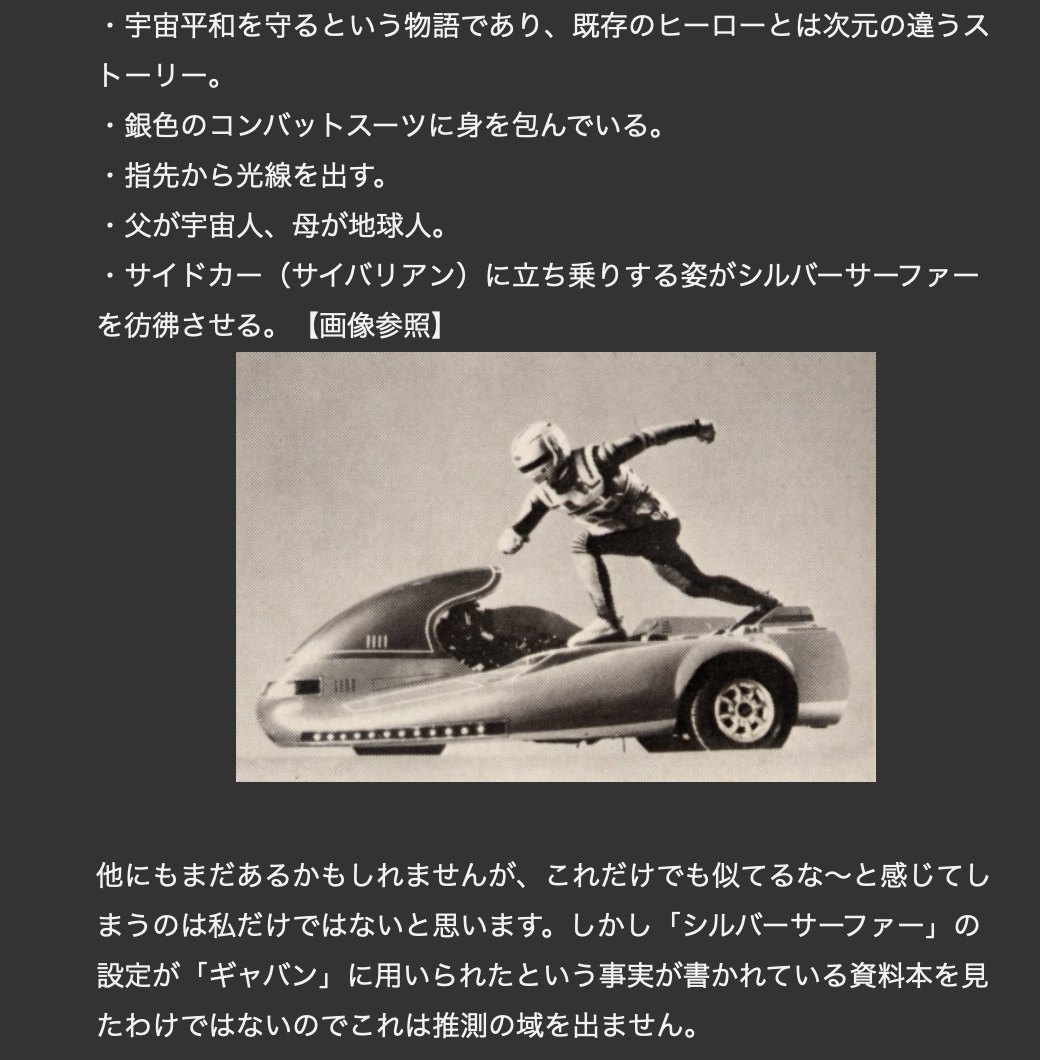
Then there are the fingertip blasts, the theme of protecting cosmic peace and the image of the hero riding upright on a vehicle. When Gavan balances on the Cyberian in open space, the composition inevitably recalls the Surfer on his board. The coincidence gets more provocative next to the 1981 date attached to Toei's project.
None of that is enough to establish a direct transfer of ideas. Space heroes, beams fired from the hands, alien fathers and galactic organizations were already part of the Japanese science fiction repertoire. Gavan's silver surface can be explained by Murakami's wish to create a mechanical warrior and by Bandai's interest in a metallic finish for the toys. It would be just as wrong to imagine that Toei simply swapped the Silver Surfer for Gavan once the Marvel partnership ended. The differences run deep: Gavan is a police officer attached to a galactic institution, with training, weapons, vehicles and an official mission, while Koji Shibuki would have been a fugitive altered by the enemy, fighting the organization that once enslaved him.
Internal circulation of concepts, though, remains a reasonable possibility. Rejected projects do not always vanish inside a studio. Their documents sit in files, pass through producers' hands and can supply solutions for other shows. A family origin, a visual composition or the way a power is presented can resurface without any formal decision to reuse it. In that scenario, the Silver Surfer could have been one of several ideas floating around Toei while Gavan took shape. The proposal would have demonstrated the potential of a silver hero from space; Murakami and Yoshikawa would then have developed that territory in their own way. It is a plausible reading, and it still depends on documents that explicitly connect the two projects.
The booklet's publication in 2005 shows that Toei itself considered those abandoned plans relevant to the history of its partnership with Marvel. The Surfer's appearance alongside 3-D Man and Moon Knight suggests all three belonged to an experimental phase, when the companies were weighing which characters could survive the kind of cultural adaptation that had so radically transformed Spider-Man. The Surfer may have been the best candidate: his look required no specifically American identity, he already had a metallic body, he crossed space and he faced planet-scale threats. His board could become a sellable vehicle, Galactus provided the basis for an organization of monsters and soldiers, and Ms. Marvel and the Thing expanded the cast and opened new possibilities for toys, costumes and licensed products.
It was also the riskiest project. The character would require constant flying effects, cosmic settings and a convincing solution for his silver surface. The Thing would need a heavy suit, makeup or some kind of special build. Galactus would have to be scaled down to television. The budget could exceed that of a conventional series before Toei even knew whether Japanese audiences would accept the characters. The known proposal does not explain why the program was dropped. The end of the Marvel and Toei partnership in 1981 offers a likely reason; rights issues, costs and shifts in both companies' strategies may have played a part as well. Without meeting minutes or testimony from the people involved, any explanation stays incomplete.
The photographs of the document and the references in the booklet at least lift the project out of the realm of baseless rumor. There was a Japanese plan for the Silver Surfer. It was conceived as a live-action series, even though some later sources raised the possibility of animation. Its format, the involvement of Toei and Planning Company 104 and the language of the proposal point more strongly to a tokusatsu television show. What remains unproven is the best-known claim: that this Surfer gave rise to the Metal Heroes. The available documentation supports talk of historical proximity and creative parallels, and it stops there. Calling Gavan an adaptation in disguise, or saying Murakami based his armor on the Marvel character, goes beyond what the evidence can carry.
The discovery keeps its value even without a definitive conclusion. For a few months in 1981, the Silver Surfer came close to a new life on Japanese television. He would have had a human name, an Earth mother, a routine built around ocean sports and a team made up of Ms. Marvel and the Thing. Galactus would have ruled a conquering empire, and Earth's defense would have rested on a former slave who chose to turn against his master.
The series never reached the cameras. What survives is a proposal, four color images, a few pages of a booklet and the accounts of collectors who handled the material. Gavan came along shortly afterward and became one of the most important heroes in Toei's history. Between the two lies a still poorly documented stretch, occupied by ideas that may have been shared, abandoned or reinvented. Perhaps some Toei archive still holds the answer. Until it surfaces, the Japanese Silver Surfer should be remembered for what can be demonstrated: an elaborate project, conceived for television and developed at a decisive moment in the relationship between American comics and tokusatsu. A hero who never made it to the screen, and who came close enough to leave tracks.
Reported in September 2026 from Japanese sources: Toei's シルバーサーファー proposal, the 148-page booklet from the Spider-Man DVD box set (2005) and collectors' records. Starting point: the Resistência Tokusatsu livestream in memory of Katsushi Murakami, August 31, 2026.